

Measles and the State’s Absence: Israel’s Unseen Crisis
While measles deaths are rare in the U.S., Israel’s ultra-Orthodox communities suffer disproportionately — a warning for the country’s future

Iran: This Substack is being sent while negotiations between the United States and Iran are still underway, and tensions across the region are extremely high. I’ve written several times (here, here, and here, for instance) about where things stand. But allow me to summarize — and save everyone some time: the President will make a decision. It is his decision. While many in Israel and elsewhere are convinced Trump will order a strike, it could still go either way. As Vice President Vance put it: “He’s going to keep his options open. He’s going to talk to everybody. He’s going to try to accomplish what he can through non-military means. And if he feels like the military is the only option, then he’s ultimately going to choose that option.”
Gaza: On February 3, an IDF reserve officer was critically wounded by gunfire from Gaza, which the IDF viewed as a violation of the ceasefire. The response included airstrikes in the Shati and Mawasi areas of Gaza, targeting the terrorist Bilal Abu Assi, who led the Nukhba special forces’ invasion of Nir Oz — where a quarter of the kibbutz’s residents were either massacred or kidnapped. 27 people were killed in Gaza as a result of the IDF strikes, according to the Hamas-controlled Gaza Health Ministry.
A Deadly Measles Outbreak in the Year 2025
Since April 2025, there has been a measles outbreak rampaging through Israel. So far, a Western world-leading 13 children or infants have died from that outbreak and about 900 people have been hospitalized. Right now, there are 14 hospitalized, 4 of them in the ICU. According to the Israeli Ministry of Health, almost all of those who have died came from ultra-Orthodox communities and were not vaccinated.
Measles is the most contagious disease known to man. It kills 1-3 people (usually children) out of every thousand. There is no cure. Hospitals can provide supportive care, which can save lives. But most importantly, there is a vaccine: safe, remarkably effective, and well-established.
In 2025, three people in the entire United States died from measles, according to CDC data. The US has a population of more than 340 million people. There are a significant number of U.S. states with lower life expectancy than Israel. There are all kinds of religions, sects, cults, and other groups — among them many anti-vaxxers. Needless to say, there is a wealth of ultra-Orthodox Jewish communities in America, too.
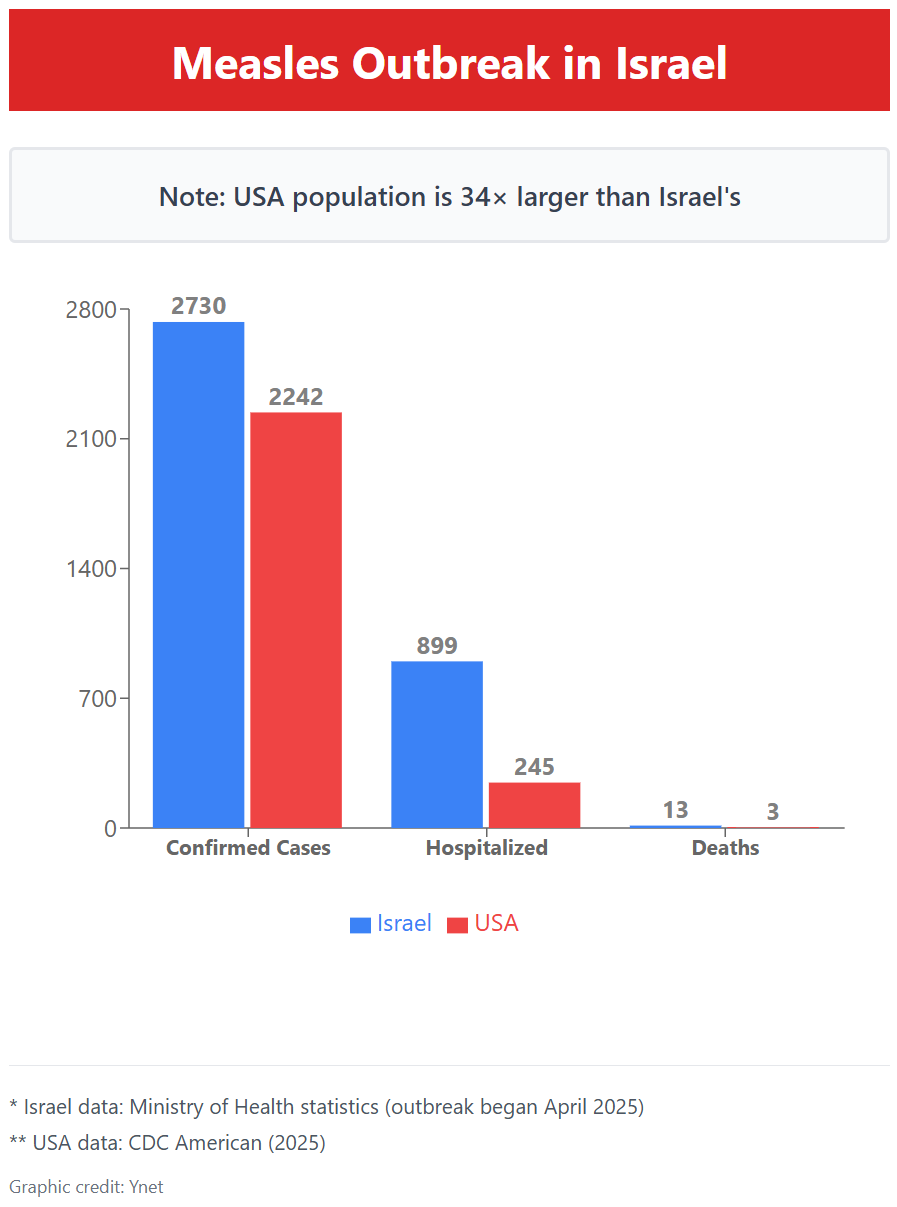
In the European Union, a total of 10 people died from measles between December 1st, 2024 and November 30, 2025. The EU’s population is 450 million, 45 times that of the State of Israel. The EU has regions, especially in Eastern and Central Europe, with completely failed, backward healthcare systems. Israel’s healthcare system is better than that of many countries in Europe. The lethality and extent of the Israeli outbreak are exceptional in the West.
Incredibly, as of December 2025, almost all the deceased in Israel came from within one square kilometer (0.8 mile), just north of central Jerusalem. Namely, the ultra-Orthodox (Haredi in Hebrew) neighborhoods of Beit Yisrael, Mea She’arim, the Bukharim Quarter, and Sanhedriya. It should be emphasized that the overwhelming majority of ultra-Orthodox communities do vaccinate their children, and that the overwhelming majority of rabbis and community leaders support vaccination.
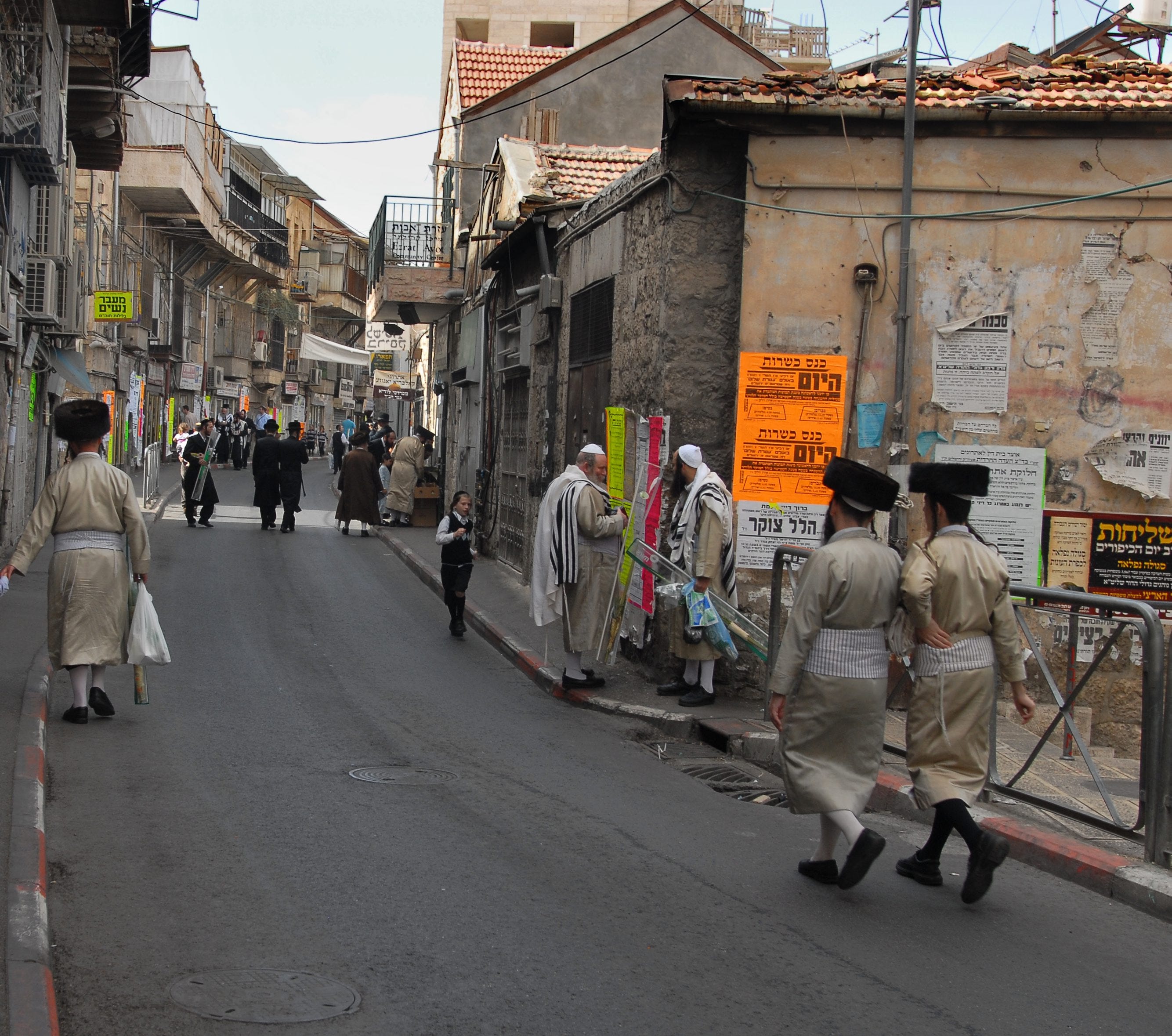
The Looming Challenge: Integration of Haredim
Israel’s ultra-Orthodox, or Haredi, sector is by far the fastest-growing demographic in the country, at a clip of 4.2% per year according to the Israel Democracy Institute’s research. While the average non-Haredi Jewish woman has 2.2 children, the fertility rate for the average Haredi woman stands at 6.5, which is actually a decrease from 7.5 between the years 2003-2005.
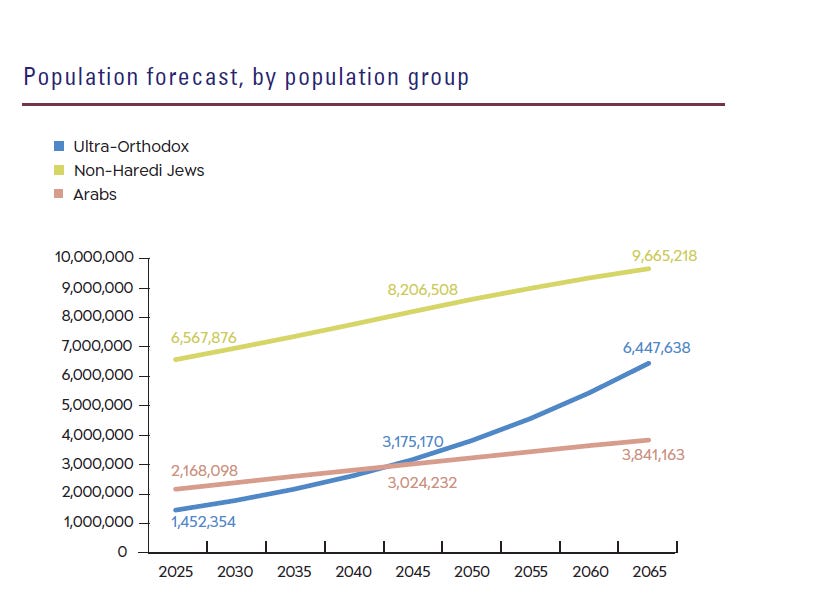
This reality presents a range of issues for the rest of Israeli society. As I write, the government is trying to appease the Haredi parties, a vital part of the coalition. They insist Haredim, who do not serve in the military, must continue to be exempt from this requirement, regardless of the crushing burden being carried by the IDF’s reservists — some of whom served 200-300 days per year, during the October 7 war. This will be a major issue in the upcoming elections.
Welfare Benefits and Education as Engines of Social Change
Today, Haredi men work less and earn much less (about half as much) than non-Haredi Israeli peers, with an employment level hovering around 50% — up from around 37% in 2003. Poverty is commonplace. Instead of working, Haredi men study as a vocation, while their wives go to work, and the most common occupation for those who do work is in the education sector (heavily subsizdized by the state and charities).
But it wasn’t always like this, even in Israel. In the 1970s, the Likud government under Prime Minister Menachem Begin ushered in an era of uncapped military service exemptions (the so-called “Torato-Omanuto”), welfare benefits, and subsidies for the families of Haredi men who study Torah all day. Before that, Haredi employment was comparable to other Israeli groups, about 84%, according to the economist Eitan Regev at the Tab Center for Social Policy Studies in Israel. Until the first Likud government, the Israeli government assigned the Haredi community a quota — a fixed ratio or number of yeshiva students exempt from military service. Menachem Begin abolished this quota as part of his newly forged alliance with the Haredi parties, which until then had largely aligned with Labor-led governments. Since then, the numbers have steadily swelled. Today, an increasing number of rabbis rule that even those who are not studying should not be conscripted into the army.
This arrangement is widely seen by Israel’s judiciary as problematic, if not outright illegal. Successive governments have attempted to resolve the issue through legislation, but these efforts have either failed to pass or failed to survive judicial review.
Moreover, the issue goes well beyond military exemption. The underlying bargain has been that those exempt from service do not participate in the workforce, on the principle that they were spared the army because they devoted their lives to Torah study. As a result, many of these men — willingly or not — are effectively locked into the system: until a certain age, any formal departure from the yeshiva exposes them to immediate conscription. In some Haredi communities, this remains almost unthinkable, though there are signs that this, too, is beginning to change.
As the benefits system took hold, Haredi male employment declined sharply. Just take a look at this amazing graph, by Prof. Dan Ben David of Tel Aviv University, from Shoresh Institution for Socioeconomic Research:
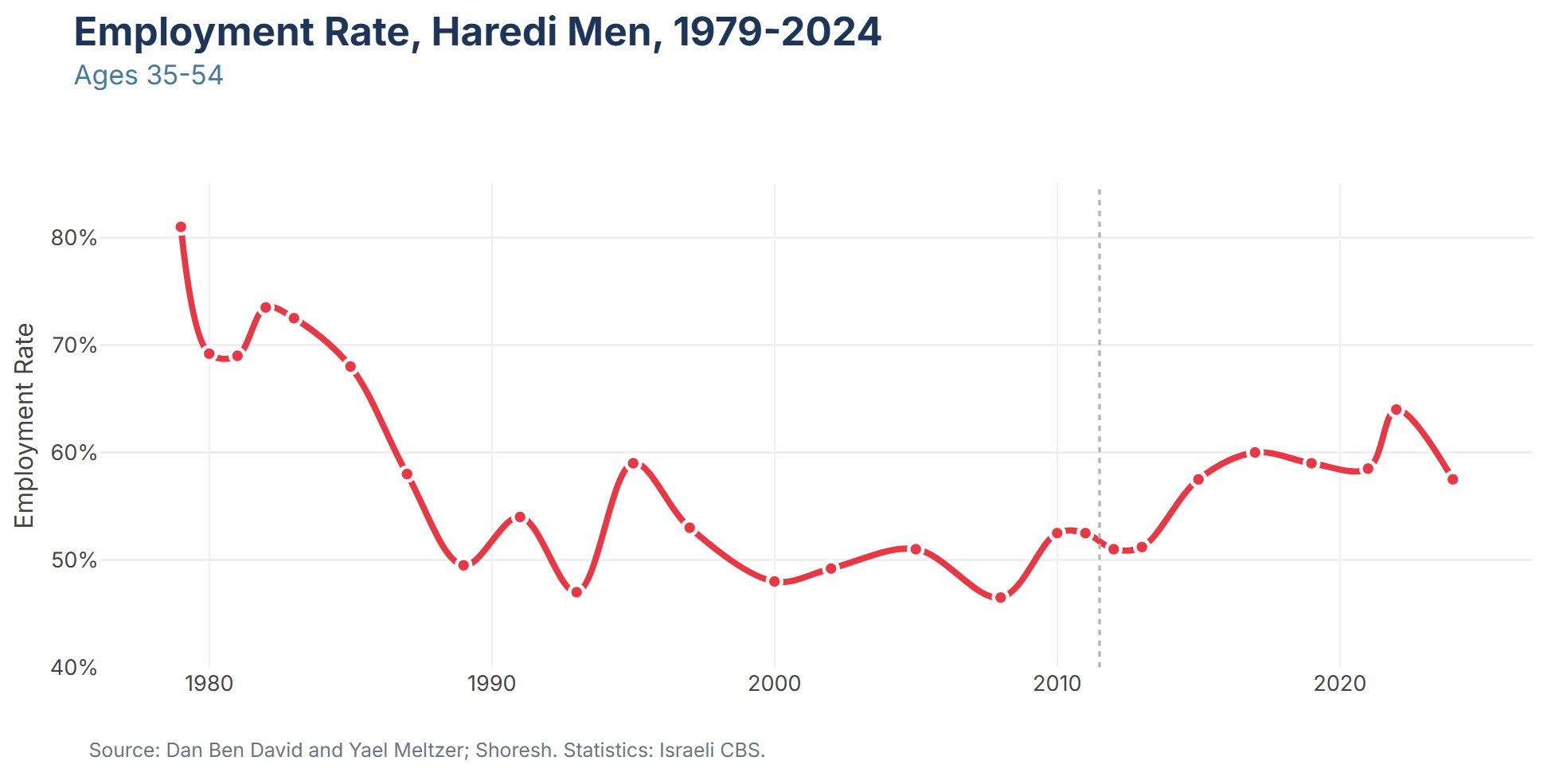
Since the economic reforms of 2003, there has been some turnaround, with a notable dip during the Great Financial Crisis of 2008. But that welfare system never went away. Instead, state support for Haredi post-secondary education institutions has increased, driving a 71% rise in yeshiva and kollel students from 2013 to 2023.
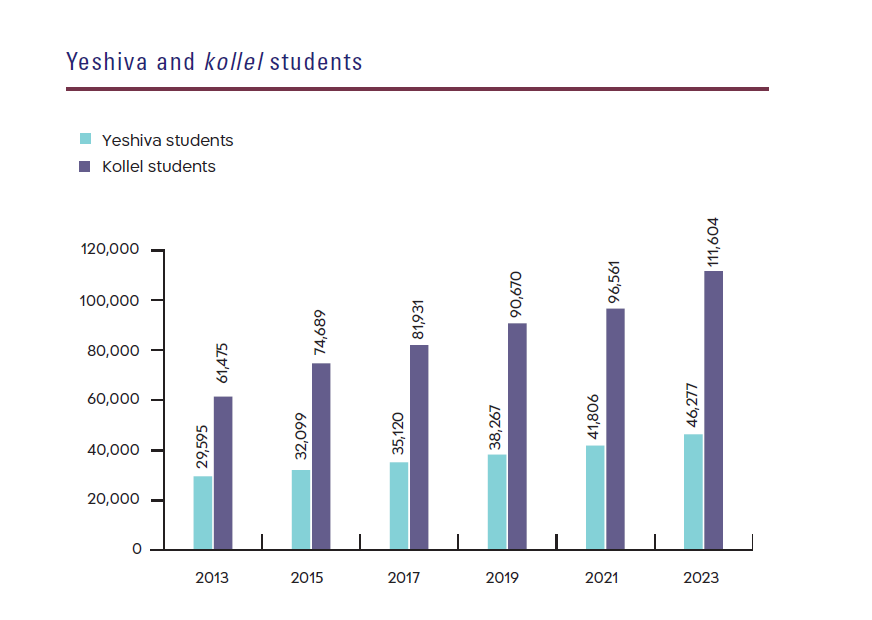
So what do we have here? A society that is deeply religious and deeply poor; one with low participation in the labor market; with politicians and community leaders actively reinforcing legal constraints that make it harder for men in their prime working years to enter the workforce; one that is unwilling to share the burden of service in the IDF; and, it should be added, one whose schools and education system are funded — fully or in part—by the state, yet operate with little real oversight over educational standards, including core subjects essential for modern life, such as mathematics and English. To a large extent, the Haredi community appears to be held captive by its own leadership. Many within the community are far more flexible, pragmatic, and connected to broader Israeli society than their politicians and rabbis suggest. Yet it is precisely these leaders who enforce isolation — because they, in particular, have much to gain from preserving it.
Given the demographic trends, this situation is unsustainable in the long term. But in the short term, the cracks are already starting to appear in Israeli society, where the government has gone AWOL from many Haredi neighborhoods.
Jerusalem’s Governance Black Hole
On January 19th, 2026, at an unlicensed and overcrowded Haredi daycare in the Jerusalem neighborhood of Romema, a nightmare unfolded. Two babies, one four months old and the other six months old, died from a still-unclear incident that some experts suggested could have been carbon monoxide poisoning or heat-induced dehydration. Dozens of babies and toddlers were evacuated in various states of medical need. Three caregivers were taken in for questioning by the police. The police arriving on the scene found a toddler sleeping under the toilets and strollers crammed into rooms.

The Problem of Fragmentation
A straight line connects the daycare disaster in Jerusalem and the measles: the absence of the state in parts of the Haredi public. Until recently, in these neighborhoods, only about 50% of children were vaccinated, perhaps less.
The Ministry of Health has worked hard to change this, painstakingly, sending senior officials from rabbi to rabbi. As a result, vaccination coverage today stands at over 60-70%. No small achievement, especially for those children now protected. But, because measles is so contagious, reaching herd immunity requires vaccination rates of about 93-94%.
The vast majority of ultra-Orthodox Jews in Israel vaccinate their children, following rabbinical instruction. But ultra-Orthodox society is undergoing an accelerated process of fragmentation, of atomization into communities, and further sub-communities, and within those even tinier groups. Often, these tiny groups are extreme. The rabbis of these groups, even if they hold sway over 50 families, want to be in control, so they pile on additional stringencies to their congregations. Vaccine prohibition is an opportunity for them to gain prominence.
In early December, a year-and-a-half-old infant was hospitalized at Poria Medical Center, in the north of Israel as a result of Measels. His father was convinced that staying at the hospital over Saturday would violate Shabbat. He pulled the IV from his son’s body, and took him home despite the doctors’ pleas and warnings about his complicated condition. On Saturday night, after midnight, the father returned with the infant in critical condition. He was transferred to Rambam Hospital and died there.
Grim Facts Israelis Must Face
Even given the problems with immunization, the number of deaths from measles among Israel’s Haredi demographic is still high. A senior health official explained to me how this is possible. The problem, he said, is not just the vaccine, or the disease. “Many of the children arrived at the hospital already in critical condition, or actually dead on arrival”, he said. This is happening in Israel, with its extraordinary healthcare system and 83.8-year-long life expectancy.
The measles outbreak holds up a grim mirror to present-day Israel. The country is cultivating neglect among its fastest-growing demographics. That neglect — combined with ignorance and fanaticism — has led to non-vaccination and to a broader, deeply rooted distrust of medicine. This dynamic has now metastasized to the point of denying medical treatment to children — who are innocent.
At the root of this lies dysfunctional Israeli politics, and the government’s persistent unwillingness to address the source of these problems. It is easier to ignore it or to pander to cynical Haredi political operatives.
The absence of the state from the Haredi community — and from other communities as well — is not a marginal issue; it is a defining feature of present-day Israel. Given current demographic trends, if the country continues to ignore it and refuses to act, this may well be a preview of Israel’s future.
This is a terrifyingly insightful analysis that places the issue in the larger context. Uncomfortable but essential, as always.