

Intelligence Sources: IRGC Could Seize Control if Iran Enters Critical Crisis
The Islamic Republic’s legitimacy is quickly eroding, and security assessments indicate that a military takeover is more likely than a democratic transition

Intelligence services are notoriously poor at predicting revolutions. Whether violent uprisings or “velvet revolutions”, major societal shifts - especially inside adversary states - tend to arrive as strategic surprises. This was true of the fall of the Berlin Wall in 1989, just as it had been a decade earlier with the Iranian Revolution. In that case, the U.S. intelligence community famously assessed the regime of Mohammad Reza Shah Pahlavi as fundamentally stable almost until the revolution was already underway.
This is why we should be extremely cautious about the constant game of predictions surrounding the events unfolding in Iran during the first days of the 2026 uprising.
With that caveat in place, here is a fact.
In meetings with Israeli security officials about a month ago, I was told quite plainly that the Islamic Republic is exhibiting the worst indicators of regime instability ever recorded. According to internal Israeli intelligence assessments used to measure regime stability, Iran was at its most critical and vulnerable point. To their credit, this assessment was made before a single demonstration had been reported.
Developments inside Iran are moving quickly, and many unforeseen and decisive variables will shape the outcome: loyalty within the armed forces; deliberations inside the Iranian leadership; economic crisis deepening; the regime’s capacity and willingness to suppress protests by force; and crucially, the actual scale of the protest movement.
Here is how Western intelligence sources are currently evaluating the situation: If the regime begins to lose genuine control across the country - a development intelligence assessments do not see at present - a military coup of sorts, led by the Islamic Revolutionary Guard Corps (IRGC), ׂ is considered very plausible. It is viewed as far more likely than alternative scenarios, such as a democratic “velvet revolution” of the kind seen in Eastern Europe. In other words, watch the generals.
There is little doubt that the IRGC is already the most powerful institution in Iran after the Supreme Leader. It maintains its own military and economic infrastructure, fuses religious and nationalist loyalty, and is defined by an entrenched culture of combativeness. According to Israeli security sources, the IRGC is, at present, fully loyal to the Supreme Leader. But if its top leadership concludes that Khamenei has lost his grip - and that he is no longer capable of reforming the system or forcefully suppressing threats to the regime - they are likely to intervene directly.
It is a bleak assessment: that the greatest likelihood today is not regime collapse into democracy, but a transition from a theocratic dictatorship to a military one.
This analysis aligns with an interesting interview given yesterday by an adviser to Iran’s former so-called reformist president, Mohammad Khatami. Speaking to Euronews, he said:
“The pace of deterioration of the economic and social situation in Iran is increasing. Both mentally and materially, the problem is getting worse.
The government’s control and governance seem to be weakening day by day. I do not yet see the current situation leading to the overthrow of the government.
I believe the Islamic Republic has reached a dead end but still lacks a viable alternative. Because of this combination-systemic deadlock and lack of an alternative -I concluded eight years ago that Iran would face something like Bonapartism.
This appears in slogans such as ‘Reza Shah, may your soul rest in peace,’ but this does not necessarily indicate a desire to restore the monarchy. People today are not primarily seeking regime change; they are desperately seeking efficiency.”
In other words, Iranians are looking for a strong hand to run the country - an opening, potentially, for a military regime to replace an ayatollah-led one.
This assessment also corresponds with intelligence gathered by Israel and other actors suggesting that Supreme Leader Ali Khamenei’s personal grip is weakening. Until recently, Israeli intelligence believed this erosion stemmed primarily from his age (86) and declining health, rather than from any loss of loyalty within the administrative or security apparatus.
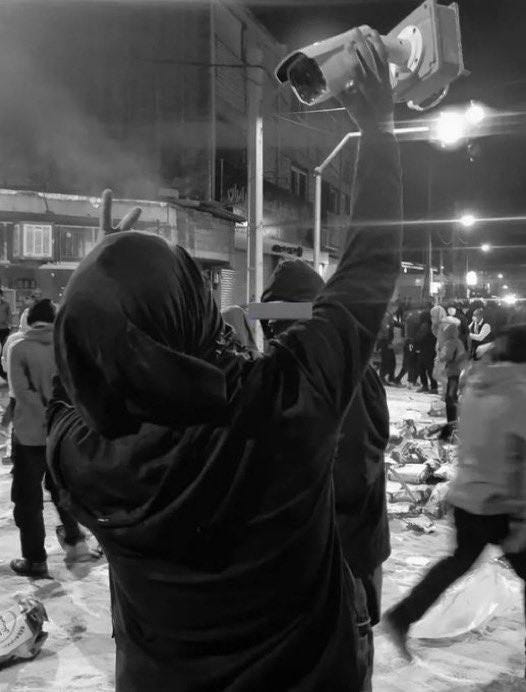
Now come the demonstrations.
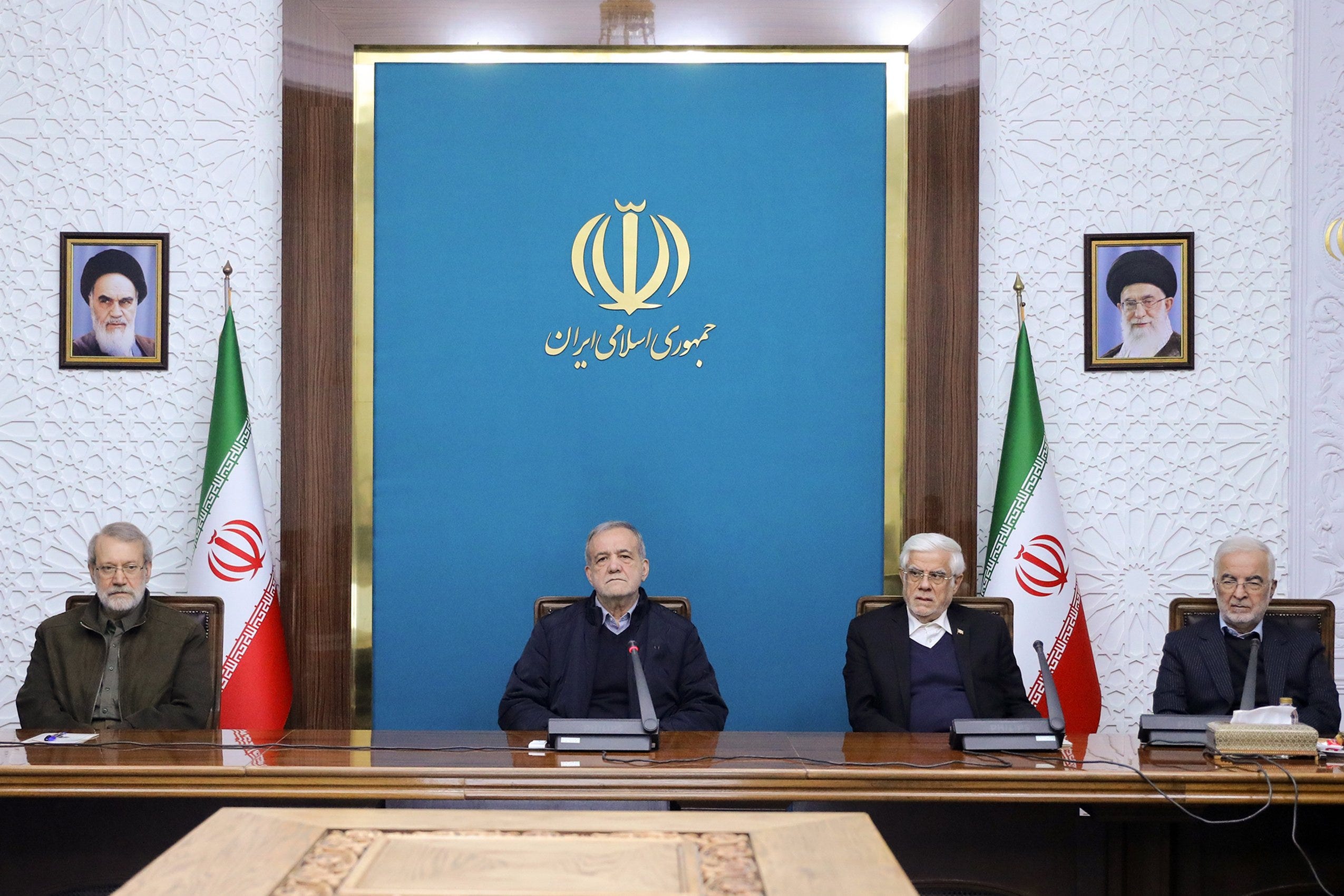
While Iran’s current president has shown understanding of the protesters’ grievances, the Supreme Leader is demanding a heavy-handed response. Is this a genuine internal rift - or merely a “good cop, bad cop” performance by the regime? No one yet has a definitive answer.
Here are several observations, looking forward.
1. Mass participation is decisive
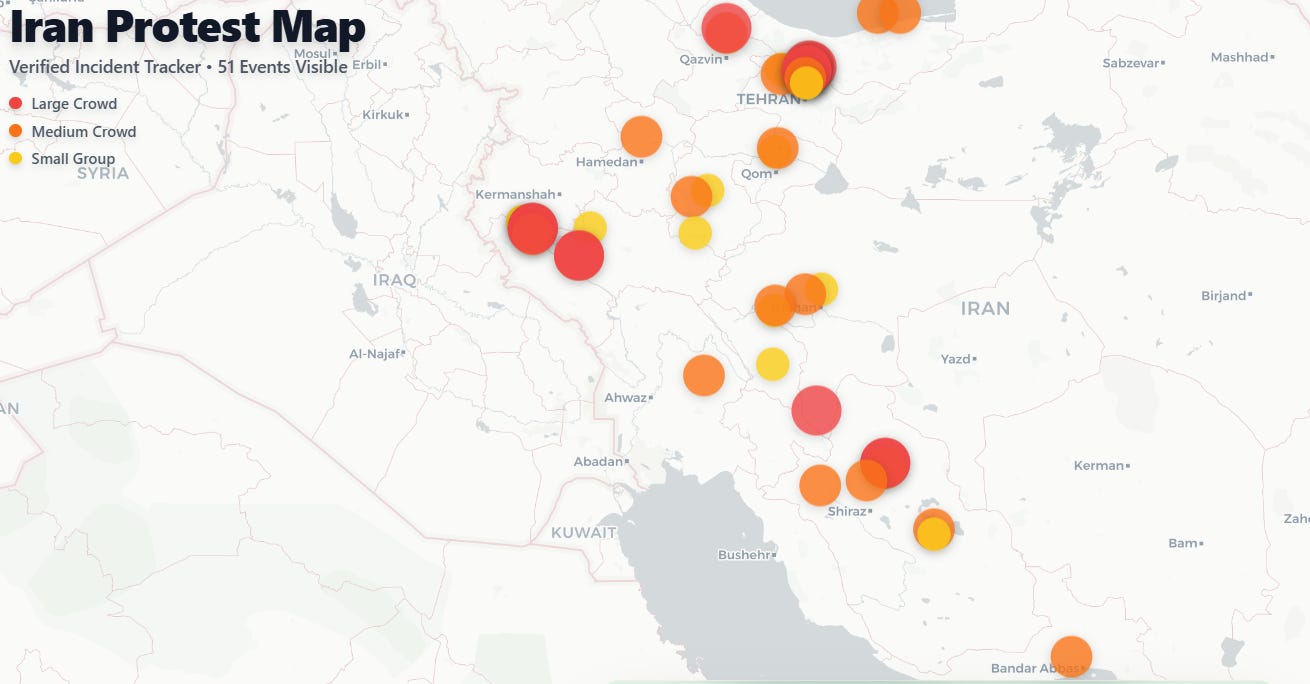
Demonstrations appear to be either maintaining size, or growing. Its the sheer numbers that can push a society into revolutionary mode - numbers we didn’t see yet. Experts have long argued that the Islamic Republic suffers from a deep legitimacy crisis and that conditions are ripe for a meaningful change. Coupled with economic collapse - the exchange rate is approaching two million rials to the dollar - it is not far-fetched to imagine very large numbers taking to the streets and staying there. This could be a long process, as the previous revolution itself took many months to unfold.
2. The bazaar question requires caution
Some commentators argue that the participation of Tehran’s central bazaar merchants - the traditional bazari class - is a decisive signal of imminent regime collapse, as it was in 1979. But Dr. Raz Zimmt, one of Israel’s leading Iran experts and head of the Iran program with the INSS, urges restraint. He notes:
“I see many interpretations about the political significance of the bazaar merchants joining the current wave of protests, especially in its early stages. Some argue this is an unprecedented development, given the bazaar’s historical political importance and its long-standing image as a core support base of the regime.
Some brief points:
First, this is not unprecedented. In fact, the protest wave of late 2017 developed in a similar way - it began, among other things, with bazaar merchants in Tehran amid worsening economic conditions, spread nationwide, escalated, and included clear anti-establishment slogans, including against the Supreme Leader.
Second, while the bazaar did play a central role in protest movements, including the Islamic Revolution, it largely lost its independence afterward. It became dependent on the regime, maintaining close ideological, familial, and economic ties with the religious establishment. Its economic power has also declined with the growth of industry and the public sector.”
3. Iran is not a one-man dictatorship
It is a totalitarian, theocratic regime - but not a personalist one in the narrow sense. Its totalitarian nature is evident not only in the way state ideology penetrates nearly every aspect of life (or at least attempts to), but also in the scale of the state operation itself: a vast enterprise that employs, subsidizes, regulates, and entangles enormous segments of society. In other words, many, many people have a great deal to lose if the regime collapses. Yashar Ali has made this point more precisely than I can.
While large parts of Iranian society clearly want change, others remember the years of the revolution and its aftermath. As an Iranian friend once told me, years ago: “Those who have lived through one revolution do not want to see another. Blood flows in the streets.”
None of this suggests that totalitarian regimes are immune to changes- including relatively non-violent ones, such as the process that led to the collapse of the Soviet Union. But it does help explain why moments like this do not translate quickly into regime overthrow.
4. And this leads to the final - and probably most important point
What we are witnessing now, and what we have seen again and again over the years, is rooted in a simple fact: the Islamic Republic has been a comprehensive failure at delivering a better life to its own people. Now, it is rapidly declining - yet the sunset could be long and violent.
Here’s a small example. Over the past two years, Iran has transferred more than a billion dollars to Lebanon to support its distressed proxy, Hezbollah - whose forces began attacking Israel on the morning of October 8, one day after Hamas’s invasion. At the same time, the regime has announced tax hikes, the cancellation of subsidies, and the closure of educational institutions in some regions due to energy costs.
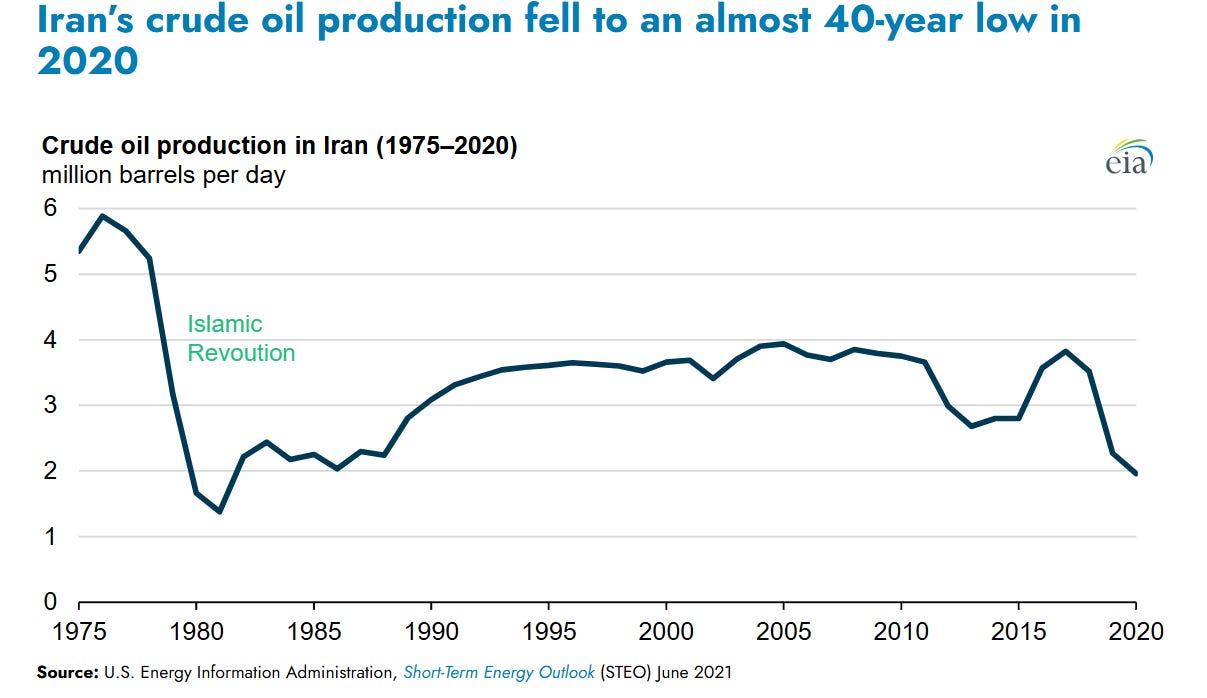
A glance at Iran’s oil production over time tells much of the story. The country’s most important export has never fully recovered to its pre-revolution levels. Structural decay, sanctions, mismanagement and corruption have taken a toll.
I recall a conversation with an Israeli security source - an Iran specialist- about the country’s devastating water crisis, one serious enough to raise the possibility of relocating the capital from Tehran. I asked, perhaps naively, why Iran had not focused its efforts on building water desalination plants, as Israel has done. This is hardly cutting-edge technology. Israel may excel at it, but Iran has the resources and capacity to address the problem.
He looked at me and said: “Because this is how the Republic works. They understand the problem. They know it is critical. The president might even talk about it. But nothing happens. The system is slow, corrupt, and incompetent. Sending money to Hezbollah or producing weapons is much easier- and that’s where the talent is.”
The failure is systemic. Absent meaningful structural change, the kind of protests we are seeing now will return - again and again.
This is a moment to recall Bernard Lewis’s famous prediction, made roughly a quarter of a century ago: that Turkey would become Iran (more Islamist), and Iran would become Turkey (more secular, oriented toward the West). In Turkey, Lewis’s prophecy is materializing. In Iran, the signs suggest change is coming.The question is how long it will take - and at what cost.
Thank you for sharing this thorough briefing, Nadav. Western readers "wish" they never heard of the high-probability of IRGC seizure of power likelihood. If Prince Reza Pahlavi's 08-09 "Iranians Stand Up" event miraculously translates to a somewhat peaceful transition to democracy, then this would indeed be wonderful. The people of Iran are aware of this "event" and that their "showing up" to the Pahlavi event creates greater world awareness & impetus for popular global sentiment to support US & European intimidation of IRGC planners. If IRGC fails to see Iranian (& global) mass support, IRGC will be inclined to seize power and (unfortunately) rush to nuclear statehood. There is no mass outcry from the UN, Arab States, EU members in support of the Iranian people. Western media will look askance at US intervention akin to western medias castigation of US Venezuela intervention. Nevertheless, the least common denominator for Israel, the US, and IAEA is securing all nuclear R&D sites and contents. Sorties to accomplish this would be forthcoming if IRGC power seizure occurs, but Iranians' quest for freedom will likely remain unanswered. No full-scale (Iraq-like) invasion is likely if Iranians fail to "show up" en masse before an IRGC takeover. Lastly, please note the Sunni Islam and & pro-Palestine voices SILENCE regarding the people of Iran. I would urge you to read op-ed pieces in Al-Jazeera today ASAP.
In the video, there are two chants. The first , at 0:10, sounds like it might be مرگ بر خامنهای/marg bar Khamenei/Death to/Down with Khamenei. The second, at about 0:32, is harder to make out.
Are there any Farsi speakers out there who could enlighten us?