


Tensions in the Middle East are at a peak amid expectations that the Trump administration may carry out some form of attack against the Iranian regime, following the mass killing of protesters across Iran – despite the President’s explicit warnings to Tehran. In Israel, officials believe that if the United States carries out a substantial strike against Iran, Supreme Leader Ali Khamenei would likely order the Iranian military and the Revolutionary Guards to retaliate forcefully against Israeli targets. In such a scenario, one could only estimate Israel will respond – in coordination with the U.S.
Major General (res.) Tamir Hayman, former head of Israel’s Military Intelligence Directorate and current director of the INSS, says that “there is already American action” underway in Iran. “In my assessment, the United States is currently conducting a very significant influence operation inside Iran,” he says. “The stream of reports emerging from within Iran – rumors, videos, unexplained events – suggests that many things are happening. It could be coincidence, or it could be something else. Influence operations mainly operate in the cyber domain and through local subversion. I believe such efforts exist.”
A number of foreign governments are urging their citizens to leave Iran immediately. Regional Middle Eastern media report that Israel has warned Hezbollah not to intervene should war break out. President Trump’s decision has apparently not been made yet, and could still go either way; just yesterday, Trump again mentioned the possibility of negotiations with the Islamic Republic. Israeli officials are warning that Tehran is attempting to buy time and has no intention of making meaningful concessions – on its nuclear program, its regional aggression, or internal reform.
1. What Is Happening Inside Iran
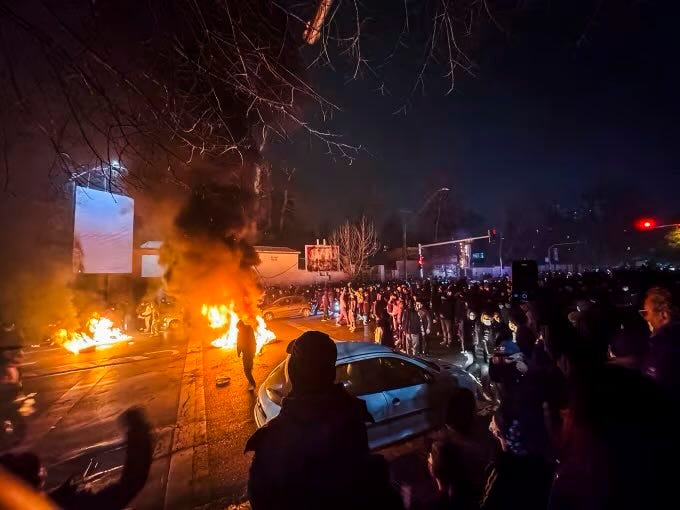
We are now in the fifth day of a complete internet and intenational phone calls shutdown across Iran. Starlink terminals are relatively scarce, and information trickling out is fragmented. Ayatollah Khamenei has placed Iran on the highest level of alert. Reports indicate that Iran is now under actual military rule, with many cities and villages under strict curfews. The economy is paralyzed, while security forces continue killing civilians protesting against the regime.
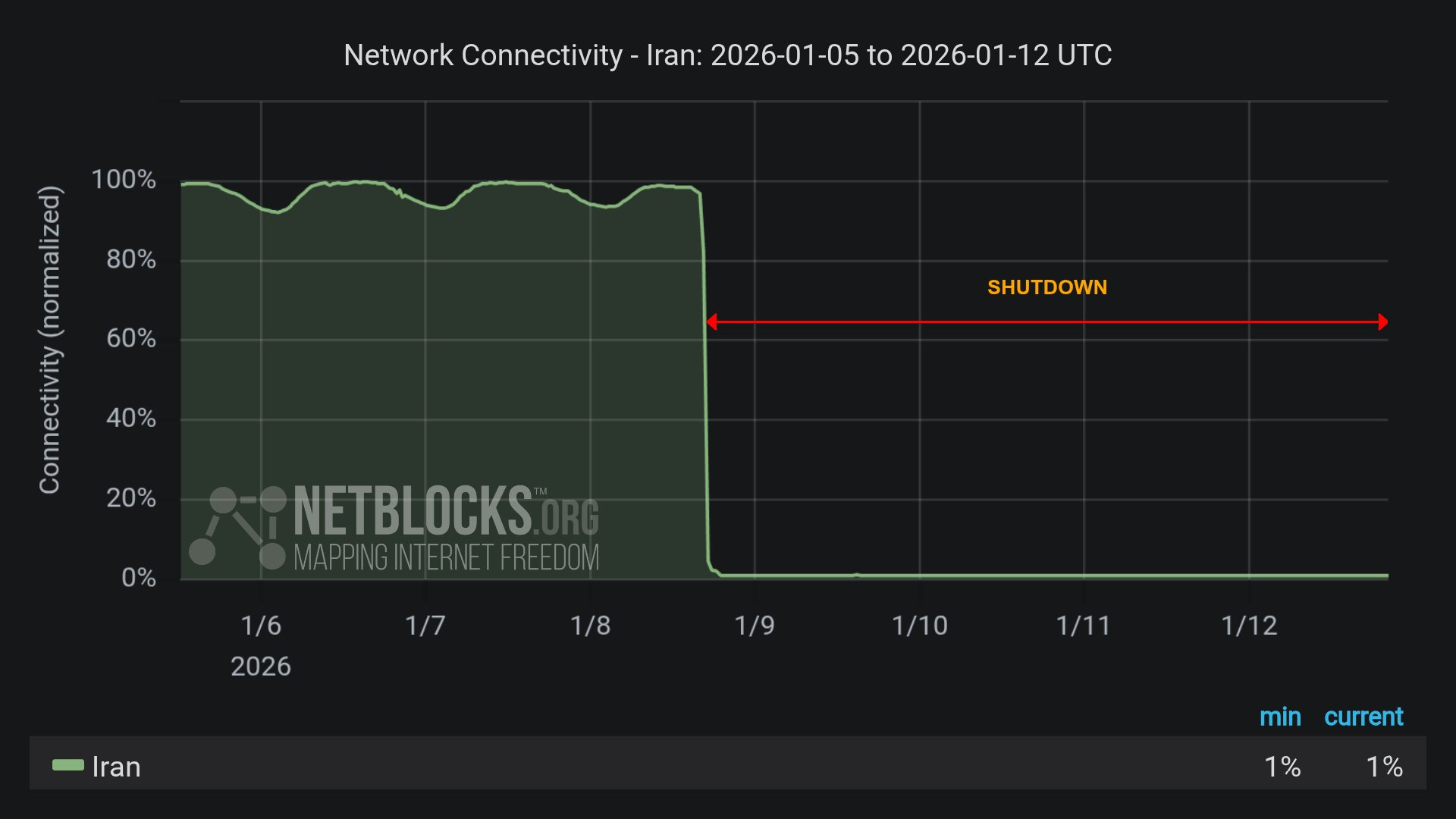
Demonstrations continue, but tracking their size has been made difficult due to the internet blackout. Regime officials have told news agencies they believe about 2,000 people have been killed, including security forces. Opposition media outlets claim more than 12,000 civilians have been murdered since the uprising began. Iranian opposition also reports that planned executions of detainees will begin on Wednesday.
One fact is undeniable: regime forces continue to attack protestors. Meantime, Iranian police and Basij units have not mutinied en masse against their commanders.
This last point is crucial; as long as the security echelon – the Revolutionary Guards, Army, police, and Basij – remains willing to suppress the population, a revolution cannot advance. As noted here several days ago, Western intelligence agencies continue to assess that there is a significant possibility of a military takeover or internal power shift within the Iranian regime, aimed at preventing the collapse of the Islamic Republic.
2. Six Minutes of Horror
Here is a sobering report from an Iranian X account operating abroad, describing a conversation with a contact inside Iran.
“If you want to understand the reality on Iran’s streets, I managed to speak a short while ago with a close friend inside Iran and receive first-hand, accurate, and non-emotional information. I am sharing part of the conversation here, with locations removed:
‘Starlink is the only way to communicate with the outside world. No configuration or VPN works on this semi-connected national network. Some households have Starlink…
A semi-military rule is in control. From 8:00 p.m. onward, people are not allowed to leave their neighborhoods. Young people from each neighborhood gather in the same place between 8:00 and 10:00 p.m. The police do nothing about chanting or gatherings, but if they see movement within the crowd, they respond violently. My friend witnessed live fire at close range.
Most Iranians have not seen the videos from the Kahrizak morgue because they have no internet and no messaging services work.
People are truly empty-handed. This is not a situation where they can simply storm the Iranian Broadcasting Authority (for example). Everyone stays in place between 8:00 and 10:00 p.m., waiting to see how things will develop, and whether help (from the outside world) might arrive.’”
This testimony refers to videos from the Kahrizak morgue. I am attaching a short excerpt from that horrifying six-minute video documenting just one single morning earlier this week at South Tehran’s regional morgue.
These are extremely graphic and disturbing images that convey the scale of the massacre in Iran.
This is the parking lot of the morgue on the southern outskirts of Tehran. The cameraman walks continuously with his phone. Bodies wrapped in black plastic fill the lot, and the sound of wailing – women and men, usually one or two next to each body – is constant. It is impossible to count the dead. The video then shows people clustering around a truck filled with yet more bodies; a large hall with a blood-soaked floor; another hall with dozens of corpses at its entrance; roads and neglected sidewalks; faces frozen, lost.
This video should have shaken the world – foreign ministries, the United Nations, and global media. Among all the footage documenting resistance to the Islamic Republic, there is nothing as damning as civilians shot by the regime, with no actual conflict to excuse this murder away. It is difficult to watch, but should be even harder to look away.
3. The Israeli Angle
Within Israel, there is an internal, classified debate over current events. Parts of the security establishment believe the Islamic Republic is on a path toward radical change or genuine collapse, and that an American strike would accelerate this process. Prime Minister Netanyahu has expressed similar views in closed conversations, and senior figures in Jerusalem are quoted as saying this is a historic moment – an opportunity that may not return.
Many Israeli officials, deeply involved in the Iranian portfolio over time, are more skeptical. They point to the continued obedience of security forces in killing protesters, and the difficulty of sustaining demonstrations under prolonged curfew.
This is not an academic discussion. Its conclusions will shape major Israeli decisions in the weeks ahead. If one believes the Iranian regime is nearing collapse, the inclination may be to commit greater resources and take more risks in confronting the clerical leadership.
Both sides agree that Iran is experiencing a profound sense of state dysfunction - but its not enough. “Revolutionaries do not make revolutions!” wrote Hannah Arendt , “The revolutionaries are those who know when power is lying in the street and when they can pick it up. Armed uprising by itself has never yet led to revolution.”
For their part, Western intelligence agencies that once feared an American strike would cause Iranians to “rally around the flag” have largely abandoned that view. On the contrary, a U.S. response could even strengthen the protesters.
The question remains: how could the protests become genuine change?
4. Enter Prince Reza Pahlavi
The son of the long-deposed Shah, Reza Pahlavi, is a controversial figure for many Iranians, yet one whose very existence symbolizes total opposition to the current system – and the memory of a better past.
I myself met Prince Pahlavi more then a decade ago at his home in Maryland, where he spoke to me about the danger posed by the Islamic Republic and the need to re-establish good relations with Israel.
Though many Iranians prefer to have no monarchy at all, Pahlavi’s public activities, conducted from exile in the United States, present a dilemma for protestors. Revolutions often gravitate toward figures who exist entirely outside the ruling system.
In 1979, the revolution required a face. The Shah himself had been a paternal figure, and revolutionaries believed they needed a replacement. Ayatollah Khomeini, exiled in France, became that symbol. He was everything the Shah was not: religious, austere, seemingly devoted to the poor, implacably opposed to the regime. To many secular and leftist revolutionaries, he seemed like a tool they could wield to their advantage. He was neither.
Khomeini proved to be a ruthless authoritarian, determined to establish a clerical dictatorship and willing to use mass violence to do so. Those who believed they were merely borrowing his symbolism – especially secularists and Marxists – learned too late that symbols often rule revolutions far more than people do.
In today’s Iran, so-called “reformists” cannot credibly function as outsiders. Embedded in the Islamic Republic, many of them clerics, they are disqualified in the eyes of a revolutionary public.
As in 1979, the opposition has yet to build a strong, middle-of-the-road, democratic, classical-liberal symbol of a contemporary Iran.
5. A Final Note on Western Media
Over the weekend, I wrote about the betrayal of political classes who are so fixated on Western blame, on a narrowed and orthodox version of Third Worldism, and on the demonization of Israel – that they have turned their backs on the Iranian people.
And what is happening in much of the Western media? its response has been slow and subdued - to say the least. One has to wonder. This is the biggest tale in the world: people rising up against a totalitarian dictatorship of the worst kind. You do not need to support them to grasp how historically crucial this story is.
There has been some improvement in recent days, and while The New York Times news coverage is becoming better and more detailed, I browsed the past ten days of episodes of The New York Times’ The Daily – from December 28 (“Best Movies of 2025”), through episodes like “She Fell in Love with ChatGPT,” features on Venezuela, the 2026 elections, and ICE operations in Minneapolis.
Iran? Nothing.
Nadav, thank you again for keeping us informed and being among the very few who still practice journalism! Yes, our press and media continue to focus repeating the same issues all day and night, with only a short comment about what is happening in Iran! Yes, there are a number of troubling events to cover, but the Iran coverage is like a whisper. I pray for the freedom safety and peace for the Iranian people, and may it form a democratic government. May the Mulla's be speedily flushed into the dustbin of history, including the IRGC! Negotiations with them will only keep them in power, and history shows they can't be trusted to follow through on agreements. May Hashem also keep all Israel safe, and protect our Troops and those who will help liberate the Iranian people!! ברוך השם
I first heard of you on Dan Senor’s podcast and how grateful am I. Your Substack is worth the paid subscription. You’ve notably pointed out the absence of coverage of events in Iran by media outlets like The New York Times. As a consumer of news, I find that for years most major papers - like TV stations before them - report the same thing. The problem has only gotten worse over time. Your columns here are a breath of fresh air for the brain.