


Tensions are rising between the U.S., Iran, and Israel as military buildups continue, and the next move could catch everyone off guard. Israeli officials worry about a possible Iranian first strike, yet the more plausible surprise may come from Washington itself. More on this below.
Key developments
Israel’s military intelligence chief, Maj. Gen. Shlomi Binder, has been in Washington this week, briefing senior officials at the Pentagon, the CIA, and the White House on specific intelligence regarding Iran, amid rising concern over a possible strike.
Iran’s state media reports that the military has added 1,000 “strategic” drones to its arsenal, developed with the Defense Ministry and based on “lessons” from the recent 12-Day War.
Foreign Minister Abbas Araghchi says Iran’s forces are “with a finger on the trigger,” claiming Tehran can now respond harder, and more effectively.
According to U.S. and European officials cited by the New York Times, Washington has demanded that Iran fully halt uranium enrichment, limit its ballistic missile program, and end support for regional proxies. Those talks have stalled, with no sign Iran intends to comply with the American terms.
On Strategic Surprise
One of the topics I study and explore with students is strategic surprise. Strategic surprise rarely happens out of nowhere — and when it does, it is often not defined by timing, but by scale, method, and results. The Middle East is known for these sudden and dramatic shifts. Think of the 1967 Six-Day War, the 1973 Yom Kippur War — and how that conflict ultimately led to at least one peace treaty. More recently, October 7, 2023. Or Israel’s decapitation of Hezbollah’s leadership and capabilities, pagers included.
Absolute surprises are very rare. Strategic surprises usually occur not in a vacuum, but within an existing conflict — sometimes not violent, but always infused with the potential for violence to erupt.
As the strategic surprise scholar Michael Handel notes, it is common to encounter warnings that either trigger no real alert (as on October 7), or provoke some degree of alert, as in 1967 — yet the surprise still occurs.
We are now facing one such moment, when conflict seems almost inevitable. Iran may feel cornered and consider extreme actions, while the U.S. could use surprise to amplify its superiority and achieve a more effective and strategic outcome. Israel awaits President Trump’s decision, knowing he retains the power to call off a strike, even as it prepares for the possibility of an Iranian attack.
Surprise is often the weapon of the weaker side. The weak are drawn to surprise because it offers a way to achieve what they cannot through conventional war. By taking the initiative, they seek to offset their inherent deficiencies. And the interesting thing is that even when both sides are clearly on a path to conflict — think Iran and Israel in June 2025 — surprise still works. Whether in methods, targets, scope, or timing, it remains one of the most effective tools, perhaps the most effective, for generating advantage.
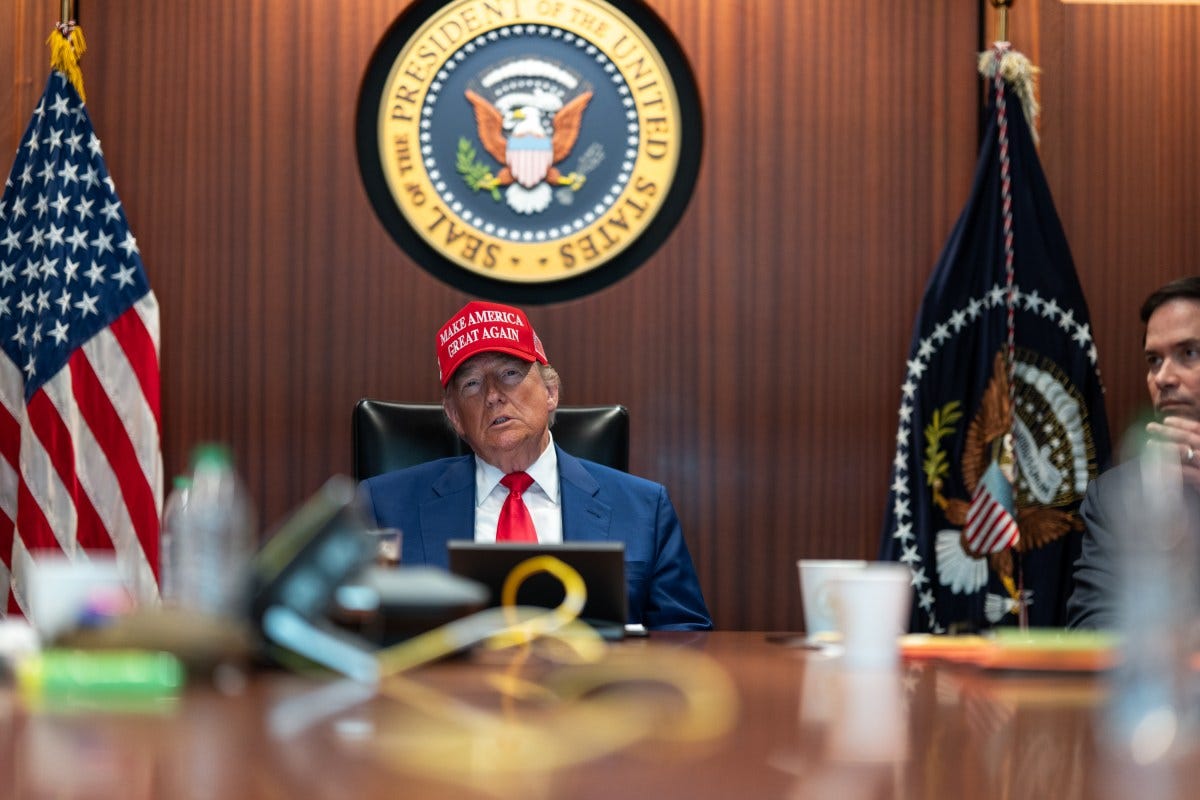
When the weaker side initiates a surprise, it may achieve real — sometimes impressive — tactical gains. But its assumptions about the results tend to be wildly optimistic (think Japan and Pearl Harbor). The fundamental advantages of the stronger side usually reassert themselves and mitigate or erase the effects of the initial shock.
Now apply this framework to the current Iran–U.S.–Israel dynamic.
The Current Situation
What we are already seeing is a clear framework of conflict. President Trump has been explicit: specific demands are being made of the Islamic Republic, and failure to comply will result in violence. A military buildup is close to completion. The Iranians, as far as we know, are refusing the type of concessions demanded. The United States, for its part, is incentivized to strike — not only to enforce its ultimatum, but to preserve regional deterrence after Iran crossed a red line publicly articulated by the president.
Iran, the militarily weaker side, is threatening retaliation with “everything it has,” including against Israel. Unless the Supreme Leader decides to “drink the cup of poison” — to quote Ayatollah Khomeini’s famous description of accepting a ceasefire with Iraq back in 1988 — it is difficult to imagine Iran satisfying Trump’s demands in a meaningful way.
At the same time, the United States cannot realistically achieve regime change through military action alone, absent an organized internal opposition, or an armed faction within the regime.
This leaves room for dangerous misperceptions. The Iranians may believe Trump is bluffing, leading to overconfidence. Or they may conclude that a dramatic move — a pre-emptive strike — offers the best chance to shift the balance, deter attack, or reshape the confrontation on more favorable terms.
Regarding Iranian logic, the leadership almost certainly recognizes that a direct surprise attack on the United States forces in the region would be suicidal. I write this myself, but it underscores an important point: this exact line of reasoning often leads stronger actors to underestimate the risk of being taken by surprise.
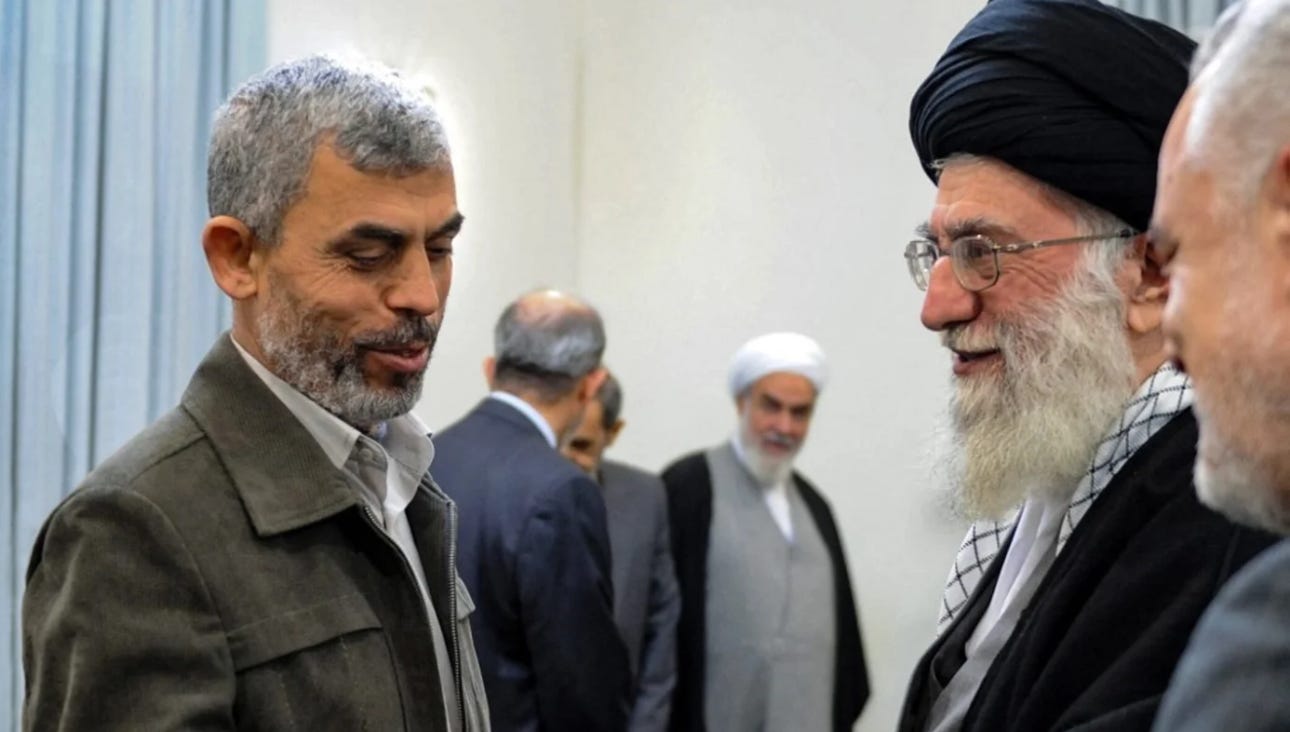
As Robert Jervis explains, strategic analysis requires more than weighing facts or assessing costs and benefits. It also demands disciplined empathy toward the adversary — not just understanding what the rival is thinking, but appreciating what it is feeling. What one side sees as suicidal behavior may, to the other, appear as a last-ditch attempt to preserve the regime.
How Might an Iranian Attack Unfold?
If Iran were to attempt a surprise, Israel — not the United States — would be the most plausible initial target. This is what senior Israeli officials fear, according to my conversations with sources.
The Iranian calculation, in this scenario, would run as follows:
Iran assumes that it will inevitably be attacked by Israel at some point as part of a U.S.-led strike.
Given that assumption, Tehran concludes it has a vested interest in firing the first shot, pulling Israel in immediately — thus taking out some of its military abilities and framing the confrontation as “Iran versus Israel” rather than “Iran versus the United States.”
Such a framing could also pay dividends in regional public opinion. A surprise attack on Israel might indeed trigger American involvement, but that involvement could be portrayed as Washington “rushing to Israel’s aid.” More importantly, Iran might believe that a successful surprise strike would restore some measure of its regional prestige and deterrence.
Needless to say, these assessments are infused with miscalculations. Miscalculation is often the midwife of a strategic attack — sometimes on the side of the attacked party, and sometimes on the attacker’s. There is usually some miscalculation on both sides.
Practical Considerations
Iran and Israel do not share a border, so any such conflict would most likely involve the launch of large numbers of missiles or other long-range projectiles. Israel is also worried about this scenario because of the asymmetry between its expensive Arrow interceptor missiles and Iran’s comparatively cheap and more abundant ballistic missiles.
A critical caveat: Iran — as the 2025 June war demonstrated — appears to be deeply penetrated by Israeli intelligence. Much of its deliberations may be compromised by its rival. That said, intelligence can be both deep and wrong; Israeli officials also believed they had comprehensive insight into Hamas’s intentions before October 7. We know how that ended.
An American Surprise
This leaves two additional possibilities:
Israel taking the lead. I find this less likely. The United States is clearly in the driver’s seat right now; this is the president’s show, not Israel’s.
A surprise conducted by the United States itself.
How could an American attack constitute a surprise? The threats are out in the open and the military assets are almost in position. It is obvious that such a strike is highly likely.
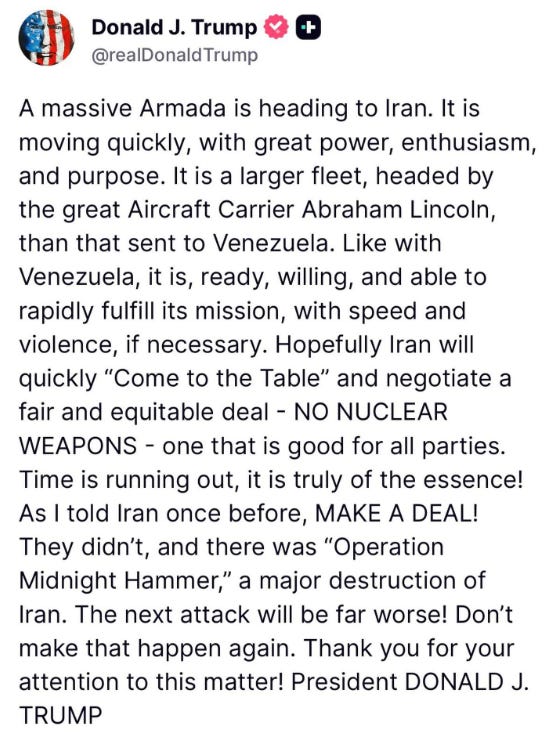
The answer is that strategic surprise is often determined not by the occurrence of an attack, but by its scale, method, speed, intensity, and — most importantly — its results.
In this case, the surprise would be a strike that goes beyond imposing a price on the Islamic Republic for its mass murder of its own civilians, and is instead designed to create meaningful internal change. This may be the most important calculation confronting key decision-makers in Washington: how to ensure that a possible strike, if ordered by the President, truly matters.
Everything written here (aside from Israeli preparations regarding the possibility of Iran striking Israel first) is a simulation, drawing on established theories of strategic surprise. The most plausible scenarios remain either a limited American strike (opening the door for negotiations afterward) or an Iranian concession significant enough to allow Washington to move away from a military option.
But surprises are like that. They are never judged plausible — and then they happen.
An insightful analysis. Which begs the question, what results would the US reasonably be after from a surprise strike?