


How Israel Feels Today
The mood in Tel Aviv over the past 48 hours has shifted dramatically. Television news opens, day after day, with the prospect of an American strike — presented as almost definite. Quietly, many are being called to reserve service. Even the traffic feels a bit light.
This time feels different from previous rounds with Iran over the last three years. “In a little while, there’ll be war,” a 63 year-old told me at a falafel stand on Ibn Gabirol Street in Tel Aviv — a conversation he opened, without me asking a single question. “And then everything is going to be fine.” Elsewhere, that might sound like a paradox; in Israel, it makes a certain sense. Israelis saw some amount of devastation in the 12-day war with Iran in June 2025, but they also learned the limitations of the Iranian threat. Now, if the U.S. leads the charge against the Islamic Republic, this war could reshape the region — potentially for the better. That assessment reflects a broad Israeli political consensus — right, center, and left — as does the perception of Iranian regime as an arch-enemy.
A constant tension surrounds travel abroad. The assumption is that if war breaks out, flights in and out of the country would stop. People currently overseas on business may find themselves stuck, looking for yachts from Greece or Cyprus to bring them home (this is what happened last time); those who want or need to leave may have to consider the same.
The country is bracing for another chapter in this war — but this should not be overstated: restaurants are full, coffee shops busy, joggers moving along the Tel Aviv Tayelet as usual. And yet, the tension is unmistakable. The most desired commodity is a sense of timing — of when this will all begin.
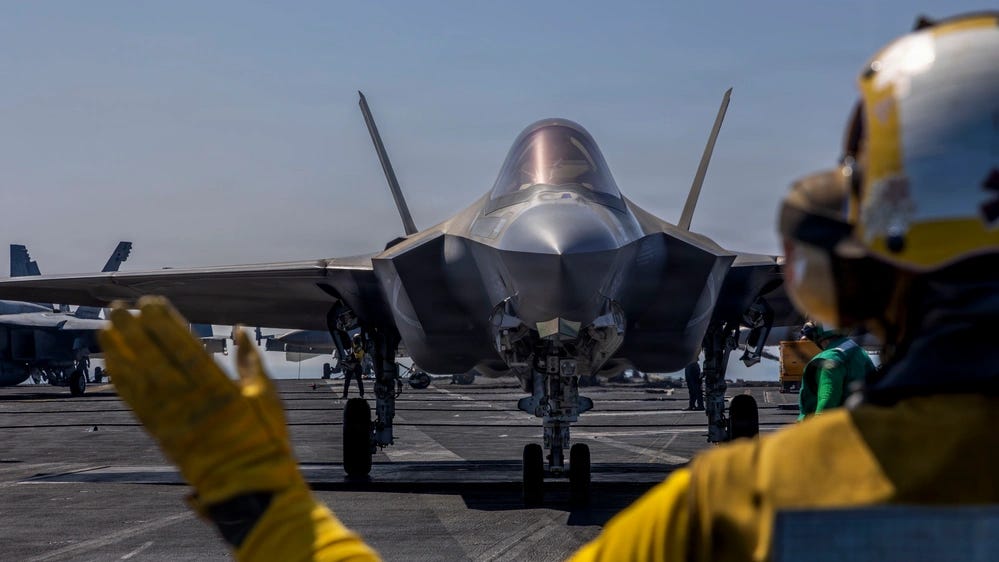
Israel is at peak readiness ahead of the possibility of an American strike — in effect, a joint U.S.–Israeli operation against the Iranian regime. American forces across the Middle East are in a posture not seen in a decade. The aircraft carrier USS Gerald R. Ford, the largest in the world, is moving eastward in the Mediterranean to join the USS Abraham Lincoln (already in position), and dozens of strike and intelligence aircraft have been transferred to the region over the past week. CBS News reported that U.S. forces could be ready for action as soon as this weekend, even as no final decision has been made.
Israel’s political and military leadership continues to assess that negotiations with Iran will not yield meaningful results; that the regime — and particularly the Supreme Leader — is not built for even the minimal concessions required by the White House; and therefore that the chances of war are high. “But this is the President’s decision, and Trump can cancel everything - or accept an Iranian offer. We understand that,” a senior Israeli official told me.
1. The Nature of the Strike
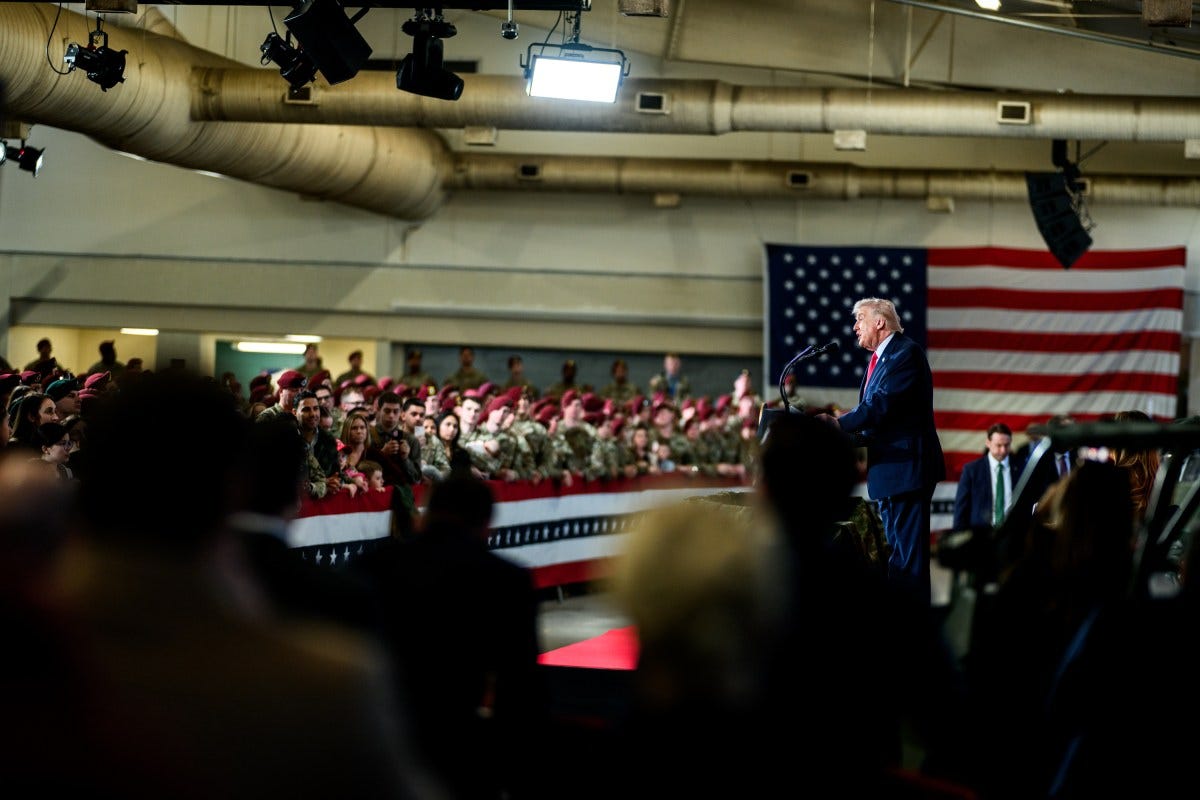
Regional sources estimate that if the United States acts, it will do so on a broad scale, seeking in its opening blows to eliminate as much of the Islamic Republic’s retaliatory capacity as possible, specifically its ballistic missile capabilities. The Wall Street Journal reported yesterday that President Trump is weighing a limited strike — designed to compel Iran to grasp the seriousness of his intentions and show flexibility in negotiations.
Sources across the region doubt the effectiveness of such a measure and find it hard to believe that Washington would ultimately go down that route. Their reasoning: Tehran is unlikely to interpret any strike as “limited.” Even a calibrated blow would almost certainly trigger retaliation. And if the strike is too measured, it could be read in Tehran as a symbolic gesture — a move designed to demonstrate action and then withdraw — thereby reducing any incentive to compromise.
From Tehran’s perspective, it might also be seen as the beginning of a gradual push into a corner, prompting a sharper response rather than restraint.
At least for now, Tehran is promising escalation and has explicitly said it will fire “with everything it has,” as I recently wrote about here. Last night, the Iranians sent a letter to members of the Security Council, explicitly warning that they would strike American bases across the region if attacked.
For these reasons, many in the region assume that if there is a strike, it will require devastating damage to Iran’s military infrastructure in the first 36 hours.
Israel has already eliminated most of Iran’s air defenses and demonstrated, in the June war, the vulnerability of the Revolutionary Guards’ command and control. U.S. press has reported — and Israeli sources confirm — among the options under consideration is a severe blow to Iran’s political and military command personnel. Israel possesses exceptional intelligence and operational capabilities and is offering to play a role in achieving at least some of these objectives. It is worth mentioning, in that regard, recent visits by Israeli security chiefs to Washington — not all of them publicly disclosed.
At the same time, Israel is bracing not only for an initial exchange, but for the possibility of a longer conflict. Security officials are preparing for sustained missile and drone fire over weeks, not days, and for the economic and civilian strain that such a scenario would entail.
2. The Objective
In the optimistic scenario, a large-scale strike could inflict serious damage on Iran’s nuclear program — already in a reduced state after the June war — dismantle much of its ballistic missile infrastructure, and strike at centers of power, particularly the war-fighting apparatus of the Revolutionary Guards. Such a blow could enable and encourage internal change within the regime, or its actual unraveling. The regime is already facing a deep crisis — in governance, in legitimacy, and mainly in a faltering economy.
Even in a less successful scenario, there is little doubt that a wide-ranging American strike would weaken Iran’s regional standing. The most rational decision for Iran, under current conditions, would be to concede and accept American demands. Any agreement would be complex, require time to implement, and would be presented as a victory by the Trump administration. Given Tehran’s extremely difficult position, this is the logical choice: tell the Americans they have won, accept the framework, and then revert to the familiar playbook — delay, “reinterpret,” buy time.
The difficulty for Iran is that the Trump administration, unlike some of its predecessors, appears less inclined to turn a blind eye to such maneuvers. And, at any rate, most Iran experts believe the republic is not prepared to take that step — because of what it perceives as sovereignty and national security.
Realism has rarely been the Supreme Leader’s compass. He operates within a tradition shaped by a state that embedded “Death to America” and “Death to Israel” into its national creed — where an ideological posture outweighs pragmatic calculation.
3. Iran’s Surprises
As I have written here before, there is concern in Israel that Iran may seek to strike first — in Israel — if it concludes that an American attack is inevitable. Tehran has tried to draw operational lessons from its defeat in the Twelve Day War. It has attempted to improve command and control and understands that the opening blow will be severe. First and foremost, the Islamic Republic will seek to preserve its political leadership — above all the Supreme Leader and his potential successors.
Iran will, of course, seek to hit Israel hard — targeting population centers, military bases, and critical infrastructure. The regime in Tehran has identified ballistic missiles — rather than drones — as its central deterrent vis-à-vis Israel. Israel operates a multilayered anti-missile defense system, including the Arrow. Yet the sheer volume of incoming fire, and the cost and finite supply of interceptors, make perfect protection impossible. Iran may find it easier to strike elsewhere, including energy infrastructure in the Persian Gulf. The UAE and Bahrain, in particular, could attract greater attention in an Iranian retaliation. This assessment is shared by both Israeli and Gulf sources.
For the regime, victory is survival. Even managing a limited but sustained response — ballistic missiles, drones, proxy attacks — over time, so long as the regime does not fall, would be framed as an achievement. Endurance itself becomes proof of strength. If, after absorbing devastating blows, the leadership remains intact and in control, it will declare a historic victory over the United States.
Faced with a massive American strike, Iranian leaders could conclude that their best course is to widen and complicate the conflict — making it more costly for Washington. That could mean attempting to close the Strait of Hormuz, targeting oil facilities, driving up energy prices, fueling inflation in the United States, and seeking American casualties in order to project an image of a war they can sustain over time.
To outside observers, such moves might appear suicidal. But the regime sees them as plausible. The alternative would be to give up its nuclear ambitions — after years of sanctions and political cost already paid, with interest — and its ballistic missile program, which it views as essential to its survival and not formally restricted by a treaty in the way the nuclear program is.
That logic forms part of the risk in any decision to strike. On the other hand, refraining from action now — or conducting only a symbolic strike — could embolden Iran further.
4. The Riddle of the Exit Strategy
A central question is whether the West maintains coordinated contact with factions inside the regime, or with elements of the opposition, that could seize on a moment of change. In Israel, some argue that without clarity on this point, a strike could produce dramatic and unintended consequences.
Alternatively, if the United States were to attempt — and succeed — in decapitating much of the political leadership, change will follow of its own accord. Most Israeli intelligence sources argue that at this stage, almost any outcome that results in the replacement of Supreme Leader Khamenei would be preferable to the current status quo.
In this context, it is also worth noting the recent waves of arrests of reformist figures in Iran. The regime appears to view them as a potential bridge to the West and therefore a threat (while many in the Iranian opposition see the reformists as simply another face of the same system).
Even in the most successful military scenario, absent actual regime change, fundamental questions would remain about the broader strategy. For that reason, some sources speculate — and it is important to stress that this is speculation — that structured plan exists regarding internal change in a post-war Iran.
Another dimension is more global. Iran has repeatedly sought to draw China and Russia closer — whether through asking for rapid military resupply or through attempting to create a deterrent alignment against Washington. Joint drills have taken place in recent days.

So far, however, there is no indication of a formal alliance. Moscow and Beijing are watching Iran’s performance since October 7, and they do not seem very impressed by the Islamic Republic’s results.
At the same time, a large and successful American campaign against Iran would be deeply disturbing for both China and Russia — the most significant strategic setback for them in the Middle East since the fall of Assad in Syria, and far more consequential.
Iran supplies roughly 10 percent of China’s oil imports. Recent U.S. administrations have sought to curb the expansion of Chinese influence in the Middle East. The Biden administration, for example, framed normalization between Israel and Saudi Arabia partly as a means of tightening American alignment in the region amid concerns about China. President Trump, with strong ties to Saudi Arabia and other regional states — and powerful standing in Israel — has taken steps that severely limited Beijing’s room for maneuver in the Middle East.
A decisive blow to Iran would fit within an emerging American security doctrine — including broader efforts to reinforce global energy security at a time of rising demand. What began as massive demonstrations in Tehran could evolve into a moment with far-reaching repercussions for American strategy — and for the broader rivalry with China.
Covers the ground well. We are on edge waiting to see what happens next.
Hamas have training camps in Afghanistan, far from Israeli air force bases. If the US does declare war on the Iranian regime, maybe they could detail a strike package targeting Iranian proxies outside Iran... such as those sites in Afghanistan?