

Why Netanyahu Put Zohran Mamdani on a Billboard in Tel Aviv
Netanyahu is badly trailing in the polls. History suggests violence could change that. Until then, Mamdani is one political gift Bibi won’t let go

Israelis go to the polls on October 27, in the first election since the Hamas invasion of October 7, 2023, and the wars that followed it in Gaza, in Lebanon, and against Iran. By the standards of Israeli politics this is remarkable: the outgoing Knesset is the first since 1988 to serve out a full four-year term rather than collapsing early.
By any measure, Israel’s election campaign is now moving into high gear. The deadline for parties to submit their candidate lists for the Knesset, Israel’s 120-seat parliament, does not arrive until early September, and the first week of next month is likely to be critical. But at this relatively early stage - Israeli elections can change dramatically even in their final 24 hours - Netanyahu and Likud look, there is no delicate way to put it, terrible. Gadi Eisenkot, the former military chief and one of Netanyahu’s main rivals, has so far proved remarkably Teflon-coated.
The Israeli media is wary of declaring the race over, and rightly so. Netanyahu is the most formidable campaigner in Israeli politics, and he has won more elections in a democracy than any other living leader. Still, caution can be justified and excessive at the same time.
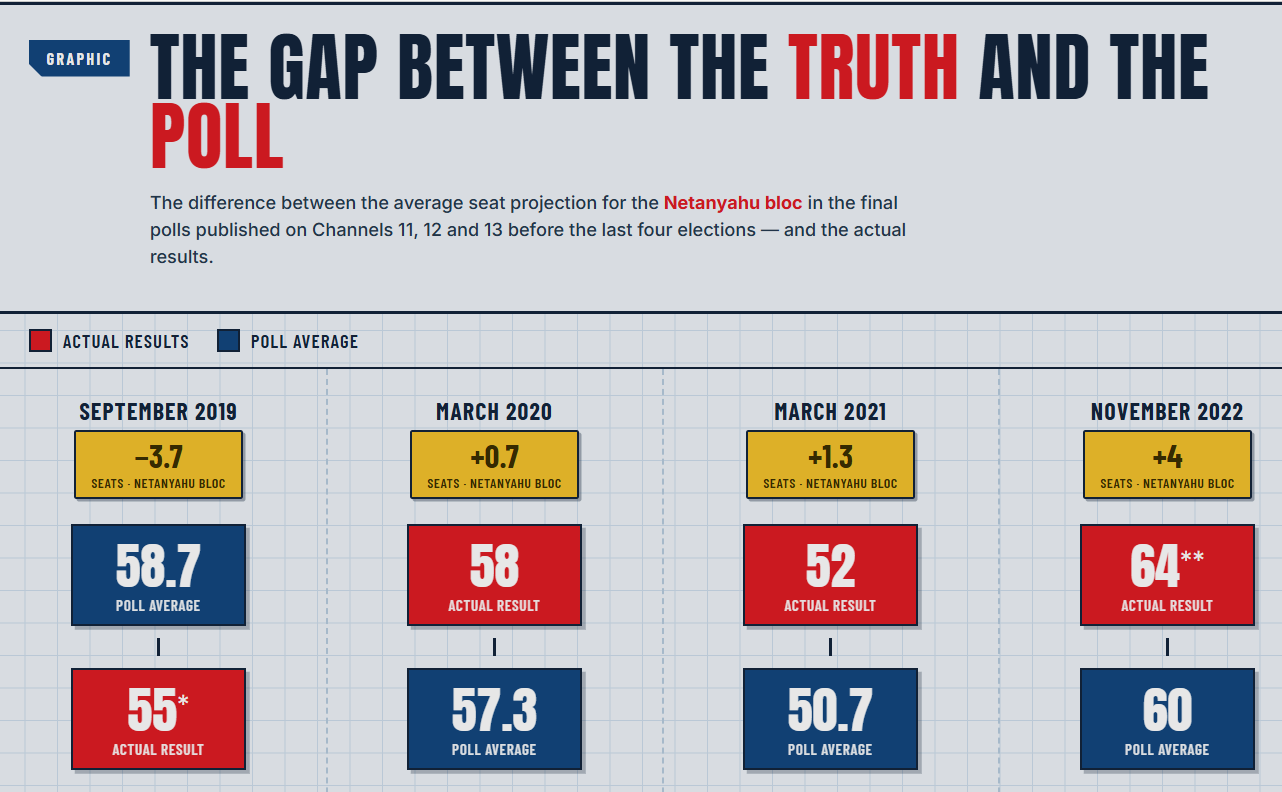
My newspaper’s weekend magazine conducted a quick comparison of past polling with actual election results. The record is fairly clear. Across Israel’s four most recent elections, the average of final TV polls — those published on the Friday before voting— was reasonably accurate. Netanyahu’s bloc has tended to outperform the polling average by roughly one Knesset seat (out of 120).
There is one important complication peculiar to Israel’s proportional system: When a party fails to clear the electoral threshold, its votes are effectively lost, sometimes shifting the balance between the blocs. This happened to the far-right Otzma Yehudit in one of the 2019 elections and to the left-wing Meretz in 2022. But broadly speaking, recent Israeli elections have not produced enormous polling surprises. So far, Netanyahu’s bloc has trailed in almost every reputable poll since March 2023 - seven months before the worst massacre of Jews since the Holocaust. The exception is Channel 14, a coalition-infused television network, whose polls generally show Netanyahu ahead. Netanyahu himself does not seem to put much faith in those numbers; if he did, he might have called an early election
Some observers abroad tend to ask whether the opposition bloc can reach 61 seats, an outright majority in the 120-seat Knesset. That is basically the right question, but it misses an important feature of Israeli politics: A government can also be formed as a minority government.
This matters. The parties representing much of Israel’s Arab public are formally non-Zionist. Many members of the anti-Netanyahu bloc are themselves on the right and do not regard these parties as legitimate coalition partners. But that does not necessarily prevent a change of government. Arab citizens are roughly a fifth of the population. The parties representing them could support — or simply decline to vote against — a government not led by Netanyahu, without formally joining it. Most political insiders, on both the left and the right, believe this is exactly what they will do.
Counted this way, the picture is much clearer. For years, the parties opposed to another Netanyahu government have consistently held roughly 66 to 71 seats in the polls.
Netanyahu’s present situation is bad enough that slogans and dreary campaign videos are unlikely, by themselves, to transform it. But he does have one source of hope: a serious outbreak of violence involving Arabs. There is, politically speaking, a hierarchy here. The closer the confrontation is to home — first with Arab citizens of Israel, then with Palestinians in the West Bank or Gaza, and then with Israel’s more distant enemies — the greater Netanyahu’s potential political benefit.
Since the Likud first came to power in 1977, almost every major deterioration in Israel’s security environment — a wave of terrorism, a war, an Israeli military operation, or an attack on Israel — has benefited the right at the ballot box. Menachem Begin’s decision to bomb Iraq’s nuclear reactor in 1981; the outbreak of the first intifada in 1987; the collapse of the Camp David peace talks in 2000; the devastating suicide-bombing campaign before the 1996 election: Again and again, Likud and the Israeli right collected a political dividend.
It does not necessarily matter who was prime minister when the crisis began, or who bears responsibility for it. When Israelis feel threatened, public opinion becomes more hawkish. A small portion of the electorate — small, but in Israel’s closely divided politics often decisive — moves to the right.
October 7 was a watershed for many reasons. One of the smaller ones was political. For most of the previous two decades, Netanyahu had shaped Israel’s policy toward Gaza. He and his allies developed what Israelis call a conceptzia — an entrenched strategic assumption — that Hamas’s continued rule in Gaza could serve Israeli interests and that destroying the organization was neither necessary nor desirable. That conception ended catastrophically on October 7. And for once, a segment of the Israeli right turned against Netanyahu because of a security failure.
It is a rare thing in Israeli politics for Likud and the right to pay an electoral price for deteriorating security. The previous notable case came in 1992, amid a wave of Palestinian knife attacks, when Yitzhak Rabin successfully campaigned on a promise to restore Israelis’ personal security.
A new wave of violence — regional, tribal, religious — could save Bibi.
Netanyahu’s opponents might reject this argument. Another eruption of violence, they will say, would merely demonstrate once again that Netanyahu has failed to provide security. It would be another echo of October 7: another breakdown on his watch, another indictment of his leadership.
That is a rational argument. It may even be correct. But contemporary politics is driven less by rational accounting than by sentiment — by the instincts of a tribe that feels it is losing control. In the event of another serious security escalation, the dominant Israeli sentiment is likely to be simple: hit back, and hit back hard.
There is a reason Netanyahu has been investing so much political energy in warnings about “the Arabs” deciding the next elections, or being part of the other block’s government. He is planting a seed. If an eruption comes — and some figures on the Israeli far right, most notably National Security Minister Itamar Ben-Gvir, seem to be working hard to make confrontation more rather than less likely — Netanyahu hopes to harvest the political fruit.
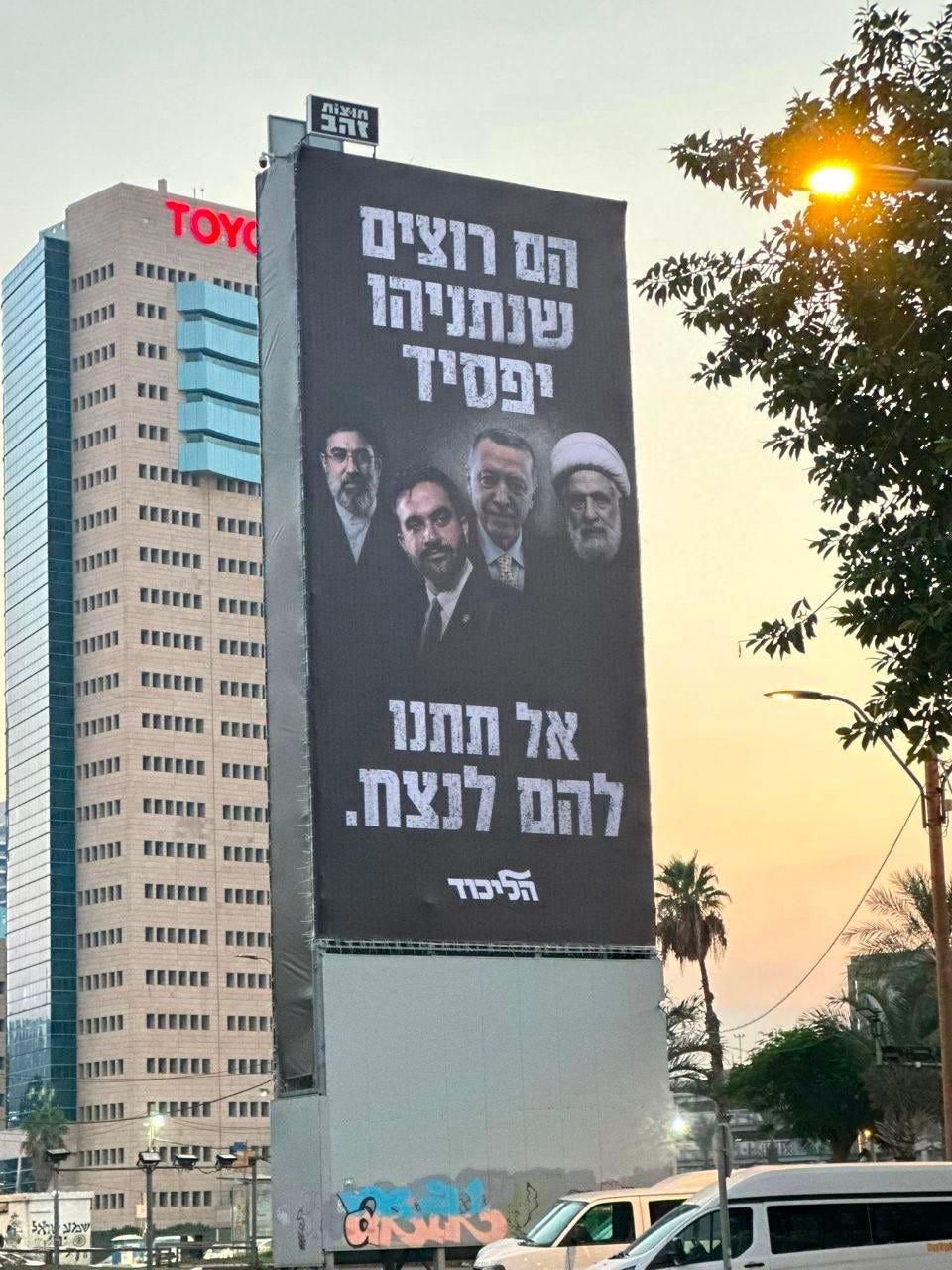
Violence is not the only card. A Likud campaign billboard unveiled this week reads: “They want Netanyahu to lose. Don’t let them win.” It features, from left, Mojtaba Khamenei, son of Iran’s supreme leader; New York City Mayor Zohran Mamdani; Turkish President Recep Tayyip Erdoğan; and Naim Qassem, the leader of Hezbollah.
Mamdani and his ilk are a gift to Netanyahu: He can turn their rhetoric into campaign material. Putting the mayor of New York alongside the leader of Hezbollah is almost tailor-made for Israeli right-wing voters. And the message of they want Netanyahu to lose may sound a little desperate — but in Israeli politics, desperate can work.
He sell New York to hell
It is his current version of “they are coming with buses” of previous election. I have no affection for Mamdani, he is a snake. But BB is vile, as always. I just hope that the citizens of Israel will be smarter this time.