

Truth After the Bluffs: Could Israel Have Ended the War a Year Ago?
Probably- but not with this agreement. The question is: was the price worth it?

The Trump plan that ended the war in Gaza marks a significant Israeli achievement compared to previous rounds of negotiations. The IDF remains in the Gaza Strip while all living hostages have been released. Until two or three months ago, Hamas rejected any partial deal that would free even some of the hostages if the IDF stayed in Gaza. It was forced to accept a deal releasing all the hostages - with the IDF still controlling half the Strip.
A former American official involved in the ceasefire talks told me he is still “trying to understand exactly how it happened, but it’s amazing.” He added that Hamas “wasn’t willing to even hear about” releasing all the hostages before Israel’s complete withdrawal from Gaza, “while we were trying to advance a perimeter of only 700 meters.”
Beyond this achievement, there is a regional commitment to disarm Hamas- though it remains to be seen whether that will materialize. Israel, under Netanyahu, began working with the previous U.S. administration and the UAE on the framework of such an agreement, particularly its international components. Talks stalled partly because of Biden’s insistence on deep Palestinian Authority involvement. The deeper problem, however, was Hamas itself. As the Qataris told the Biden administration at one point: “They [Hamas] feel there is a regional war against Israel - and they like it.”
Why did Hamas back down? A mix of American determination, IDF military pressure on Hamas’s military wing inside Gaza, and regional isolation of Hamas through Turkish and Qatari involvement. Could an agreement have been reached a year ago? Probably yes - but not this one.
Let’s unpack this. An agreement could have been reached a year ago, or even a year and a half ago, but under far worse terms for Jerusalem. Israel could not have remained in most of the Strip, perhaps only symbolically. It is doubtful Hamas would have agreed to disarmament. It would have dragged out the release of hostages. On the other hand, such an agreement would have spared Israel international damage, the murder of hostages, and the loss of many dozens of soldiers in battle.
An important detail: the Biden administration explicitly told Netanyahu’s governmet- get the hostages back, and if necessary, you can resume fighting. The Israeli Shin Bet and IDF generals were certain that Hamas would violate any agreement, thus handing Israel the right to act - this time, with no operational constraints as a result of Hamas holding to Israeli human shields. “Nothing can erode your right to self-defense, even after reaching an agreement with Hamas,” senior U.S. officials told Netanyahu over a year ago.
In other words, this was not a concept proposed by Gadi Eisenkot or the Hostages’ Headquarters. It came from the White House. “But the prime minister, instead of telling us to turn over every stone to get a deal, was on the opposite side: don’t turn any stone. He didn’t want a deal,” said one Israeli official deeply involved in the talks. “There’s no way of knowing if an agreement could have been reached - Netanyahu didn’t want to try.” This version is far from what some Biden officials are reporting, in off-the-record conversations. They felt Bibi wanted a deal.
If there is a true failure of Netanyahu’s government, it lies in this: the war has ended, and in Gaza there is now only one large organized armed force. Every area Israel withdrew from, it took over. That force is Hamas. Despite repeated requests by Chief of Staff Halevi, Netanyahu consistently refused to allow a structured discussion about the day after in Gaza. Israel tried to develop small militias in the Strip; Hamas crushed some of those within a day (others operate in the area held by the IDF).
Other options existed: the U.S. and Israel’s defense establishment had a plan to bring thousands of armed Fatah members into Gaza. Defense Minister Gallant had already reached understandings on the matter, with Netanyahu’s initial consent (quickly reversed). Would a massive insertion of armed Palestinian forces have failed? Possibly. But it certainly would have had more legitimacy and chance of success than the Yasser Abu Shabab and his small gang.
Israel tried various ideas to defeat Hamas’s rule. One was military - Hamas would collapse, its fighters would emerge from bunkers with their hands raised, and we would witness a “total victory,” a promise made by Netanyahu numerous times. Another approach sought to choke off its revenue through food distribution control. This was the GHF fund - an episode that certainly caused distress to Hamas, but at the cost of enormous international damage to Israel. Another was the “Migration Directorate” plan from Gaza, which the IDF rejected over fears it would be accused of war crimes. None of this ultimately came to pass.
What was achieved is an agreement favorable to Israel in the short term, though in the long term it resembles many of the early-war frameworks. This week in the Knesset, President Trump spoke of an international “board” to govern Gaza. That exact term emerged in IDF discussions in November–December 2023. The political echelon refused to engage with it.
**
On October 7, the era of illusions ended- and that remains true even this week.
Hamas is weakened but survived the war and remains operationally functional. Most of its senior leadership was eliminated, but not all. Those who remain are not young or inexperienced. The commander of Gaza City is Azz al-Din al-Haddad, a veteran and brutal commander. The head of Hamas’s military production is Ra’ad Sa’ad, a senior figure, involved for many years in the Hamas–Iran axis. The head of intelligence is Mahmoud Odeh, wanted by Israel for 25 years. The man apparently overseeing Hamas’s current internal purges in Gaza is Tawfik Abu Naim, Hamas’s internal security chief, arrested together with Yahya Sinwar in 1989. Abroad sit Khalil al-Hayya and others - also highly experienced.
Few in Israel or the region believe Hamas’s light weapons - rifles and submachine guns - will be taken away. At most, there may be dismantling and confiscation of heavy weapons, rockets, tunnels, and mortars. Almost since the beginning of the war, Hamas sought to relinquish formal rule in Gaza and implement a Lebanese model, playing Hezbollah’s role.

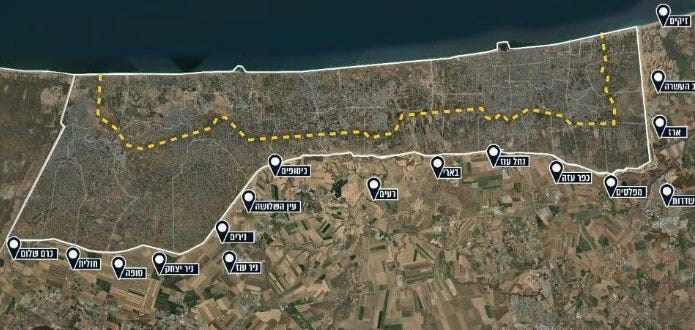
The current agreement offers a path to that- even if a complicated one. Israel now holds the “yellow line,” controlling about half the Strip. If it stays there, Hamas will adopt a new identity: an organization fighting to “liberate the plundered land of Gaza,” akin to Hezbollah and the security zone. If the IDF withdraws, control is supposed to pass to a multinational force-the ISF-whose composition is unclear; in any case, it is doubtful its members will confront Hamas. Netanyahu promised neither Hamas nor (Mahmoud) Abbas, meaning the PA; in Gaza right now, there is mostly Hamas - and a few drops of Abbas.
Yet President Trump’s continued pressure for the return of the fallen and for Hamas’s disarmament is crucial. The countries financing Gaza’s reconstruction have a vital interest in ensuring Hamas does not rearm or return to “the path of resistance.” Otherwise, another clash with Israel will follow - and their entire investment will be lost. Hamas’s repression of its opponents is possible only because it precedes the appointment of Gaza’s technocratic government and the ISF’s deployment.
And most importantly: America is serious. It has demonstrated that by establishing a command center with some 200 American troops, led by a three-star general. The importance of this step cannot be overstated. In Lebanon, only a few dozen U.S. soldiers oversee the ceasefire and Hezbollah’s disarmament in the south- and the strategic impact is immense. No one wants to mess with the Americans. There is a foundation for change, and a measure of hope - much of it, at this stage, coming from Washington.