

They Believe Israel Can Be Destroyed
Herzog’s visit to Australia was more successful than it appeared. Yet it revealed something deeper: the strength of the movement to destroy Israel lies in its belief that it can succeed

“I hope you’re well,” I wrote to President Herzog on WhatsApp (yes, everyone in Israel is on WhatsApp), “I have friends in Australia who are worried about this visit and about your safety.”
The president answered me: “We are in the ditches and we are fighting. The people of eternity (Am HaNetzach), are not afraid. This is an important visit.”
Indeed, to many watching the Israeli president’s visit to Australia, which concluded a few days ago, it appeared to be a public diplomacy battle fought in the trenches. Images of massive demonstrations created a sense of imminent violence — all the more intimidating given that only a couple months earlier, Australia’s Jewish community had endured its worst antisemitic attack: the massacre on Bondi Beach.

The demonstrations featured repeated calls to “globalize the intifada.” Even before Herzog’s visit, protesters circulated images depicting him as Hitler. Given what we already know about the radical fringes of anti-Israel activism in Australia — and at a moment when the country is still reeling from a devastating antisemitic attack — it was difficult to escape the impression that little has been learned.
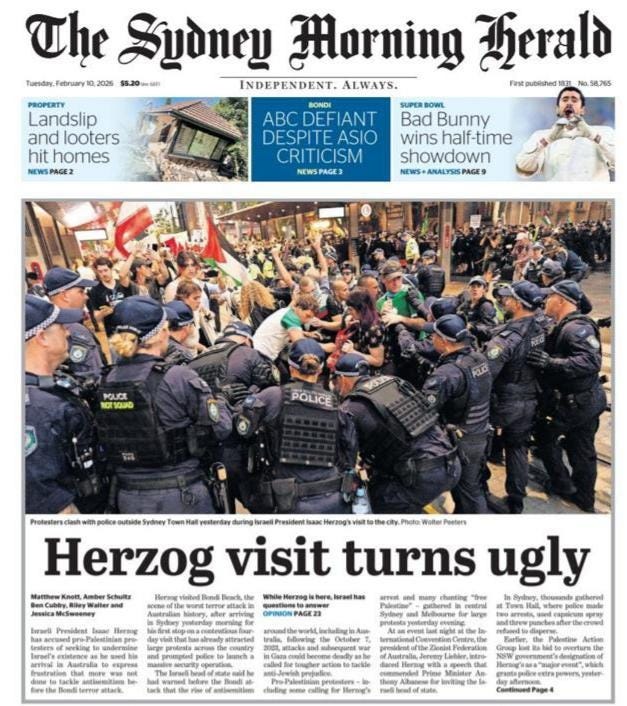
Yet it may be too early to draw that conclusion. I spoke with the President himself, members of his staff, and several people in Australia to better understand what unfolded during the visit. What I heard offers a different picture.
The President’s close advisers believe they were received respectfully by the Australian government, even as they did not soften their criticism of the government’s failure to adequately defend the Jewish community. They sensed an effort to listen, to express solidarity, to draw lessons — and, crucially, to act in defense of the community.
Many Australian Jews hold Prime Minister Albanese responsible for the chain of events that culminated in the Bondi Beach massacre. The Israeli president did not enter into that debate directly. His aides remarked to me repeatedly that the government — and the Prime Minister personally — engaged with Herzog across multiple events. From the Israeli vantage point, there was a clear sense that the government understands the gravity of this moment for Australia’s Jewish community, recognizes that more must be done, and received the delegation with seriousness and respect. The Israelis also said that the police substantially limited the escalation of the protests, confronting demonstrators when necessary. Overall, Herzog views the visit as more successful than many anticipated.
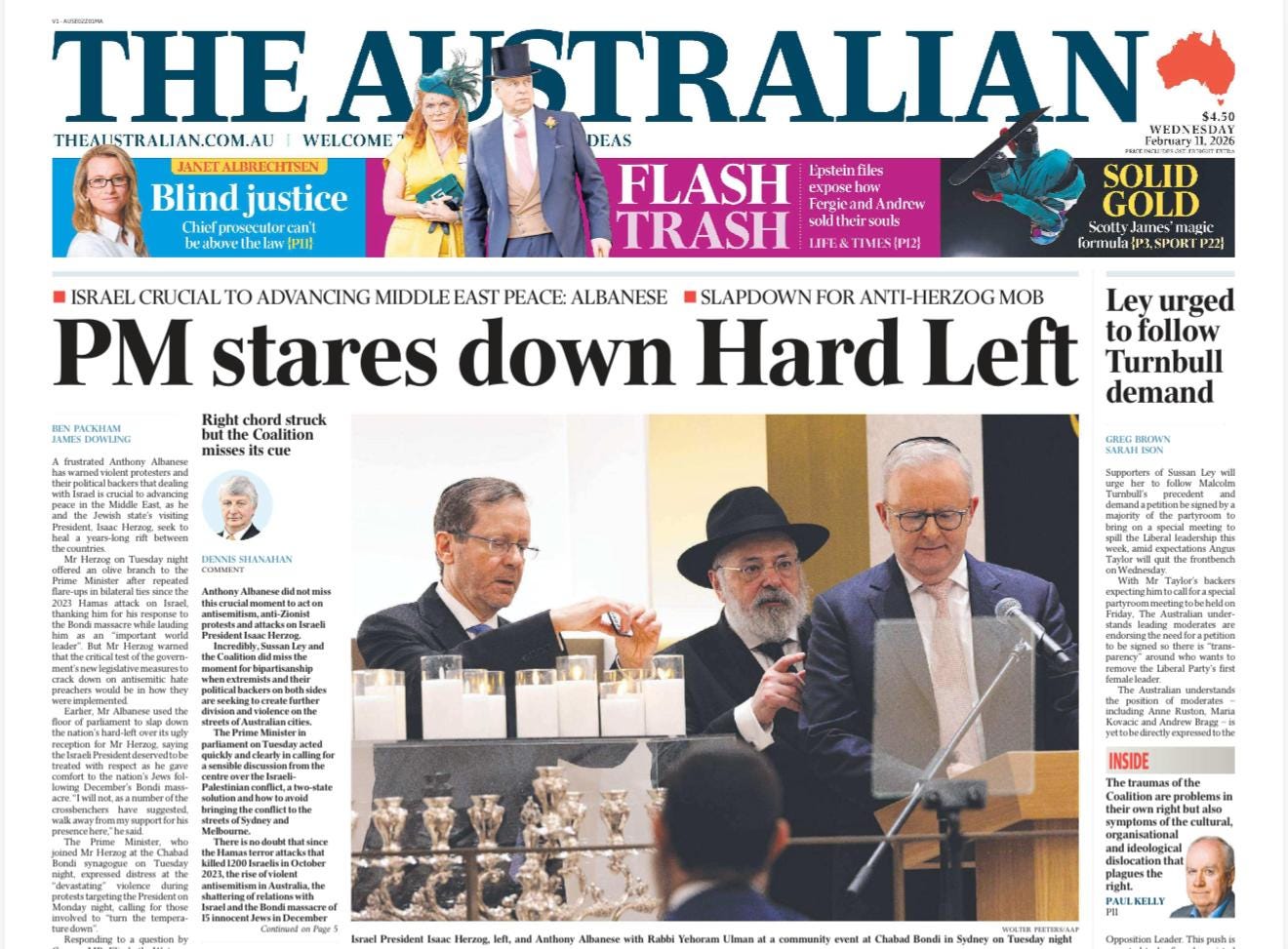
I spoke with Paul Rubinstein, the chairman of the Australia-Israel and Jewish Affairs Council (IAJAC). “I thought it was a very successful visit. It gave a lot of comfort to the Jewish community and gave everyone a real shot in the arm,” he said. Regarding Australia-Israel relations, he said it was ‘a start’. He also added: “Even though the spectacle of so many people protesting was unsavory, I think the pro-Palestinian protester hate movement took a real hit and looked bad with the stunts they pulled….“I’m not saying the demonstrations weren’t bad. They were. It was unpleasant. And also the left-wing media had a field day. But what felt different is that this is the first time the protesters didn’t get their way. The police answered back at them, and there were calls in many quarters for them to stop. And I think what happened is that a lot of people, especially post-Bondi, have just had enough.”
Writing as a journalist — acknowledging our familiar shortcomings — here is one obvious conclusion: we chase the anomaly, and social networks amplify that instinct. Protests and clashes with police draw far more attention than a president sitting quietly with grieving families. The anti-Israel radicals sought to project an image of Herzog as wholly rejected in Australia. From what I see and hear, that simply was not the case.
My second conclusion is more somber.
Watching these demonstrations — not only the marching, but the slogans calling for Israel’s collapse and for the “globalization” of what is framed as resistance — this visit underscored something about what we have been witnessing worldwide since October 8, 2023.
It goes by many names. Some describe it as antisemitism re-branded as extreme anti-Israel activism, with the war in Gaza serving as cover. Others call it anti-Zionism, now seen by many as a hate movement. The taxonomy is worth examining, but I prefer a more descriptive definition — one grounded in the open demands of these activists and the intellectual environments that sustain them.
What we are seeing is a grassroots global movement fueled by a single objective: the elimination of the Jewish state. It’s the movement to destroy Israel, and it’s a grassroots movement.
They are disciplined, single-minded, and driven by an ideological passion. Even when 15 Australians are murdered on Bondi Beach — in a country where such violence has long seemed unthinkable — they do not pause. The movement does not recalibrate. It continues.
We can debate labels. Calling it anti-Zionism may be convenient, but it risks granting coherence where there is little. Many of those chanting have no serious interest in Zionism’s history, in the Jewish people’s connection to the land, or in the intellectual arguments they claim to oppose. Their objective is more simple; They want Israel gone.
Some of the activists will provide the public pressure that pushes elected officials in that direction. Some will travel, organize. A minority will become violent. The through line is constant: the existence of Israel itself is, in their eyes, intolerable — and thus legitimizes violence.
The global movement to destroy Israel did not emerge overnight. Its seeds were planted decades ago. Many of the arguments heard today echoed in the rhetoric of Arab leaders after 1948 — in some cases, before — and resurfaced in the 1960s among regimes aligned with the Soviet Union.
On Western campuses, a heavily post-Marxist framework recast Israel as a colonial project: an instrument of repression, dispossession against an indigenous population. That narrative gained intellectual currency and an institutional space.
Yet the campaign was never confined to the left. It also found fertile ground on the far right. I once interviewed German neo-Nazis who blamed Israel — and me personally — for expelling Palestinians from their land. The ideological language differed; the esssence did not.
What makes this movement distinct is not simply its intensity, but its horizon.
There are activists who call for boycotts of China over Tibet, for example. Yet few among them advocate the dissolution of China as a state, and fewer still believe such an outcome is plausible. The demand remains limited.
With Israel, it is different. A central driver of this movement is the belief that Israel’s destruction is not only desirable, but attainable. Without that sense of possibility, the call would sound fantastical: a Don Quixote–like campaign for the dismantling of Germany, France, or Switzerland. It is precisely the conviction that it can be done that gives the movement its energy. And why do they keep alive the hope of Israel’s demise? Because the conflict goes on, and actors across the region — from Iran to Hamas — continue to advance that aim. What might otherwise remain an abstract ideological position becomes concrete: just another war, another incursion, another boycott. They feel they are close.
Naturally, a major part of this energy draws from a conflict, one that predates 1948. Israel has been a sovereign state since its founding; the Palestinians who rejected partition did not establish one of their own. The unresolved conflict — and the suffering it has produced — is an undeniable driver of the hostility directed at Israel. It is not the only reason, but it is a central one.
The movement to destroy Israel is grassroots in character. I have reported myself on foreign-backed efforts to lead antisemitism and anti-Israel narratives. Still, we should confront the hard facts. The war in Gaza has resulted in the deaths of many innocent people and immense suffering. Those images and realities have echoed around the world, strengthening an intellectual, political, and on-the-ground campaign. Israel’s political leadership made terrible mistakes during the war. Those mistakes should not be downplayed.
Stating this is not to diminish Hamas’s moral responsibility for initiating the war. It is to acknowledge the real politik conditions in which this movement has gained traction.
Zionism itself was a grassroots movement. The idea that the Jewish people should have a state of their own in Eretz Yisrael began as a civic cause, sustained by intellectuals, organizers, and political leaders across the West and beyond. Zionists understood, from the outset, the power of public opinion — the capacity of organized citizens to pressure decision-makers and reshape political reality.
Watching the demonstrations in Australia — and the persistence of calls not merely to criticize Israel but to dismantle it — alongside the clear deterioration of Israel’s global standing, leads to a practical conclusion: Israel needs a strategic plan to confront delegitimization worldwide.
Militarily, Israel cannot be erased. The IDF has demonstrated overwhelming regional superiority since the war begun. While Israel must ensure that catastrophic failures like October 7 never recur, military strength alone is insufficient. A state cannot secure its future by force alone.
Anti-Israel sentiment across parts of the West — including among segments of younger Americans — is no longer marginal. The Israeli government should already have allocated substantial resources and convened serious strategic deliberations on this front. As far as I know, no serious, structured process has begun — unsurprisingly, I should add.
There are internal strategic challenges for Israel — conscription, education, labor participation, racism — that Israelis themselves see as existential. But in the realm of foreign policy and national security, the central danger is not only Iran. It is the spread of an idea: that Israel’s very existence is illegitimate. That idea has moved from radical fringes toward parts of the mainstream. Fighting it demands strategy, planning, and resources.
To treat this as a hasbara problem is both shallow and dangrous. Public relations assumes the policy is great and only the messaging needs improvement. History suggests otherwise. The early Zionist movement understood that survival required compromise and constant change of policies and positions. The maximalist claim to Eretz Israel, including Transjordan, was largely set aside in the 1920s to secure political viability. Pragmatism, including attentiveness to global opinion, were central to Zionism’s success.
The images from Australia underscore the the fierce urgency of now, to quote Martin Luther King Jr., a steadfast supporter of Israel. The primary responsibility to address this challenge rests with Israel itself.
I’m surprised that you see this activism as grassroots. Clearly, the ground was prepared for this movement by years of Qatari and left wing ideology in academia and media.
They had the slogans, posters and plans in place by October 8, one day after the massacre started — while Israel was still driving terrorists out of the country. That’s not grassroots. That’s an organised, well-funded campaign.
What many Australians don’t know how to articulate right now is the understanding that a very dangerous transnational movement is flourishing in their tolerant country right now. This movement was the true motive of Hamas all along, to instigate a war designed to advance the global alliance of leftists and Islamists, to recreate the movement that tore down Iran 47 years ago. Today what the open west has on its hands is full-blown Neo-Jihadism.
Israel needs to be world leaders against the Neo-Jihadist movement exploding across the western left.
https://open.substack.com/pub/thegoldenpill/p/the-common-bonds-of-leftists-and?r=31tulb&utm_medium=ios