

The Mob at the Door
The campaign against Lucy Aharish and other journalists reveals how intimidation, racism, and the erosion of civic norms may define Israel’s next election cycle

The most important political story in Israel over the past two weeks — and the one most representative of the currents now at work beneath the surface of Israeli society — has nothing to do with Iran. Not with the state budget. Not with the visit of India’s Prime Minister Narendra Modi. Not even with Gaza.
It is about an award-winning journalist, a television anchor. Her name is Lucy Aharish.
What is happening to Aharish offers a glimpse into the ugliness that may define the months ahead, as the country moves toward elections that will be held, at the latest, in October (in Israel’s parliamentary system, there is always a possibility of early elections).
Who is Lucy Aharish
Ahrish is an anchor on Channel 13; a veteran journalist. She is an Arab Muslim who was educated largely in Hebrew-speaking schools. In international press, she is often described as the first Arab Muslim to present the news on mainstream, Hebrew-language Israeli television. Aharish is eloquent, opinionated and informed, widely recognized for embodying Jewish-Arab shared existence as much as any public figure in Israel.
Indeed, 11 years ago, during one of Benjamin Netanyahu’s terms as prime minister, Aharish was selected for one of Israel’s most distinguished civic honors — lighting a torch at the official Independence Day ceremony. Apart from the Israel Prize, there is no higher symbolic recognition by the state to a citizen. In the presence of the president, the government, the prime minister, and the Knesset, she lit one of the twelve torches — symbolizing the twelve tribes of ancient Israel — thereby opening the national celebration. She declared that she was lighting it as a Muslim and an Arab woman, and concluded, as every torch-lighter does, with the ceremonial words: “For the glory of the State of Israel.”
Aharish is married to Tzachi Halevi, a well-known Israeli actor best known for his role in Fauda. He is Jewish, and they have a child together. Since October 7th, her husband (50) has served hundreds of days in reserve duty in an elite unit, spending some of this time in Gaza. On October 7th itself, Halevy drove south immediately, without waiting for formal orders, to assist in the fighting against Hamas terrorists.
At the same time, Aharish — like many other Israeli journalists — was receiving desperate messages from families trapped in their homes under siege around the southern border. She directed her husband and others to specific locations where civilians were stranded. In recent days, families have publicly credited her with helping save their lives.
Throughout the years, Aharish has spoken clearly in favor of shared existence and against racism toward Arabs inside Israel. She has been vocal and unequivocal in condemning strands of Jewish supremacy. At the same time, she has firmly rejected the claim that Israel is an apartheid state. Look at this part of an interview she gave to Bari Weiss during the war:
When Racism Comes to the Front Door
Up until now, this should have been a story celebrated by the State of Israel.
Instead, that story has collided with darker currents — racism mixed with an attempt to intimidate journalists and narrow the boundaries of free speech under Israel’s most far-right government to date.
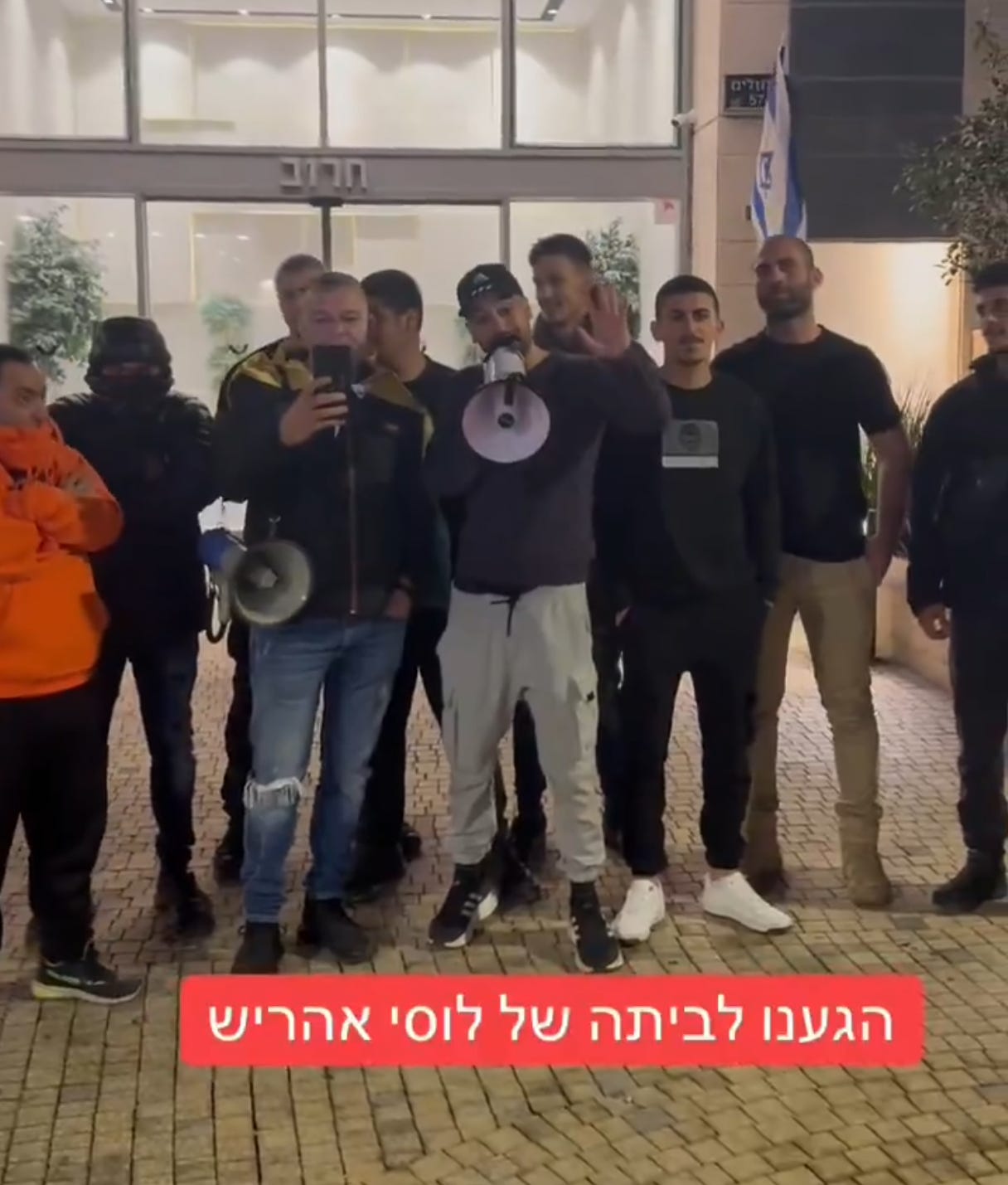
This week marked the fourth time that a far-right small mob gathered outside Aharish’s home. They intimidated her, frightened her five-year-old child, shouted abuse in the street, and confronted neighbors. The police stood nearby, mainly watching. And while the last event was in the street, a few days earlier the mob actually entered the building, went up to her floor, and stood directly across from her door.
Among the chants last night were, “Arabs are sons of bitches; Jews have souls,” and speeches directed toward her five-year-old son: “Adam Halevi Aharish, do you know you’re an Arab? Did your mother teach you to say inshallah?” You get the idea. It was targeted, racist hatred.
See for yourself:
The specific reference to inshallah — “God willing” in Arabic — stems from a viral video in which Aharish expressed hope that Arab voters would help bring about the defeat of the current coalition, adding the phrase at the end.
For Jewish supremacists, Aharish is intolerable. She is successful, married to a highly accomplished Israeli Jewish actor who has served extensively in the war, and they have a child together. She wears her identity openly and fights racism without apology.
A Campaign of Intimidation Against Journalists
The attacks on Aharish are part of a broader phenomenon led by a figure who has become a cultural hero for large segments of the Israeli right — not only its far-right fringe: Mordechai David. David began as a TikTok phenomenon and is now expanding rapidly. He has a history: he has been convicted twice of criminal offenses, the most serious during riots in the Haredi city of Bnei Brak against COVID restrictions, when he was accused of lighting a public bus on fire, which in turn led to a larger fire. He was sentenced to imprisonment, which he served through community service.
In 2022, David drew further publicity when he entered the crocodile enclosure at the Israel Safari in Ramat Gan and provoked the animals. He later explained that he was bored. He was serving his community service there.
His transformation into someone who films videos alongside Israel’s justice and police ministers (see screenshot below) stems from the fact that David began harassing, tailing, and blocking the vehicles of activists and journalists considered critical of the government.

Together with others, he obstructed the cars and harassed the senior legal correspondents of two of Israel’s leading television channels. He films these confrontations and uploads the footage in real time. It was David who initiated the demonstrations outside Lucy Aharish’s home; this is his campaign. He presents these actions as legitimate demonstrations — even as a kind of parody — and argues that they are therefore legal.
His power derives from hundreds of thousands of followers on social media and, as a result, from an NGO he has now founded called “Brothers in Justice” (a sarcastic play on “Brothers in Arms,” the left-wing group of IDF veterans known for protesting the judicial overhaul in 2023). According to media reports, he collects a salary from this association. In other words, this is now his day job.
In another incident last month, David blocked the car of 89-year-old former Supreme Court President Aharon Barak. Barak, a Holocaust survivor who has not held an official position for many years, was called “Khamenei” (the Iranian Ayatollah who founded the Islamic Republic) and a “dictator” by David, who prevented his vehicle from moving out of the parking lot. Justice Barak is seen by the Israeli Right as an archenemy because of the “judicial revolution” he led three decades ago. He filed a police complaint.
The Israeli police, however, are currently under the authority of National Security Minister Itamar Ben-Gvir, a disciple of Rabbi Meir Kahane and a man with multiple criminal convictions himself. Actually, it was Ben Gvir who invited David to his office in the Knesset back in 2024 (he was already the minister responsible for the police). In the various incidents, officers have treated David with notable courtesy. Israeli courts have issued multiple short-term restraining and no-contact orders against David.
David’s harassment (he will argue - legitimate protest) is almost always directed at private individuals — not elected politicians opposed to Netanyahu, but rather journalists or political activists. These activities are popular on the Israeli Right because they are perceived as a justified act of retaliation for years of intensive public protest against Netanyahu’s governments.
The argument goes that just as demonstrators blocked roads, or prevented Sara Netanyahu from leaving her hair salon, or as there were incidents (not organized, it should be noted — unlike David’s actions) of harassment against media figures supportive of Netanyahu — the same thing is now happening to the other side. According to his supporters, the “elite, privileged Left” is now getting a taste of its own medicine. His actions are often presented as a kind of parody — a “boomerang,” as some on the Right call it.
It has reached the point that David is now a sought-after and admired interviewee, particularly on the television channel identified with the current government, Channel 14, with anchors calling him “incredible.”
The Unraveling of Israeli Civility
The comparison, of course, is inapt.
First, for better or for worse, protests in Israel are often characterized by road blockages — and the first to adopt this tactic were right-wingers opposing the Oslo Accords in the 1990s. Ultra-Orthodox groups have blocked roads and are still doing so to protest conscription. Disability rights organizations have blocked roads. There is a difference between such actions carried out as part of a general public demonstration and targeted personal harassment against individuals.
Second, protests outside homes are typically directed against decision-makers — members of Knesset and ministers, politicians accustomed to such pressure. But this has been the convention shared across Israel’s political spectrum; Likud itself employed it in efforts to bring down the previous government.
To be sure, there were notable instances of harassment during the judicial overhaul protests. In one case, for example, a demonstrator smashed the rear window of a car carrying children that was attempting to pass through a blocked road. But such incidents were almost never premeditated actions against private individuals, and they were widely condemned, not celebrated. No one became a hero because of them.
What we are seeing in the case of Mordechai David and his underlings, then, are not actually “protests” in the typical Israeli sense, but focused acts of intimidation and harassment that receive wide support online and by the coalition.
Then there is the fact that Aharish is a journalist.
Israel’s media landscape is already under significant strain. There are roughly nine million Hebrew speakers worldwide, and like much of the world, Israel’s media market relies primarily on advertising. But giants such as Meta and Google have effectively cannibalized that market, and most news organizations are fighting for survival.
Israeli journalism remains vibrant and highly active, producing remarkable reporting on everything from public corruption to intelligence failures during wartime. At the same time, however, it is steadily shrinking.
The government has recently advanced legislation that commercial broadcasters say constitutes direct and improper interference in their independence. The prime minister — along with several of his ministers — is boycotting any outlet other than Channel 14, which is identified with the government.
Israel is a small country. I have been a journalist for more than twenty-five years, covering many dramatic events, and my views have long been well known. Israelis, despite their directness and bluntness, traditionally showed a basic respect toward journalists — and even toward people with whom they disagreed — even in the most heated circumstances. I reported on numerous terrorist attacks, diplomatic initiatives, election campaigns, and the evacuation of settlements. I never received threats at those events.
In recent years, with the rise of what former Prime Minister Naftali Bennett has called the “poison machine” — an organized attempt of marking and targeting rivals of the Likud (who are often not politicians but journalists) — something has shifted in Israeli public discourse (Bennett condemned the intimidation of Aharish as “a dangerous crossing of a red line”).
There is little doubt that the judicial overhaul intensified this dynamic; many Israelis sincerely believed, and still believe, that the proposed laws would have effectively ended Israeli democracy — an idea comparable, in American terms, to abolishing the Constitution in favor of a one-branch, simple-majority-vote system with no checks and balances. That is why they protested as they never had before.
In any case, journalists — myself included — are now experiencing far more verbal abuse and threats of physical harm. Mordechai David and his group represent a new escalation: now they come to journalists’ homes — in this case, to the home of an Arab journalist.
Her “crime,” according to David, is that Aharish hosted left-wing activist Sigal Shukrun, who campaigns against the actions of extremist settlers in the West Bank. The logic being promoted is simple and dangerous: if a journalist gives a platform to someone who confronts settlers, then that journalist is now fair game for personal harassment. The basic civility of Israeli society, the quality that has helped prevent severe violence despite deep internal disagreements, is eroding.
After one of the incidents, in which 15 men stood with megaphones in the hallway of her building outside her apartment door, Lucy Aharish publicly blamed Prime Minister Netanyahu for the atmosphere that enables such harassment. She said the Prime Minister “doesn’t see, doesn’t hear, doesn’t know what’s going on under his nose — doesn’t know what he himself wrought by his own hands, with his words and with his silence.” She added, “until you call off your goons… you are the leader of this mob.”
She also described her child trying to calm her down during the chaos: “Should my five-year-old child need to calm his mother down?” she asked. “There is no forgiveness for what my child went through yesterday.”
All of this reminds me of the pro-Hamas group from Code Pink that “protested” outside Jake Tapper’s house in the United States because they disliked his coverage of the war in Gaza. On the surface, these scenes look unrelated — far-right Israelis on one side, pro-Palestinian activists in America on the other. But there is a throughline connecting them.
That line is the collapse of civility. The erosion of shared rules about what is legitimate and what is off limits, combined with a mob mentality and extremism. Worsened by some in power who wink and nod at the extremists, because they believe they can harness and control the energy of the mob for personal political gain at the expense of the country.
It is all but certain that the elevation of a convicted felon into a recurring media persona — someone treated with respect by broadcasters — signals something about the coming election campaign. Will this style of politics — the normalization of personal viciousness — define 2026? The unfortunate answer is a resounding yes.
This is a blot on all of us. A shanda. We must collectively denounce these racists in the strongest possible terms. They ought to have no place in a liberal, democratic Israel. I fear that's changing.
I agree that individuals should not be harassed in their homes. That’s crossing a red line. But the left is no better than the right, the poison that has been poured out about the so called settlers is unreal. That also should be a red line.
These stories should be investigated thoroughly before jumping on the settler deformation bandwagon. The so called settlers in Judea and Samaria are living on Jewish land. Why are they called settlers?
Many so called settler criminalities have been found to be false accusations by Palestinians. They were the culprits of the crimes, than turning it round and pointing their fingers at the „settlers“.
Israel is a miracle. Is it any wonder that there are differences in Israel, with a diverse population in a very small country? Israel is a mini United Nations with Jews from every corner of the world living together with other ethnic groups and different faiths.
In today’s world Justice and Truth have been devalued to Personal feelings and adopted Ideologies. Only a return to the G-D of Israel, who is Truth and Justice, can fix this decline of morality.