

The Numbers Behind Israel’s Brain Drain
Fresh data from Tel Aviv University economists show a sharp rise in departures among doctors, engineers and young graduates

In a globalized world, migration is part of life - particularly for people with skills and high earnings. In Norway, more than 40% of the physicians were educated abroad. In Britain, it is roughly a third. President Trump has, in recent weeks, explained to the American public the need for work visas for people with special abilities (the H-1B visa).
“We have to bring talent in,” the president told Laura Ingraham in Fox News. “You have plenty of talent here,” she replied. Here is Trump’s rational, economic answer:
“No, you don’t. No, you don’t. … You don’t have certain skills, and people have to go to school. You can’t take people out of the unemployment line and say, ‘I’m going to make you into a missile manufacturer.’ … It doesn’t work that way.”
These are significant words from the American president who ran two campaigns on immigratiin issues, and they clarify an important nuance: today, countries reject migrants who lack high earning potential while opening their arms to skilled and well-established migrants. This is precisely why governments in Central and Southern Europe- from Greece to Romania, Italy, Serbia, Portugal, and more- see negative migration as a strategic threat. In their case, the combination of talented young people emigrating and natural fertility, birthss, decreasing is lethal. In Israel, the natural growth rate (again, births) is the highest among industrialized countries. But outward migration is rising, and the trend is clear.
Here are the data from the Knesset Research and Information Center report from last month:
“During 2022–2023 there was a surge in the number of Israelis leaving for the long term. In 2022, 59,400 Israelis left—an increase of 44% from the previous year; in 2023, 82,800 Israelis left—an increase of 39% from the previous year. In October 2023 there was a pronounced increase in departures… The increase in the number of departures continued into 2024, with the number of people leaving from January to August 2024 similar to the parallel months of 2023… The number of Israelis returning after a long stay abroad in 2023 (24,200) was lower than in 2022 (29,600), a trend that continued in 2024…”.
In other words, there is a substantial emigration of Israelis, and a weakening in the return of Israelis who left. The Knesset research center added that in the overall migration balance, Israel is still growing- thanks to new immigrants, naturalizations, and family reunifications. This raises important questions: who is leaving?
On this last point, three economists at Tel Aviv University have intervened: Prof. Itai Atar of the School of Management; Prof. Nittai Bergman, head of the School of Economics; and Doron Zamir, a doctoral student in the School of Management.
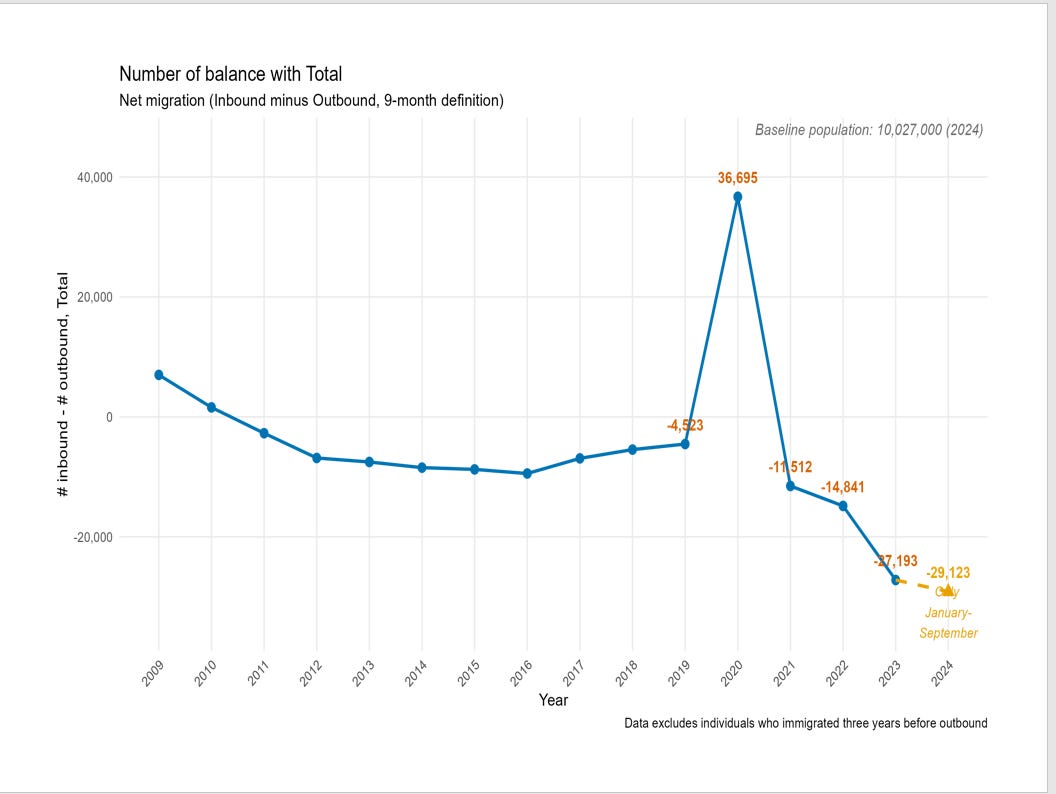
They cross-referenced data from the Central Bureau of Statistics, the Population and Immigration Authority, and the Tax Authority, and adjusted the data so that tens of thousands of arrivals from Ukraine- many of whom soon returned because of the war- would not be mistakenly counted. Their adjustment “softens” Israel’s migration balance: while the CBS published that about 80,000 people left Israel in 2023, the economists calculate only about 50,000, because around thirty thousand were Ukrainian Jews who fled and then returned shortly afterward.
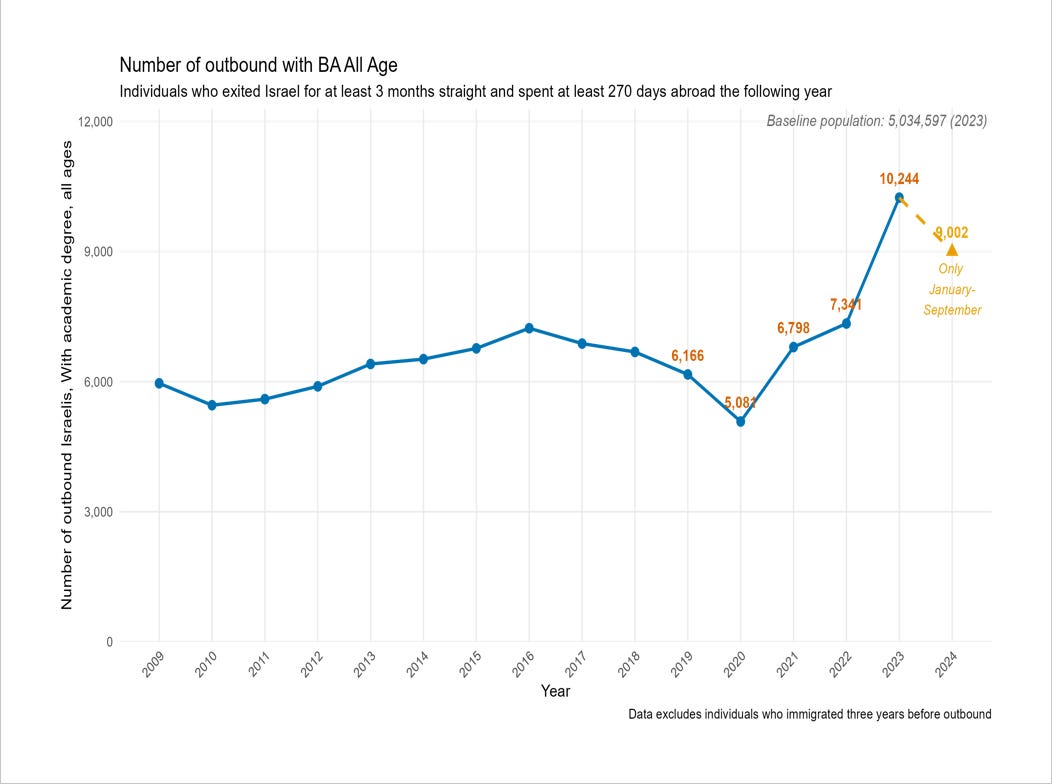
Their examination begins in 2009 and shows stability all the way until COVID, the judicial overhaul, and the war. And then Israel falls out of balance, out of equilibrium. According to them, “There is a significant and worrying increase in the number of Israelis who have left the country, with an emphasis on physicians, engineers, and people with high capabilities. It is imperative to reverse this trend before deep structural processes are set in motion, from which returning may be difficult- perhaps impossible.”
According to their report, between January 2023 and September 2024, 875 doctors left Israel (481 after netting out returnees/new immigrants), more than 19,000 bachelor’s-degree holders, including about 6,600 graduates in science and technology; more than 3,000 engineers (2,330 net of returnees). Three out of four who left are under 40—and this is a strengthening trend.
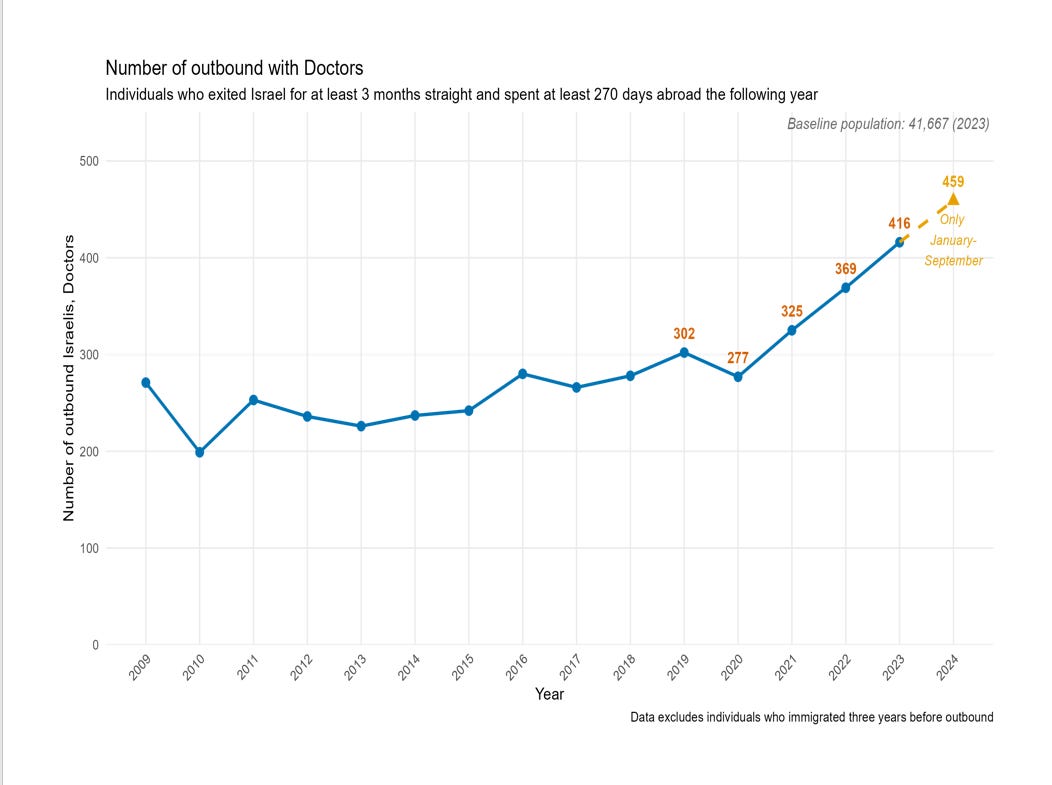
These trends echo the warnings of Prof. Dan Ben-David of Tel Aviv University, who has cautioned for years that Israel’s output and capabilities rest on a very small share of people with high abilities, and that damage to- or emigration from- this sector could trigger a catastrophic spiral.
Prof. Atar, who is also head of the Economists for Democracy Forum, says: “One can assess that the enormous gaps in sharing the national burden, the spiraling cost of living, and the fact that the government advances the interests of particular interest groups rather than those of the general population, are pushing more and more young people with education and good earning potential to leave Israel. In this sense, the assessment is strengthening that the upcoming elections will be fateful for determining the character and future of the State of Israel.”
As for elections: the only politician on the Israeli right who deals with the issue of emigration from Israel is Naftali Bennett. Bennett has repeatedly urged young Israelis not to leave the country.
In a more responsible, alternative reality, PM Netanyahu would convene a series of government discussions on the matter and establish a ministerial committe to present startegies and quick incentives for remaining in, or returning to, Israel. At present, the coalition is focused mainly on incentives for the Ultra Orthodox parties to remain in the coalition.
For years, Israel’s ruling class, ans Netanyahu himself, ran an unrelenting campaign against “the elites.” But those same elites- doctors, researchers, academics, high-income earners, entrepreneurs, and cultural figures- are an essential precondition for the prosperous existence of any first-world economy. It was not merely rhetoric: budgets for civil infrastructure and universities eroded, while ever-growing resources were directed to short-term political needs that harm long-term growth.
When a society persists in denigrating its elites, and essential services such as education, policing and security erode - as exposed on October 7- those elites take the hint and, at times, simply leave. It is easy to find the elites of South and Central America in Miami; likewise, Serbia’s most talented engineers may no longer see their future in Belgrade. In a globalized world, many who depart will still return to the “old country” for holidays or family visits; some may even keep an apartment in Mexico City. But in practice, they have adopted a new homeland. And in such a world, the competition is global- for talent, and for the countries capable of attracting and retaining it.
Israel is not an open migration country and offers nothing to engineers, doctors, or researchers who are neither Jewish nor have family ties to Israeli citizens. At the same time, it is endangering its attractiveness for the very populations it seeks to keep within it.
In the end, a country that accustoms itself to fighting its elites may discover that they will not remain to fight for it. “We’ll manage without them,” angry commenters on Twitter, Facebook and Instagram will retort. But anger will not secure prosperity. The trend is still reversible- but only if policymakers choose to act.
This piece is based on my Friday column in Yediot, originally published in Hebrew.