

The Conceptzia Returns: How Israel Misreads Jewish Terror in the West Bank
Israel's Security data show a sharp rise in Jewish nationalist attacks, while political leaders look away

Once or twice a day - sometimes more - an alert sounds in the ‘Hilltop Youth’ Telegram channel.
The wording is almost always the same.
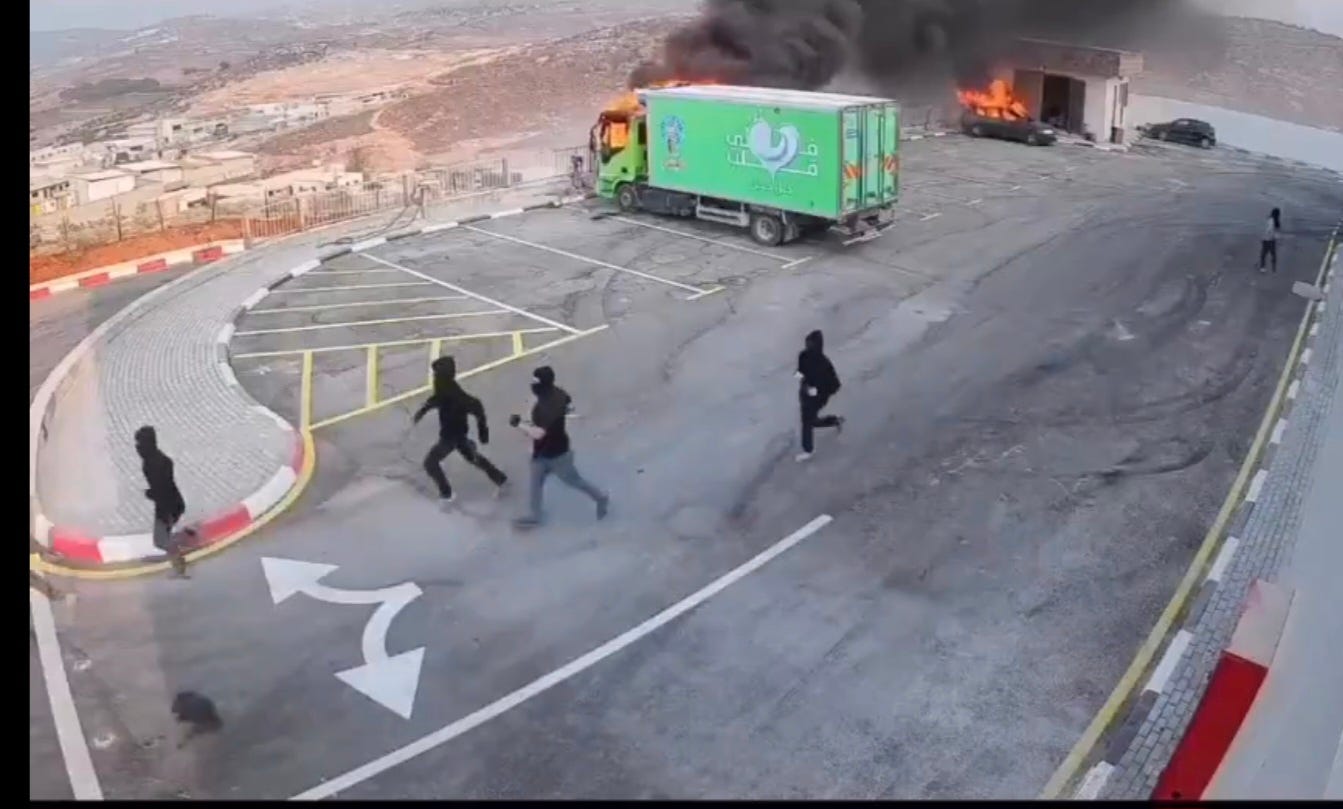
“Arabs report that Jews attacked the village of Raba, in the Jenin district,” accompanied by a photograph of masked men taken from Palestinian media.
A day earlier: “Arabs report that Jews attacked Arabs near Hebron,” or “Arabs report that Jews set fire to several vehicles in the village of Mukhamas, east of Ramallah,” with a video of burnt-out cars.
The asterisks do part of the work: attacked, set fire. And the repeated formulation “Arabs report” is there to avoid any implication of legal responsibility. It is only a report. From “Arabs.” From time to time the channel circulates messages of support for Far-right detainees who have been held for questioning and then released.
This week, one piece of footage managed to break into the national news cycle: dozens of masked Jewish men torching a factory, a sheep pen and trucks in the Palestinian industrial zone near Beit Lid and in the village of Deir Sharaf.
Yet as the ‘Hilltop Youth’ forums make clear, the attacks are a daily routine. They stretch from the Jenin area in the north down to Hebron.
Following this week’s mass arson, the Israel Defense Forces’ chief of staff Zamir condemned the incident - as did President Isaac Herzog. The US Secretary of State, Marco Rubio, said that “Certainly there’s some concern about events in the West Bank spilling over and creating an effect that could undermine what we’re doing in Gaza,”
Prime Minister Benjamin Netanyahu and Defence Minister Yoav Katz remained silent.
Few arenas display the dangers of the Israeli “conceptzia” - a deeply held strategic assumption, usually proved disastrously wrong - more clearly than the state’s treatment of far-right Jewish nationalist violence in Judea and Samaria.
The conceptzia has several layers.
One claims that the militants involved constitute “a hard core of only a few dozen.”
That is an odd statement; dozens participated in this week’s attack near Nablus alone.
Another layer dismisses them as “a welfare problem,” “the margins of the settlement movement.” But while most of the settler leadership in the West Bank condemns - and some abhor - this violence, the actions carried out by the ‘Hilltop Youth’ have acquired far greater legitimacy since 7 October.
After all, if every Palestinian village in the West Bank is framed as a staging ground for the next massacre - a view some settlement leaders express openly - then why would it not seem “natural” to forcibly drive away any Palestinian farmer “within line of sight of Jews”?
Particularly when the Shin Bet appears rather impotent, the police serve a far-right national security minister (who was convicted himseld numroues times), and the IDF hesitates in confronting extremist activists.
The core assumption of the conceptzia is that Palestinians are deterred and frightened by what happened in Gaza. That Palestinian society in the West Bank will not erupt in response to industrial zones set on fire, houses targeted with families inside, cars torched, and farmers assaulted.
Jewish fundamentalists follow Lenin’s dictum: “The worse, the better.”
In one scenario, Palestinians lose territory and foothold, are pushed into city centres, and any future Palestinian state is thwarted.
In the best case scenario for the far-right, Palestinians respond with violance - and experience a new Nakba in the West Bank. A divine opportunity.
The conceptzia does not really treat the Hilltop Youth as “terrorists.”
Their violence is framed as local: disputes over land, revenge operations.
“Graffiti and car-torchings,” a senior security official once told me, dismissively.
And what of strategic terror - blowing up a mosque with its worshippers, or attacking the Temple Mount?
Unlikely, security officials reply. They do not believe such a scenario is pluasible.
These are sentences we heard not long ago, in a very different context.
Smotrich and the Shock Doctrine
It is doubtful that Bezalel Smotrich has read Naomi Klein’s The Shock Doctrine, but he has certainly applied its method. Klein described how elites exploit moments of public panic to force through extreme changes that serve those in power; she focused on capitalism. In the West Bank, the power-holders are the aristocracy of the settlement movement.
Smotrich, alongside his political partner Orit Strock, used the trauma of 7 October and the national focus on Gaza to fundamentally reshape the reality in the West Bank - dramatically, and with minimal public scrutiny.
It began even earlier, with the coalition agreement granting Smotrich unprecedented authority in the West Bank. “Make no mistake, he is effectively the defence minister in the territories,” a senior official told me. “He has achieved a major victory there.”
But it is a solitary victory.
The messianic far-right’s fantasy - born on 7 October - of expelling Gaza’s population, establishing new settlements there, selling land and launching a “real-estate bonanza” (to quote Smotrich himself) has been blocked. The Trump administration curtailed those dreams; a few weeks ago the current president closed the door firmly on West Bank annexation.
The energy of the far right has now turned to reshaping - if necessary through violence - the reality in the West Bank.
The vision is explicit: prevent a Palestinian state at all costs.
The Numbers
The security establishment’s data are unequivocal and show a steep deterioration.
Since the start of the war, there have been 1,586 incidents of Jewish nationalist crime in the West Bank - an average of two per day.
There were 114 attacks by far-right Jewish activists against the IDF, Border Police and regular police, and 174 “Palestinian casualties” (as the security services classify them). The trend is worsening: a 20–25 per cent increase in incidents compared to 2024.
Some readers will object: what about Palestinian terrorism? Indeed , that remains the dominant source of violence in the West Bank - from stones and Molotov cocktails to deadly shootings.
The answer is that the IDF responds to this phenomenon forcefully, including the operations with destructive power in the refugee camps, the use of air power, and regular incursions into Palestinian city centers.
Jewish extremist violence disrupts the army’s operations - operations that are already aggressive. These are not private assessments but the view of the current Chief of Staff and all his predecessors.