

Benny Gantz’s Collapse, Netanyahu, and the Elusive Dream of Israel’s Political Center
How the politician who symbolized national unity fell from 43 projected Knesset seats to zero — and what it reveals about Israel’s political center and the election ahead. Plus, updates on Iran

First, Iran:
While today’s newsletter focuses mainly on domestic Israeli politics, Israel is tracking developments in Iran very closely.
Senior Israeli officials say that most of the protests and the uprising against Iran’s regime have now been suppressed “efficiently and brutally.”
Still, they believe that some form of U.S. action against the regime is being discussed at the White House. In Jerusalem, officials say the likelihood of such a move has “grown in recent days, not diminished.” What that move will be remains unclear. A question that repeatedly surfaces in policy and intelligence circles is whether there are contacts with factions inside Iran, or elements of the regime itself, ready to assume power.
Western intelligence agencies assess that, after a short period of stabilization, the regime is likely to launch a sweeping purge in Iran — including mass arrests and executions — and that hardliners who favor repression and deeper isolation from the world already see recent events as a vindication of their approach. The dominant assessment in Israel remains that change from within the regime is more likely than its outright collapse. President Donald Trump spoke to Politico during the weekend of the need for “new leadership in Iran,” and sharply attacked Supreme Leader Ali Khamenei. Iranian leadership has adopted an aggressive tone in response — with Iran's president warning that any strikes on Supreme Leader Ali Khamenei would lead to "all-out war".
From Israel’s perspective, a desirable outcome would be either the collapse of the regime or a profound transformation that deprioritizes “exporting the revolution” and direct threats to Israel. The second most desirable scenario is a weakened, fragmented Iran — preoccupied with internal power struggles and a failing economy, and with little bandwidth left for rearmament or regional proxies.
The scenario that most alarms Israeli officials is one in which the Supreme Leader loses his grip, but the regime merely reinvents itself cosmetically. A friendlier face masking a stronger, more entrenched, and better positioned regime equally committed to the destruction of Israel would be nothing more than “putting lipstick on a pig,” as one source put it. Such a regime could cloak its intentions and rebuild international alliances under the guise of “reform.”
A likely — and bleak — outcome of Iran’s uprising is a system that emerges even more repressive: more sealed off from the world, more totalitarian in its methods, and potentially emboldened by what it perceives as Western hesitation or restraint.
A reality check to this scenario: such a system may not be sustainable. Iran’s economy, its society, and the institutional foundations of the Islamic Republic itself are exhibiting deep and widening fractures. The system did not begin to fail because of the uprising; the uprising erupted because the system had already failed. The regime continues to sink — but this could be a long twilight, particularly if Khamenei remains alive and in control.
The Political Vanishing Act of Benny Gantz
At the end of November 2023, with Israelis reeling from the massacres of October 7th, Benny Gantz’s National Unity party polled at a sky-high 43 Knesset seats in the polls — by far the largest party on offer. Gantz, a former IDF Chief of Staff, joined an emergency government just four days after the Hamas attack together with his party members Gideon Sa’ar and Gadi Eisenkot.
With the sitting government facing the public’s wrath, Gantz was, according to every survey, the man poised to succeed Benjamin Netanyahu. He trounced Likud in projected mandates, as Likud was dramatically weakened; in the same poll, he also led Netanyahu in suitability for prime minister 52% to 27% (with 21% undecided).
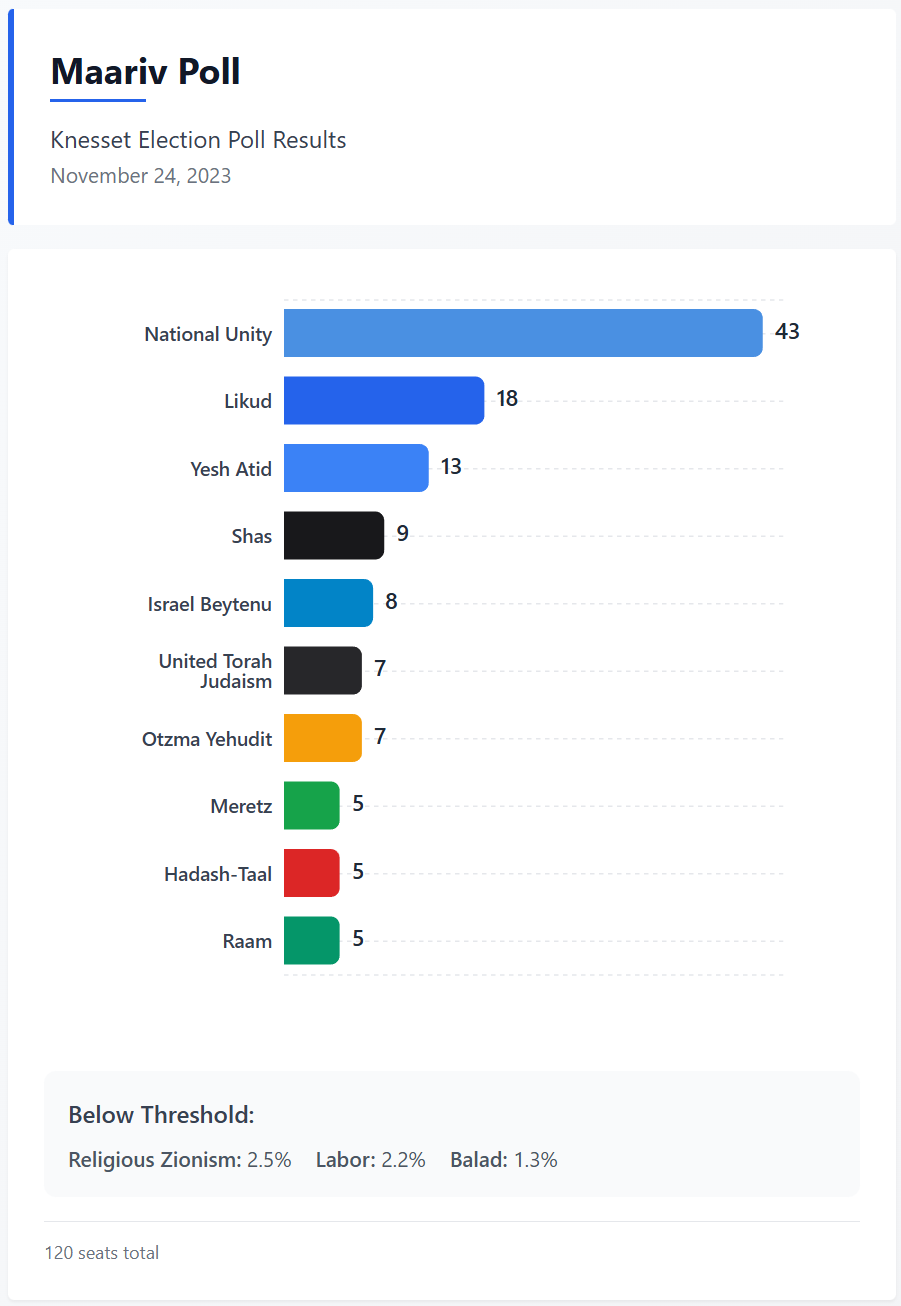
It was a stunning ascent for a party that holds only 12 Knesset seats. But with his security-focused messaging, his extensive defense credentials (Gantz led the IDF from 2011 to 2015), his willingness to join a Netanyahu-led government (allegedly putting country over political differences), and above all the catastrophic failure of Hamas’s invasion and the mass murder of Israelis — Gantz was catapulted to the head of Israeli politics. His victory in the polls only ended nine months later, in August 2024, when Netanyahu and the Likud finally clawed back his lead 22-20. Even then, Gantz would still have led the second-largest party.
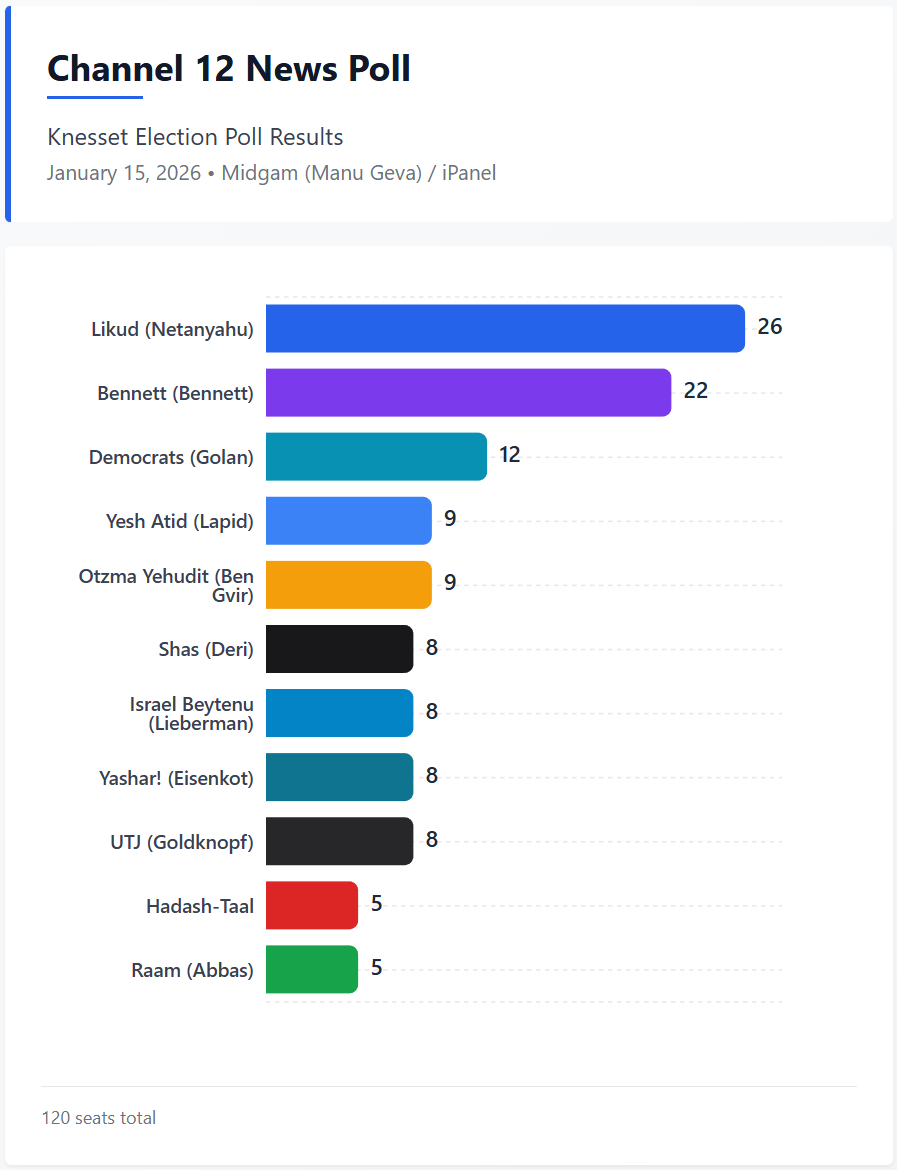
But in a classic twist of Israel politics, Benny Gantz is now circling the political drain, fighting to stay above the electoral threshold and win any Knesset seats at all in the upcoming 2026 elections. Gantz left Netanyahu’s government long ago in June 2024, after considerable public pressure. His partner Gideon Sa’ar decided to secede from the party and return, along with his small New Hope faction, to Likud. (Sa’ar now serves as Netanyahu’s foreign minister.) Gantz’s other key ally, former IDF Chief of Staff Gadi Eisenkot, has formed a party of his own, Yashar!. That party polls at a modest 6–8 seats — much better than Gantz.
In short, Gantz himself is currently seen as approaching the end of his political career.
The Gantz Rebrand
Last week, in an attempt to revive his fading political career, Gantz launched a new campaign: one that insists he not be counted as part of the center-left bloc he once led, pledges to try to replace Netanyahu but does not rule out sitting with him in government (signaling openness to a coalition with him), and, above all, adopts many of Likud and Netanyahu’s messages.
He adopted one notable Netanyahu-esque message: In one ad, a family is shown in a bomb shelter as air-raid sirens sound during an attack on Israel, while the news reports that the security cabinet cannot convene because Arab parties in the government oppose it. The doomsday ad — which suggested that parties representing Arab voters would be treacherous in the event of an attack on the country — drew harsh backlash from Gantz’s own camp (or former camp) for adopting Netanyahu-style anti-Arab messaging.
The Coalition Arithmetic
Where does the 2026 Knesset race sit today?
Here’s the most important coalition math: any partnership between Jewish and Arab parties threatens Netanyahu’s position. In almost all polls in the last 2 years (including four polls in just the last 3 days from Maariv, Channel 12, Israel Hayom, and Zman Israel), the current government loses to the opposition by roughly 69 to 51 out of the Knesset’s 120 seats.
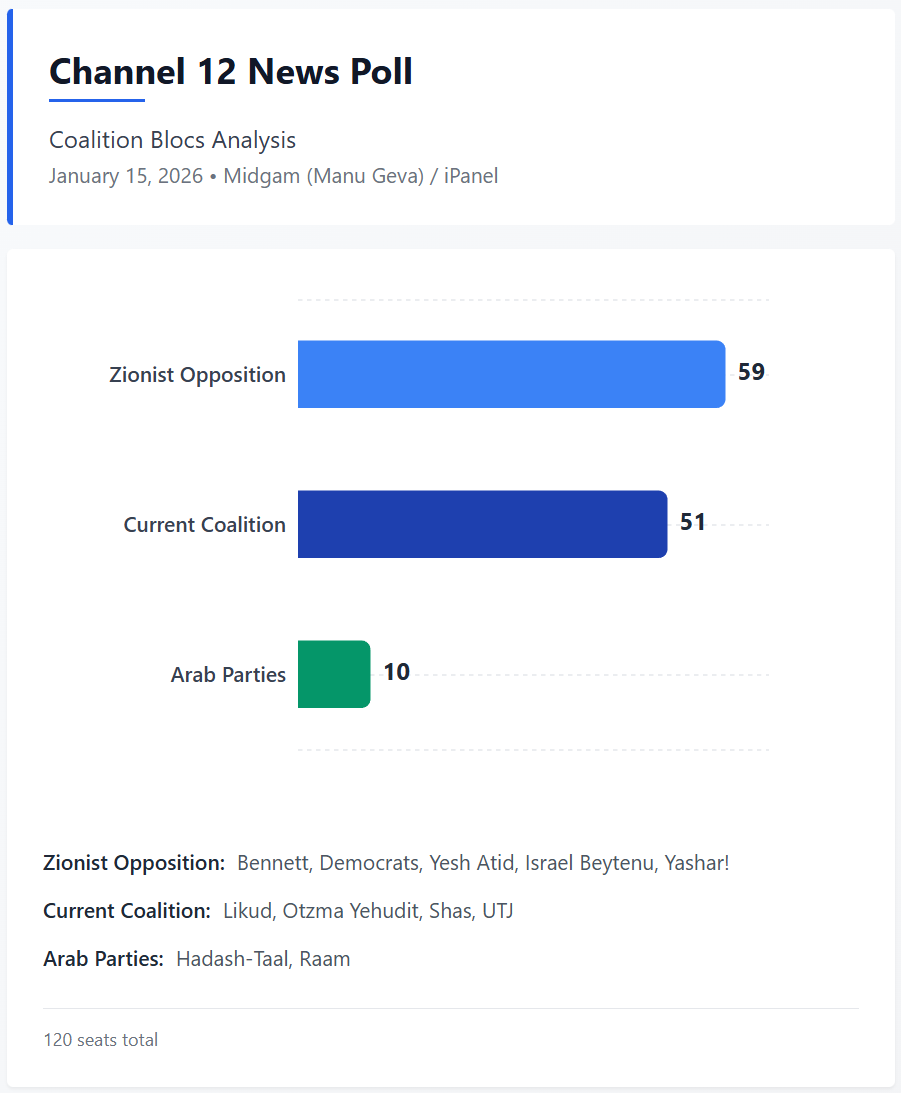
However, part of the opposition — around 10 seats — includes the Arab parties, which are non-Zionist. Consider the above poll reported this past Thursday. Unless the opposition is able to cut a deal with Likud, a Haredi party, or an Arab party, they will be stuck at 59, unable to form a coalition.
After October 7th, most of the Israeli public largely opposes having Arab parties in the next government, including the Ra’am party, which represents the Islamic Movement in Israel and is seen by much of the Jewish public as Muslim Brotherhood-affiliated. Ra’am is led by the remarkably moderate politician Mansour Abbas, with whom Netanyahu himself initiated coalition negotiations in 2022 (but who eventually joined the Bennett-Lapid government — the first time an Arab party joined a government in Israel's history). Abbas recently announced that his party plans to approve a decision to separate its institutions from the Islamic Movement.
Netanyahu’s political narrative is: if you don’t choose me, my opponents will form a government with Arab parties that would endanger your security and bring about another October 7. He seeks to publicly delegitimize any such coalition, thus improving his chances of holding on to power.
Here we return to Benny Gantz, who has now fallen in line with Netanyahu’s campaign strategy.
Besides that ad - which could have just as easily been produced by Likud - Gantz expressed regret in an interview last week for not joining Netanyahu’s government after the last elections (a government that at the time was already considered far-right). He even claimed, in a stunning statement, that “if we would have joined the government after the last elections, maybe October 7th would not have happened.”
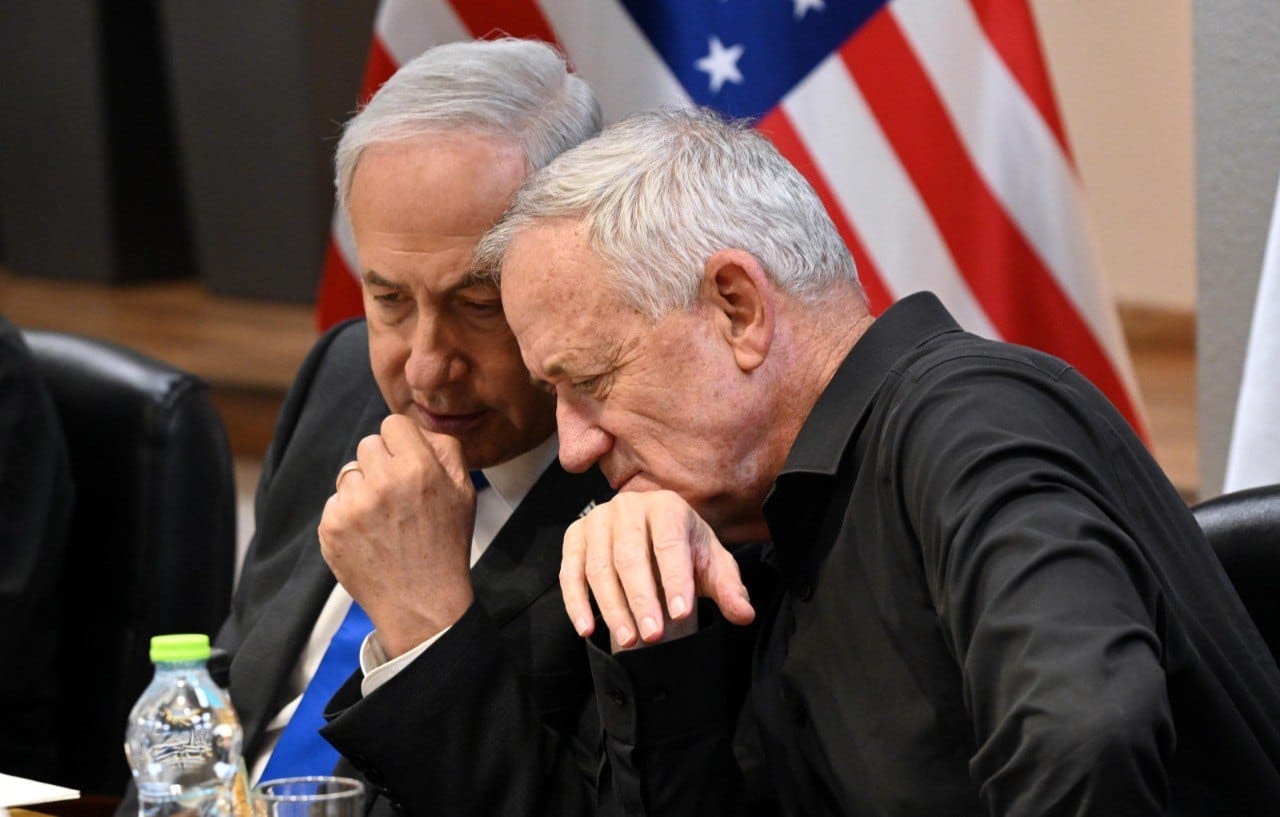
It’s an extraordinary quote — Netanyahu himself could not have phrased it any better. Gantz knows full well that after the elections Netanyahu had a natural, ideologically aligned right-wing coalition of Likud, the far right parties, and the ultra-Orthodox, and had no interest in compromising it by allying with Gantz’s party — which could have left at any moment and triggered elections. Netanyahu preferred the far right, because Ben-Gvir and Smotrich would pay a heavy political price if they brought down such a right wing government.
Gantz is trying to outflank Naftali Bennett and Avigdor Lieberman — who have also pledged not to form a government with Arab parties — by going a step further, and echoing Netanyahu’s campaign messages. This is an obvious attempt to court center-right voters in Israel who may dislike Netanyahu but are turned off by the left and its prevailing “anti-Bibi” sentiment.
In the latest Maariv poll, Gantz is fielding just 2.3% of the vote, below the electoral threshold. But in prior election cycles, he was polling poorly and succeeded in reinventing himself anew.
The Collapse of the Israeli Center
The story of Gantz’s collapse is, in essence, the story of the collapse of the Israeli center after October 7. Gantz symbolized — and still symbolizes — a persistent attempt to reach consensus and form a unity government. That was always his thing.
In his initial attempt, Gantz joined Netanyahu’s government during COVID (2020), and signed a rotation agreement with Netanyahu that was supposed to eventually grant him the premiership. That decision led to a rift in his Blue and White party, which ultimately fell apart. Netanyahu, the master of political machinations, then ensured that a state budget would not pass, which had been a condition for the rotation and Gantz becoming the Prime Minister. It was something Gantz never imagined Netanyahu would do: trigger a coalition crisis to stay in power and break their agreement.
Gantz was thus squeezed from both sides: his own camp preferred new elections over another Netanyahu term, yet he turned his back on them; meanwhile, Netanyahu broke the rotation agreement after Gantz joined his coalition. Gantz never became Prime Minister and was seen by parts of his own camp as a Netanyahu associate — or worse, a sucker.
(There is a famous story in Israeli politics about a right-wing politician who came to Prime Minister Yitzhak Shamir in 1990 after signing an agreement Shamir never intended to honor. “But what should I do with this agreement?” asked the politician, holding the agreement in hand. Shamir did not blink: “You can frame it and hang it on the wall,” he replied. Welcome to Israeli politics.)
In any case, after October 7th, a determination prevailed in Israel in favor of unity, and of not “going back to October 6th,” namely the widespread sense that the nation should not return to the judicial overhaul initiated by Netanyahu’s coalition, and the resulting protest movement, the largest and most intensive in the country’s history.
In the days after the massacres, Gantz was perceived as a responsible, centrist adult. That was the source of his impressive polling strength. Many on the Israeli left suspected Gantz of being a closeted Netanyahu ally, or maybe a rank opportunist at best. But this view of Gantz was pushed aside after October 7.
As time passed since Hamas’s invasion and the massacre, and the war dragged on, Israel’s domestic fights returned. This was no accident. The government, terrified of being held responsible in the immediate aftermath of the disaster, had halted the judicial overhaul at once. Back then, ministers feared the coalition would collapse under a torrent of public outrage. Bezalel Smotrich told his colleagues at the first government meeting after the Hamas invasion: “In 48 hours, they will call on us to resign over the failure - and they will be right.”
That sense eroded. The government resumed its pursuit of the judicial overhaul. The war itself, which began with wall-to-wall consensus, became highly controversial, as most Israelis believed the government was not prioritizing the return of the hostages (a view echoed by Defense Minister Yoav Gallant himself). Protests for the hostages replaced protests against the judicial overhaul in the streets.
A separate scandal emerged, known as “Qatargate.” Prime Minister Netanyahu’s closest aides, it turned out, were receiving funds from Qatar to do public relations or influence work on behalf of Doha, a matter still under police investigation.
And in perhaps the most transparently political move, Prime Minister Netanyahu continues to refuse to establish a formal state commission of inquiry into the failures of October 7th; many bereaved families feel betrayed. He has instead suggested a new model for a commission of inquiry in which he, practically, would select half the members of a committee that would be investigating him.
The war also strengthened the government and Netanyahu, as they began claiming credit for Israel’s strategic victories in the region: the destruction of most of Hamas, a hostage deal in Gaza granting the IDF control over half the Strip, the defeat of Hezbollah, and a highly successful war against Iran. This gave both current and former supporters of the Netanyahu coalition a breath of fresh air. While the Netanyahu bloc has not yet regained all the seats it lost, it has grown stronger.
It is no accident that Netanyahu grew stronger while the man who once threatened his rule has effectively vanished. Netanyahu is one of the world’s shrewdest politicians. He understood immediately after October 7th that he needed to re-consolidate his base and camp — for example, through his affiliate TV channel blaming leftists, army generals, and reservists who said they would not volunteer if the judicial overhaul proceeded. By reclaiming his base from the center and reestablishing the sentiments that energize his supporters, Netanyahu also destroyed Gantz.
Broadly speaking, the level of tribalism in Israeli society has returned to what it had been — perhaps it is a bit worse. The center-left and parts of the right (namely, Bennett and Lieberman) accuse Netanyahu of responsibility for October 7 through years of fostering Hamas in Gaza, covering up failures and corruption, serving Qatar’s interests — and not really defeating Hamas in Gaza. Likud and Netanyahu describe their opponents as defeatists, accuse them of having contributed to the enemy’s perception that Israel was historically weak through the massive protests against the judicial overhaul — and thus of causing the October 7th attack.
In this environment, Gantz is seen as irrelevant. That weakness is the reason for his disastrous polling numbers. On Eretz Nehederet, Israel’s Saturday Night Live, he is portrayed as a nice guy, but a sucker (Israelis have a special term for that, dervied from a German word: ‘Fraayer’ פרייאר). There’s nothing worse in Israeli politics then being a Fraayer, a sucker.
And so, the 43 seats he once held in the polls have slipped away. Some returned to the Likud, many went to the former PM Naftali Bennett, who is more right-wing than Gantz and is seen as an actual change agent. Others, more left-leaning, have gone to Gadi Eisenkot or back to Yair Lapid.
Gantz was a blank cardboard cutout for a broad Israeli center for a discrete period after October 7th. But now, after the longest war in Israel’s history, the underlying fundamentals of Israeli politics (including, not least, its hatreds and resentments) have reasserted themselves.
Gantz promised this week to run ‘until the end’. Yet his remaining loyalists promise that he will step aside if he sees he has no chance of passing the threshold. This is an essential calculation: if he stays in the race until the end, his political bloc — or what remains of it — could lose a crucial number of voters. Gantz still insists he is committed to replacing Netanyahu. His real test may come before the election results: deciding whether to withdraw from the race.
Benny Gantz tried to carry the banner for national unity -- an important, indeed noble thing to do in a cutthroat political environment. I couldn't help but wonder as I read Nadav Eyal's perceptive analysis whether Gantz might be trying to position himself as a security-minded successor of Netanyahu (should the latter leave politics), however slim that possibility.