

Netanyahu’s Pardon Shakshuka
His bid for clemency - without guilt, facts, or remorse- lets Netanyahu shift the conversation from responsibility to political theater

Israel’s Basic Law on presidential powers grants the President absolute authority to pardon offenders. It states: “The President of the State holds the authority to pardon offenders and to reduce or commute their sentences.”
Anyone who read Prime Minister Benjamin Netanyahu’s letter yesterday to President Isaac Herzog could not identify an offense, nor an offender. The facts were absent, as was any admission of those facts, any acknowledgment of guilt, and certainly any remorse.
Not to worry, say Likud officials - that’s what negotiations are for. Respectable emissaries will shuttle in and out of the President’s Residence. They’ll haggle over phrasing, over quarter-sentences containing a tenth of an admission, and eventually “we’ll reach common ground.”
Meaning: Netanyahu will receive full pardon, and in return will offer some diluted formulation- crafted by his attorney Amit Haddad - that reads like a legal salad gone moldy. Even the most conservative justice on the High Court would struggle to grant a pardon to an “offender” who was never convicted, never admitted to any charge, never acknowledged any fact.
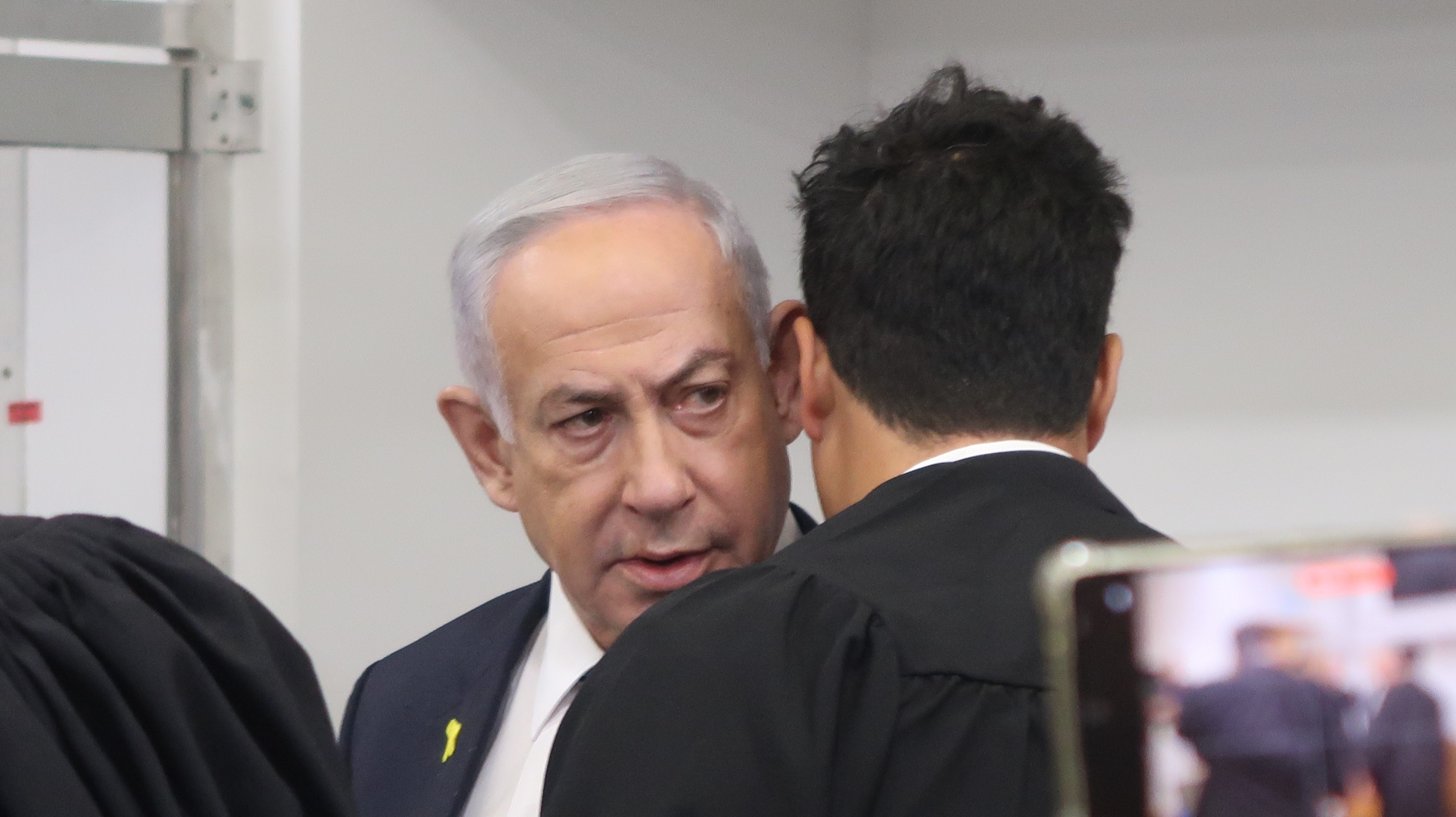
It doesn’t matter. The aim, in Netanyahu’s circle, is to shift the discussion from whether he will retire in exchange for closing the criminal case to whether he’ll utter a few words- words he will later blur, or simply ignore.
For Netanyahu, the entire situation is a win–win. He has, at this point, no intention of stepping aside - even if his criminal trial drags on indefinitely.
If President Herzog rejects the request-which isn’t really a literal pardon request - Netanyahu will say Herzog pardons murderers but not him. He’ll ride the victimhood narrative straight into the election (*see a factual remark at the end).
If Herzog agrees to grant pardon without Netanyahu leaving political life? Even better. The problem disappears. Years of supposed persecution are vindicated, and Herzog- ‘even Herzog, former Labor leader’! the Netayahu supporters will say - has recognized it.
If the president makes the mistake of entering a long negotiation, the resulting compromise might be a declaration that “the next term will be Netanyahu’s last.”
What does “last” even mean? Netanyahu has been in office longer then FDR. He wants more. What if the government falls after a year? Won’t he be allowed to complete another three and a half years in a new term? That’s not fair, the loyal echo chamber will cry.
The bottom line: any “commitment” from Netanyahu that isn’t embedded in a plea deal and a finding of felony will not result in his retirement.
The document Netanyahu sent contains an extremely peculiar line about his ability, should the case be closed, to engage in matters of the media and the judicial system.
As though he is unaware of, or does not quietly endorse, the actions of Shlomo Karhi (the Communications Minister) or Yariv Levin (the Justice Minister and architect of the judicial overhaul), whose proposed reforms have been widely described by constitutional scholars and former justices as undermining Israel’s democratic institutions and endangering core civil rights norms.
Much effort went into that sentence as well- so it might be read as a hint that Netanyahu is prepared to end the very judicial revolution he launched only after the cases against him opened. Or, alternatively, that he might intensify it- exactly as his office rushed to brief last night, after a few right-wing columnists claimed that his true nature had been exposed: the same Netanyahu who, in 2015, stood at the swearing-in ceremony of the Chief Justice and praised the Supreme Court for its rare independence in the Western world and its essential role in safeguarding Israel’s democracy.
What is happening here is a shakshuka.
(For readers unfamiliar: shakshuka is a North African–Middle Eastern dish of Eggs poached in tomato and pepper sauce. In Israeli political slang it means a messy, improvised mixture, designed to obscure the real issue.)

So whats the play here?
There are subjects Netanyahu would rather not face in an election. His responsibility for October 7 as prime minister. The sweeping exemption from army service he granted this week to Ultra Orthodox - essentially every graduate of any ultra-Orthodox high-school program will get a waiver. These actions cut deep on the right and threaten his hold on power, in an election year. In such moments, you toss in more eggs, more tomatoes, stir the pan, and create an entirely new conversation.
A conversation not about tackling the devastation of the war; not about the fact that Hamas still rules half of Gaza, armed; not about the crushing burden on reserve soldiers; not about the one senior official who did not resign and carries responsiblity for the greatest disaster in Jewish history since the Holocaust. This is the oldest, most reliable trick in the book: when you cannot win the argument- change the subject.
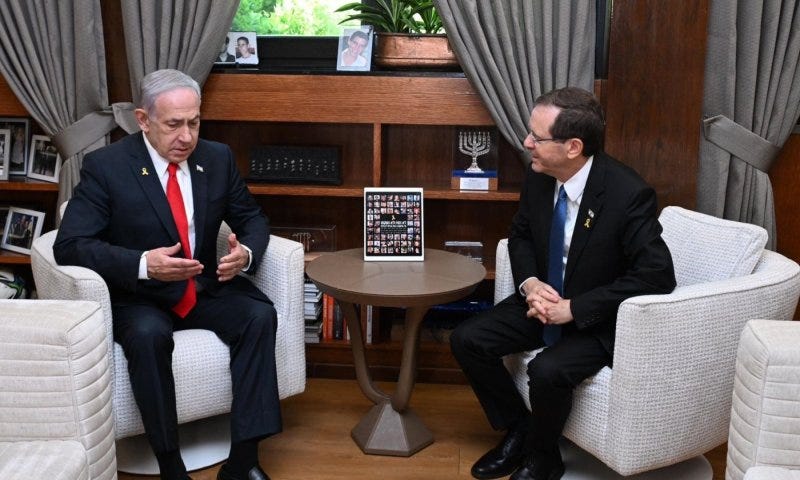
And it is tragic that this entire spectacle now lands on President Herzog’s desk. Herzog has spent years trying to sidestep the culture war tearing Israeli society apart. Critics have accused him of moral timidity. I think that’s wrong: in his own circles, it would have been far easier to maintain a consistently harsh critique of Netanyahu. His friends would have applauded; much of the press would have as well. Instead, he positioned himself as a conciliator, a bridge-builder, a president for all.
And now he faces a stark, binary choice - one that involves the President of the United States, who publicly urged him to grant Netanyahu a pardon. If the Israeli President allows Netanyahu to pull him into a protracted negotiation, to wear him down, and to extend a pardon without any meaningful or consequential return, the cost to Israel will be severe.
*The claim that Netanyahu has been singled-out collapses the moment one recalls Israel’s own legal history. The first prime minister forced from office over potential criminal wrongdoing was Yitzhak Rabin in the foreign-currency-account affair (1977). Later, Prime Minister Ehud Olmert- from the centrist Kadima- went to prison, as did his finance minister. President Ezer Weizman, from Labor, resigned under criminal investigation. President Moshe Katsav, from Likud, went to jail for rape. Israel’s legal system has long prided itself on meticulous equality before the law- a point Israelis, including Netanyahu himself, celebrated until he himself was indicted.
**photo: Oren Persico, The Seventh Eye
***photo: Haim Tzach, GPO