

Israel’s Longest Day Is Over: No Israelis Remain Held in Gaza
Today, After 843 Days, the Last Israeli Held in Gaza Was Brought Home — What the End of a Historic Chapter Reveals About Israel, Solidarity, and War

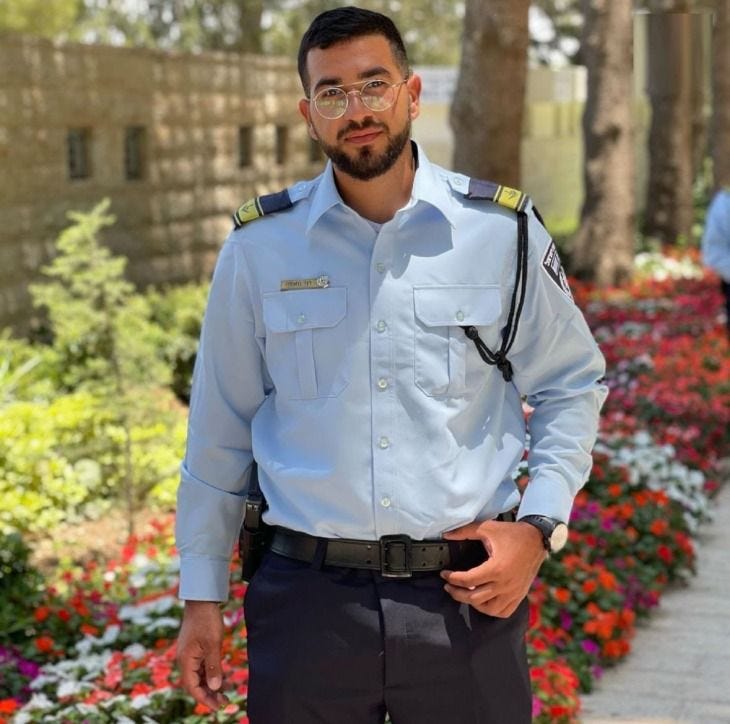
After 843 days, there are no Israelis — living or dead — being held in the Gaza Strip. 251 Israelis were taken by Hamas during its campaign of mass murder against Israel on October 7, 2023. Their abduction shook Israel to its core. For Israelis, it came to symbolize an absolute nightmare: being held in a Hamas dungeons, often underground; subjected to frequent torture and abuse; your family not knowing whether you are alive or dead; exposed to all the horrors of war. October 7 truly became the longest day — 843 days — until the last fallen soldier, Master Sgt. Ran Gvili, was brought today home from Gaza, wrapped in the Israeli flag.
Who was Ran Gvili?
Gvili, a fighter in a combat unit of the Israel Police, went out to fight on the morning of the invasion. He had a broken shoulder and was officially on medical leave from service. He was supposed to undergo urgent surgery. But when he heard about the Hamas infiltration, and without being asked, he left his home and told his family he would not abandon his comrades to fight alone. During the fighting he reached the area of Kibbutz Alumim in southern Israel. There he fought alongside other Israeli fighters, while outnumbered, and was seriously wounded in his arm and leg. Master Sgt. Gvili applied a tourniquet to himself and continued fighting. His body was abducted later that same day to the Gaza Strip.
How the recovery took place
The return of all hostages and fallen soldiers from Gaza is part of the agreement brokered by President Trump. However, according to senior security officials and the IDF, Hamas was not the source of the information that led to the recovery of Gvili’s body. Israel received intelligence regarding the location of his remains, and in a complex operation that included the insertion of forensic experts and dental specialists into the Gaza Strip, the IDF succeeded in locating Gvili’s body in a Palestinian cemetery.
What his return means to the Israeli public
There is no goal — now or ever —that has commanded broader consensus in Israel, in this war or in any the country has fought, than bringing the hostages home. Living and the fallen alike. The protest movement calling for the hostages’ return is the largest in Israel’s history, by a wide margin. It appealed directly to U.S. President Donald Trump upon his election, urging him to apply every possible pressure to secure their return. President Trump’s success in the most recent deal — one that provided for the return of all hostages — is widely regarded in Israel as a tour de force, granting him significant credit for the achievement.
Solidarity is a foundational principle of Israeli society. At its core lies a deep compact: a national identity forged in a “tough neighborhood,” yet sustained by a supportive, relatively cohesive society in which “one for all and all for one” is not a slogan.
This is not an idealistic abstraction but a strategic principle, rooted in the collective assurance that the nation will do everything for its own in a region where many seek its destruction. It is also rooted in Jewish heritage (the idea that whoever saves a single life saves an entire world, and the principle of redeeming captives), in the memory of the Holocaust, and in Israel’s foundational ideal — too rarely discussed these days — of building a model society. It is also connected to Israel’s small size and dense social networks: every hostage is someone just a few degrees of separation away from you.
Successive Israeli governments have been willing to pay extraordinarily high prices to bring hostages home — from the Jibril deal in the 1980s, through the Gilad Shalit deal (which, among other things, led to the release of the future Hamas leader along with more than 1,000 Hamas operatives in exchange for one soldier), to a series of deals during the Gaza war that began in 2023. But the highest price has been paid by the 471 soldiers who gave their lives fighting in Gaza since the war began. As someone who has spoken many times with Israeli soldiers in Gaza, I can say there was — and remains — no mission more important to them than bringing the hostages home. Israeli television today aired videos of soldiers crying and singing upon hearing that the last fallen soldier had been brought home. His return symbolizes the end of the war — or at least the end of its most widely agreed-upon objective.
For many, healing can now begin. Others will argue that it can start only when those responsible for the failure assume full responsibility for Israel’s darkest moment. But one thing is clear—at least to me: very few nations, if any, would do what Israel did to bring its own people home. The war effectively came to a close once an agreement to secure the hostages was finalized.
President Herzog shared a short video today of taking down the yellow ribbon and other symbols of the hostage campaign:
The political dimension
Prime Minister Netanyahu and his government say that by returning the last fallen soldier, they fulfilled their promise and realized one of the war’s most important goals.
Netanyahu’s government has repeatedly been accused by its opponents and by the hostage-return protest movement of not doing everything possible to bring the hostages home — of prioritizing political considerations over a deal for their return, or of delaying negotiations out of concern that a hostage deal would prevent the continuation of the war against Hamas. Netanyahu’s own defense minister, whom the prime minister later dismissed, acknowledged in an interview with me that the government did not do everything to secure their return. The reality is that the effort to return the hostages was complex and undeniably entangled with politics.
Of the 251 living hostages taken to Gaza, more than 40 died in captivity. The vast majority were murdered directly by Hamas; others died as a result of the war and IDF operations, according to the IDF’s own investigations.
The event in which six hostages were murdered in a tunnel in Rafah will not be forgotten: Carmel Gat, Eden Yerushalmi, Hersh Goldberg-Polin, Alexander Lobanov, Almog Sarusi, and MSG Ori Danino. Hamas murdered them as IDF activity in Rafah approached the tunnel, and after yet another failure in negotiations for a hostage deal. Jon Polin, Hersh Goldberg-Polin’s father, asked Netanyahu in a post he published at the time to stop claiming that “his forceful application of combined military and diplomatic pressure has so far achieved the release of 205 hostages out of a total of 255.”
Polin wrote that the “insensitive claim whitewashes the lives of the 20% of the 205 who were taken into Gaza alive, survived a period of torture, and were then killed in captivity, including my son Hersh.” He added that before Hersh’s murder, “a negotiated deal was possible to release a number of hostages, including Hersh and at least three others of the five with whom he was held.”
The debate over what Netanyahu’s coalition did — or failed to do — for the hostages is not over, and it will not end with the return of the last fallen soldier.
What now
The return of the last fallen soldier allows the parties to move forward in Gaza. First and foremost, this involves opening the Rafah Crossing, followed by the possibility of further IDF withdrawal from the Strip. At the same time, a technocratic Palestinian government is expected to begin administering the Strip. President Trump has repeatedly made clear - including this week - that Hamas must be disarmed. Israel will not want to carry out any withdrawal before a genuine process of dismantling Hamas begins. While the Trump administration is set on rebuilding Gaza, various parties remain hesitant to invest in the effort as long as Hamas is not disarmed. The return of the last fallen Israeli is deeply meaningful, but any Israeli government will struggle to accept any reality in which an armed Hamas continues to rule Gaza, even from behind the scenes.
Few believe Hamas would agree to — or actually follow through with — real demilitarization.
In closing
Eitan Horn, who was held in Hamas captivity for 738 days, gave an interview to Channel 12 (N12) about a week and a half ago, in which he spoke about his profound gratitude to the people of Israel. I strongly recommend watching that segment.
Love what Eitan said!!
May Hashem comfort all who have lost, the Jewish State, and עם ישראל and bring everlasting peace and unity, please Hashem. ברוך השם