

Israel Has a Growing Religious Intolerance Problem. It Runs Deeper Than the Smashed Jesus Statue
Netanyahu says he was “stunned.”He was not

In the past 24 hours, an image circulated widely: an Israeli soldier smashing a statue of Jesus in the Lebanese village of Debel. The IDF reviewed the photograph, confirmed its authenticity, and issued a public statement condemning the act and announcing an investigation. The incident triggered a wave of outrage directed at Israel — especially at a moment when the country is facing a deep erosion of its international standing, including within the Christian world, and a collapse of support among the U.S. public.
This action was not carried out under orders and was widely condemned in Israel. It will be seized upon by anti-Israeli and antisemitic voices, who show little concern for Christian communities across the region but are quick to indict Israel for every wrongful act committed by any Israeli, anywhere.
Yet saying that lets it off too easily. Israel has a real problem, and those who care about it should acknowledge it.
The previous flashpoint came when Israeli police prevented the Latin Patriarch of Jerusalem — a senior figure in Catholicism — from holding even a symbolic Palm Sunday ceremony, for the first time in centuries. The police cited safety concerns tied to Iranian missile attacks, yet the church had intended a minimal, ceremonial event with only a few participants. Prime Minister Benjamin Netanyahu, confronted with sharp criticism from across the Catholic world — including unusually forceful condemnations from France and Italy, the latter a country generally considered more friendly to Israel — was compelled to issue a special statement promising that prayer would be made possible.
A week earlier, Netanyahu had quoted the historian Will Durant at a press conference, invoking a comparison between Genghis Khan and Jesus Christ; that, too, required a subsequent clarification. Now, as to the event in Lebanon, Netanyahu has declared:
“Yesterday, like the overwhelming majority of Israelis, I was stunned and saddened to learn that an IDF soldier damaged a Catholic religious icon in southern Lebanon. I condemn the act in the strongest terms.”
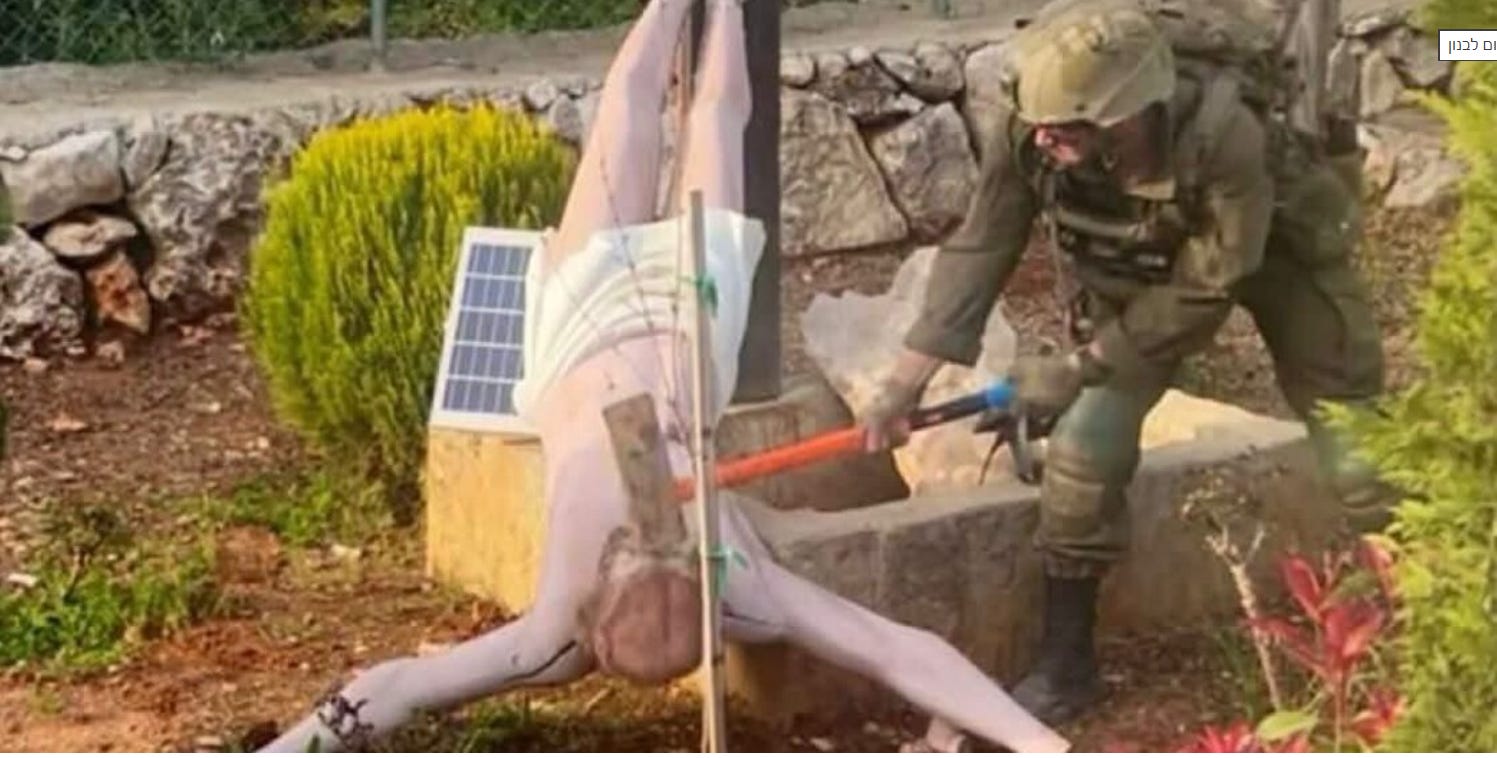
Here is the reality: Netanyahu was not stunned.
There is little left to be stunned by. Within the Israeli military, a deep process has been unfolding for years — the growing influence of religious and messianic currents, including extreme ones, reflected, for example, in the appearance of “Messiah” patches worn by some soldiers - against orders and army code. This has reached the point where the former IDF Chief of Staff had to personally order a soldier to remove the patch. This example is far less extreme and violent than the way reserve soldiers in local defence units in settlement areas are treating Palestinians, enabling violence towards them and/ or the media. It is, again, a problem the IDF senior ranks are well aware of.
In recent years, there has also been a troubling and increasingly visible rise in acts of hostility toward the Christian community, including violence, spitting incidents and verbal abuse directed at clergy. My colleague, journalist Yossi Eli of Channel 13, has documented many of these disturbing episodes.
Israel does maintain a comparatively thriving Christian community relative to neighboring countries. Freedom of worship is protected by law and, for many years, was one of the state’s great prides.
Yet religious intolerance is on the rise across society — and the military is no exception. The destruction of the statue in Debel comes in the same week that saw multiple reports of religious coercion within the IDF: female soldiers reportedly forced to run in long pants while their male counterparts ran in shorts during a Jerusalem marathon; another group of mandatory service police soldiers jailed for holding a barbecue on the Sabbath — officially due to a ban on lighting fires in military bases, but in practice tied to Sabbath observance; and conscripted female soldiers disciplined on the day of their discharge for wearing attire deemed immodest, with penalties including the withholding of their already modest pay. (It bears emphasizing: these are women fulfilling mandatory service — an obligation imposed only on secular Jewish women in Israel).
The broader truth is that Israeli society, after three years of war that began with the October 7 Hamas attack, is experiencing a sharper rise in hostility and hate, including on religious grounds.
The problem is compounded by a government — or significant parts of it — that is sympathetic and supports this posture. Its caution is more pronounced when it comes to Christians; far less so toward Muslims or other groups. The minister in charge of the police, Itamar Ben-Gvir, is a convicted felon who was raised in the ideological orbit of Meir Kahane, the architect of a doctrine of Jewish supremacy. Kahane was long treated as a pariah by the old guard of Israeli politics; Netanyahu has elevated one of his more provocative heirs to oversee law and order.
Ben-Gvir famously once displayed in his home a photograph of Baruch Goldstein, who carried out a massacre of Muslim worshippers in Hebron in 1994. He has made it a central mission to challenge the religious status quo on the Temple Mount, including promoting Jewish prayer at the site — despite explicit religious prohibitions by Israel’s Chief Rabbinate against both prayer and even ascent to the Mount. This is the messge of the minister in charge of the police as to religious tolerance.
The point is clear: PM Netanyahu is not “stunned” by the incident in Lebanon. His government does not center pluralism or the acceptance of the other, to say the least; it does not consistently repudiate hatred, except in urgent statements issued when Israel’s public image suffers severe damage.
Israel’s problem is not one of public relations. It is a matter of policy — and, in this case, of education. It reflects a worldview that has taken hold among its ruling elites, drifting away from foundational principles of tolerance.
My father, z''l, said that if the Muslims were really smart they would leave us alone and we would destroy ourselves.
Are we trying to lose world support? Can we work any harder to shoot ourselves in the foot? The government's allowing such despicable behavior only encourages the same by our detractors and enemies around the world. And this is to say nothing about how it foments violence against and weakens the diaspora Jewish community.
I personally condemn all religious intolerance - that which is an imposition of one's religious beliefs on others. Not sure why you would mention Jews going up to the Temple Mount. If that's an example of religious intolerance, it is indeed intolerance on JEWS, not Muslims. In fact, the agreement with the Jordanians was made to ensure a fragile peace, not because there is ANYTHING that should prohibit Jews from the holiest site for Jews in the entire world. It is NOT the holiest for practitioners of Islam - theirs is in the homeland of Arabs, Saudi Arabia. Israel and Jews are always held to a higher standard than others. Acknowledging that Jews are human like everyone else is not what the world wants to hear and will amplify our every infraction while dismissing that of Muslims and Christians against Jews worldwide. Those are the facts.