

Iran’s Dangerous Perception of Victory
Exclusive: Senior Officials Say Tehran Isn’t Bluffing— It Believes It Is Winning; They advocate targeting energy. Mojtaba Khamenei is believed to be alive and functioning

President Donald Trump said yesterday that he is postponing threatened US strikes on Iranian power plants by ten days, because negotiations are going “very well.”
A central question, of course, is who exactly the U.S. is talking to, and who is supposed to sign off on the negotiations. There have been no public sightings of Iran’s new Supreme Leader since his leadership was announced by the Assembly of Experts on March 8, 2026.
Apparently, he has the final say. According to intelligence reports, Mojtaba Khamenei is alive and, if not in good condition, then at least functioning. To be sure, he is not at a particularly high level of functioning, “but this is a man who has never actually held managerial responsibility for anything serious in his life,” one source told me, so “he would already be quite shaken” in his new role as Supreme Leader. Trump’s remarks yesterday suggesting the new leader is gay likely didn’t help.
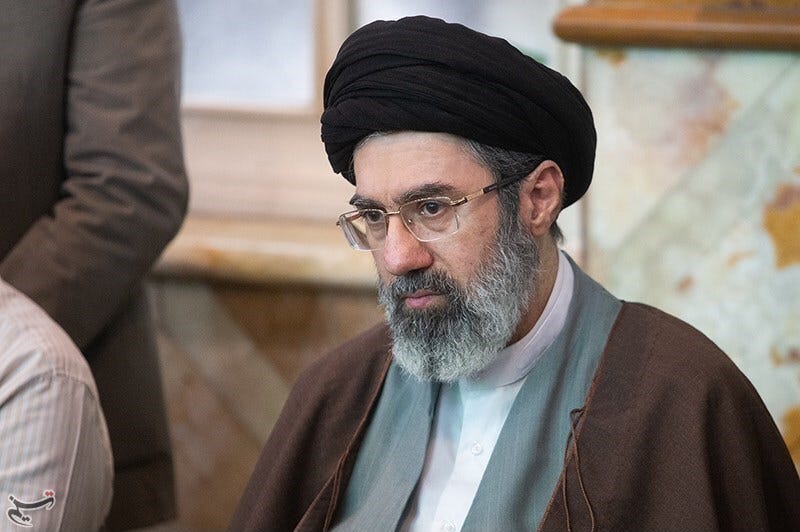

The young Khamenei has lost his father, his wife, and his son in Israeli airstrikes. He was wounded. Any communication with him could lead to another swift assassination, and he knows he is being hunted. So the discourse with him is limited, and the decisions he makes are restricted to only the most important ones.
How does it actually work?
For their part, the Iranian Revolutionary Guard Corps (IRGC) and the Iranian military are doing what they already were told to do, in line with the battle plans prepared before the war. Ultimately, the leader makes the key decisions, including signing off on negotiations with the United States.
In Israel, it is very well understood that this war could end at any minute with a decision by President Trump. Israel’s targets have even shifted away from centers of regime authority, towards hard military and industrial sites. Two main scenarios have emerged before decisionmakers.
Scenario 1: Unilateral Declaration of Victory
The first is a unilateral ending: Washington announces that all its military objectives have been achieved with great success. As for enriched uranium and the ballistic missile program — America can say these do not currently pose a real threat. If the Iranians revert to their old habits, President Trump still has about three years left in the White House. He has shown America is willing to act.
Advocates of this approach are reading the political map. The Administration has thus far managed to impressively moderate the rise in energy and commodity prices. The shape of the graph has flattened after the initial spike:
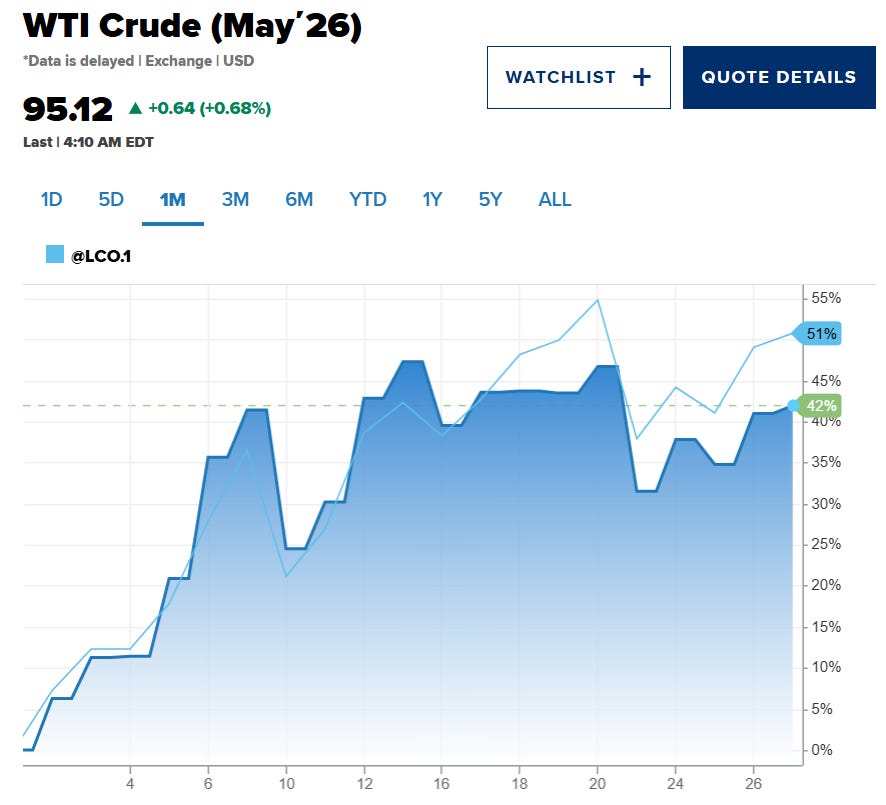
Indeed, current prices aren’t comparable to the peak of the Ukraine war in 2022, when energy spikes were far more severe. In fact, the actual oil flow situation today is more constrained — yet the administration has managed to keep it in check, for now. The president’s near-daily signals about a quick end to the war have helped. But it’s unclear how long that can hold; how long the dam can be kept together with a finger in the breach.
There is another variation of this scenario: reaching a general “declaration of principles” with Iran, something reminiscent of the declaration of principles with North Korean leader Kim Jong-Un at the Singapore summit during Trump’s first term. Will it lead to a detailed agreement? Maybe not. But it could create a sense of a breakthrough — enough basis to declare a sort of victory.
In Israel, it is assumed that the president could reach such a decision. However, the Gulf states and Saudi Arabia are extremely worried by the entertaining of any scenario in which Iran is not defeated. From their perspective, ending the war at this stage would abandon them to their fate — forcing them to reach protection agreements with a wounded, cruel enemy that believes it has won.
The long-term implications for Gulf oil prices would be significant. There would also be a sense this is only the first round. In the next, Iran could press for regional expansion — nightmare scenarios abound, from occupying Bahrain to the extraction of protection payments from Oman.
Scenario 2: A Detailed Agreement
The second scenario is, of course, reaching a detailed agreement addressing the 15 points presented by the United States. When looking at the gaps between the sides, it is hard to believe that such an agreement could be reached — at least for now.
Security officials in Israel say the main problem lies in Iran’s sense of victory. Iran is issuing international statements dripping with arrogance — demanding the removal of all American bases from the region, and the collection of tolls by Iran in the Strait of Hormuz from every oil tanker (this would be an extraordinary strategic shift, one that would make Iran an official regional power).
This is not posturing, I am told — the Iranians truly believe they are winning. “With this mindset,” a senior source told me,
“It will be impossible to hold real negotiations. Because at the first crisis, they will get up and leave the room. Right now, it’s hard to see how negotiations will succeed — with an emphasis on ‘right now.’ It may be necessary to go through another military escalation.”
One security source put it this way: part of the problem with Iran’s leadership right now is that it is so detached from reality — hiding and fearing for its survival — that it does not fully grasp the extent of the damage inside Iran. As a result, it is neither sufficiently incentivized to move toward a meaningful agreement.
What fuels Iran’s sense of victory is the energy market and the blockage of Hormuz. In the global shipping world, it is reported that the Revolutionary Guards are collecting about $2 million in protection money for every tanker crossing the strait (that is not from Europe, the U.S., or linked to Israel). I was told by energy experts that the money is transferred in cryptocurrency.
Even Iran’s “gesture” to the U.S. — apparently allowing some tankers to pass — is seen by the Iranians as recognition of their new status running the strait. It is not a kind gesture in their eyes, but a dominant one — proof of superiority.
“Their feeling is that the strategy of setting the Middle East on fire has worked well. One must recognize that this is their perception, and do something more significant in the war — even at a heavy cost. There is no choice. Otherwise Iran will retain nuclear capabilities, and the war will have been pointless,” an Israeli official told me.
Needless to say, these are striking quotes, and they come from highly placed officials. They convey a sense of frustration - but not by the actual results of the military campaign.
Doing “something more significant,” is meant to “call Iran’s bluff,” as one senior official put it, “and have a go at energy. Either way — if [the Americans] try to seize Kharg or the strait — the Iranians will attack energy facilities in the region.”
The Iranians “100% need to understand that everything is on the table, including the destruction of their energy sector. Right now they think they’ve cracked the system, but they must understand they have more to lose. Otherwise they will not come to negotiations ready for compromise.”
Looking Ahead
It is no sure thing that this Israeli official’s stance will be accepted elsewhere. The implications for the global economy and energy markets could be dire. In Washington there are many — on the Republican side — who will say that it is time to stop. On the other hand, they will follow the president’s direction. Trump has so far demonstrated total control over the party.
But it is impossible to ignore the trap. Iran has taken the global economy hostage; to free it requires a strike on Iran, one that would deeply harm the global economy. The meaning of the trap: the war began over the nuclear issue but is now being fought over Hormuz.
There is another issue worth considering: the condition of the State of Israel. Israelis, according to polls, are still willing to sacrifice; but they want to know it was worth it.
It is one thing to bear sustained missile and rocket attacks across the country for a limited time — in order to win a war with Iran and attempt to change the regional balance of power. But continuing for more and more weeks on end — with the north of the country abandoned and bombed by Hezbollah, schools closed (or, at most, in very limited hours), the country sleep-deprived after running to shelters with sirens blaring 7 to 15 times a day (and night), and the economy not functioning — that is something entirely different.
I could not help but notice that this week, Fox News aired footage of young Americans on spring break on a Florida beach.

They were all in swimsuits, talking mostly about plans to do the things college kids do— well, some more enthusiastically than others — and to celebrate life. The interviewees didn’t know the United States is at war with Iran, barely knew what had happened in Venezuela, and didn’t recognize the word “Ayatollah.”
This is not the sort of link I typically post here, but the normalcy in the video is so jarring, so far removed from the reality in Israel at this war. It reveals something not noted often enough: the United States is so powerful that it can conduct a high-risk war on one side of the world while its young people continue partying on the beach; they don’t know because they don’t need to know.
Suffice to say, in Israel, that is not the situation. For young people, old people, or anyone in between.
**
I know everyone is looking for victory in Iran. But allow me to suggest a different kind of victory — one rooted in the best traditions of the Zionist project over the past century. It is not measured by enemy installations struck or senior officials assassinated. It is measured in life — in what a country builds.
In recent days, I have spoken with municipalities in southern Israel, along the Gaza border. The government has cut their budgets in the latest cycle, and they are understandably angry. Yet part of that frustration stems from something else: the rebuilding of the South has been far more successful than is widely acknowledged.
Less than three years after October 7, this is the reality: across the towns and villages near Gaza — the very places that were raided, where Hamas carried out its brutal massacres — the population is now 10 percent higher than it was on October 6, 2023, the eve of the attack. More Israelis live along the Gaza border today than before October 7.
There are waiting lists to join the kibbutzim on the Gaza border. After a difficult 2024, many of these communities are now experiencing a baby boom, tell me my friends and sources.
None of this diminishes the challenges, or the government’s (terrible) decision to cut 100 million shekels from what may be the most important project in Israel’s history: restoring the security and prosperity of this region. But these are remarkable facts. They capture, more clearly than anything else, what this is really about - and what is a lasting victory.
Everyone is demanding clarity, timetables and much else to lift the fog of war in the service of a, frankly, unprecedented demand for a reassuring certainty that is not possible.
I see President Trump’s opaqueness as deliberate, meant to keep Iran guessing and off balance. I would guess that much of the uncertainty you report is another version of the false narrative of a growing split between Trump and Prime Minister Netanyahu that we saw before the 12 War and the unleashing of the current conflict.
Trump has given Iran another 10 days to surrender and has removed (if reports are correct) Iran’s Speaker and Foreign Minister from the “kill list” for now. If they are true believers, though, they simply cannot sign on to the terms Trump is demanding. The new 10 day deadline suggests to me that either some progress is being made or that the Marine and other reinforcements should arrive by then and Day 11 will have the endgame begin. By now Iran should recognize the significance of Trump’s deadlines, its spin about Trump negotiating and then deviously attacking (as if he never set deadlines) is not persuading very many.
The war ends when the IRGC and Basij run out of ways to pay their members. The vast majority will abandon ship at that point. There might be a rump of true believers left to mop up. Even that is not assured. Historically, it’s the difference between the isolated Japanese soldiers who kept fighting in isolation because they never heard that their country had surrendered, versus the feared existence of a “Grey Wolf” Nazi irredentist armed faction - that never came to be.
We can’t know what the future may hold, whether it favors those who would see Trump fail as more important than the West prevail have the resources to stop the war and allow Iran to recover or those who believe in Rule 1 of fighting: when your opponent is down, you don’t let him get back up.
Genocideal horseshit