

Iran After Khamenei: The Indicators That Will Decide This War
From collapsing missile capabilities to the possibility of regime fracture, the next days may determine the future of the Islamic Republic. And a note on the American-Israeli alliance

We are now entering the fifth day of the war between the United States, Iran, and Israel. I want to briefly map the indicators I am watching most closely right now - signals that may hint at where this war is heading.
This is deliberately not a summary of the news. Readers of Between Us are consuming real-time updates, as I am. The aim is to point to developments that may be slightly ahead of the curve.
1. Military: Indicators of cracks in Iran’s military response
The Islamic Republic has responded to the strikes against it by launching short- and medium-range ballistic missiles, along with hundreds of drones, at American, Israeli, Emirati, Saudi, and other targets across the region.
One important point: the United Arab Emirates has absorbed more than 50 percent of all the projectiles launched by Iran so far. Why?
Striking Israel requires Iran to fire medium- and long-range ballistic missiles. Gulf countries, by contrast, are far easier targets. That is precisely what Iran has increasingly focused on in the past several days. The UAE and Saudi Arabia are expected to join the war in some capacity, possibly symbolic. The shock in these countries- along with Bahrain and Oman- following Iranian attacks on their territory cannot be underestimated. It will likely have long-term implications for the region and might strengthen the regional defense architecture.
Overall, there is a clear decline in the scale of missile fire toward Israel. On the first day of the war Iran launched more than 90 ballistic missiles at Israel. Yesterday the number dropped to roughly 20. The Chairman of the Joint Chiefs of Staff, General Dan Caine, says that Iranian ballistic missile launcher activity has fallen by 86% compared to the first day of the fighting, while suicide drone launches are down 73%.
This is the result of the aerial campaign launched by the U.S. and Israel. Iran began the war with an estimated 2,000 ballistic missiles capable of reaching Israel. But the real constraint is not the missiles themselves. It is the number of launchers - and the logistics chain needed to fuel, arm, and move those launchers. Both the U.S. Air Force and the Israeli Air Force have trained specifically for this mission: hunting mobile missile launchers across Iran.
A senior military source told me:
“We estimate that Iran now has far fewer than a hundred operational launchers left, and we are taking them out on a daily - sometimes hourly -basis.”
The assessment in Israel is that within roughly 24 hours Iran’s ability to launch medium-range ballistic missiles toward Israel could be dramatically reduced.
That would not eliminate Iran’s strike capability entirely. Tehran would still retain greater capacity to hit Gulf states, which are closer and easier targets.
But it would represent a significant weakening of the Islamic Republic’s visible tool of retaliation against Israel.
In general, the response of the Islamic Republic to the killing of its leader, Ali Khamenei, and to the outbreak of full-scale war has been far more limited than many original scenarios predicted. However - they are still fighting, and fighting against the world’s most powerful army and navy.
As more missile launchers are destroyed, coalition air power will shift even more toward the systematic destruction of Iranian military infrastructure and industry.
2. Political: Indicators of cracks within the regime
From the beginning of the war, Washington has deliberately lowered expectations regarding regime change. Israel’s political leadership, however, has stated clearly that toppling the regime is a key aspect of the war.
Military sources in Israel have been careful to distance themselves from that objective.
“The IDF does not know how to produce regime change,” one senior source told me. “That subject belongs to other bodies.”
What they mean, of course, is the Mossad.
In recent years Israel has devoted significant resources — relative to its security budget — to preparing for the possibility of political upheaval inside Iran.
In some sense, the regime has already changed. The deaths of Khamenei, the defense minister, the commander of the Islamic Revolutionary Guard Corps, and other senior figures have already reshaped the leadership structure.
But the real question is what kind of change this will become. At the moment, the change is still internal to the regime itself. The deeper question is whether that change can be pushed, directed, or accelerated.
To understand where Iran stands, there are several indicators worth watching.
First, defections or institutional paralysis. Are there mass defections from the armed forces, the Revolutionary Guard, or the Basij—or even a simpler phenomenon: officials who simply stop showing up for work?
Part of the logic behind striking bases and administrative buildings of Iran’s security apparatus is precisely this. If workplaces are destroyed, personnel suddenly have an excuse not to report for duty. That means fewer people participating in repression or maintaining the daily functioning of the state. As we move into days five through seven of the war, we should begin to see whether this pressure campaign produces defections or institutional paralysis.
Second, whether the United States decides to target Iran’s oil and gas sector. So far, the United States has avoided striking Iran’s oil and energy infrastructure. Israel, for its part, has intentionally refrained from hitting Iran’s core national infrastructure. And notably, Iran has also avoided striking Israel’s major national infrastructure. If Washington decides to hit the oil and gas industry, it would send a very clear signal to Tehran: the gloves are off.
Destroying these installations would have enormous consequences. Oil and gas revenues are the regime’s primary source of income, and damage to this sector would likely push global oil prices higher.
Iran has already struck Saudi Aramco facilities in the past, but until now attacks on regional energy infrastructure have not been the central focus of its retaliation.
Third, internal revolt or fragmentation. Some reports suggest that Mojtaba Khamenei, the son of Ali Khamenei, may have been chosen as the next supreme leader, though this has not been verified.
Israel reportedly struck the building of the Assembly of Experts where clerics were meeting to discuss succession. Israeli defense officials I spoke with say the strike was deliberately calibrated: it targeted the site without attempting to kill all those inside.
The message, they say, was political rather than lethal.
One interpretation circulating is that this was meant to signal vulnerability to the clerical establishment without turning them into religious martyrs — something that might consolidate Shiite unity behind the regime.
An indicator to watch is whether ethnic or regional factions begin to move.
For instance, there have been reports — following conversations between President Donald Trump and Kurdish leaders — that Kurdish groups may have received arms in recent months. As I wrote here, there is a Phase B to the current strategy — one that involves direct attempt to ‘re-strucutre’ or replace the regime. The question is how organized and ready that phase actually is.
3. Strategic: Exit strategies and the future of the regime
Three broad scenarios remain plausible for Iran’s future.
The first is simple survival. In this scenario the regime attempts to ride out the war and preserve the Islamic Republic with minimal meaningful change. This is were are at right now.
The second scenario is that the framework of the Islamic Republic remains, but undergoes significant internal change. In some ways this process is already underway following Khamenei’s death. However, if his successor turns out to be his son Mojtaba or another hardliner, the change may be largely cosmetic.
Another version of this scenario would involve reform from within — or at least the appearance of reform. The regime could elevate one of the so-called reformist leaders: figures loyal to the system but perceived by many Iranians as less oppressive.
Such a move could quickly be presented by some actors in the West as a major breakthrough that justifies ending the war. Most Iranians, of course, see the “reformists” as not reformists at all, but simply another faction within the same authoritarian system. Still, this remains a significant possibility. History also reminds us that systemic change sometimes emerges from within rather than through external pressure.
As one source told me:
“The chances of finding a George Washington who will liberate Iran and lead it to democracy are small. The more plausible scenario is a Gorbachev — someone who attempts to reform the system and ends up bringing it down.”
The third scenario is far more dramatic: a coup, revolution, or fragmentation that dismantles the Islamic Republic entirely.
Iran could descend into internal conflict in which Kurdish factions seize territory in the northwest, Baluchi groups in the southeast, and other regions fall under the control of different political or military movements.
Some of those factions might be more democratic or pro-Western. Others could remain loyal to remnants of the Islamic Republic.
Among these three scenarios, Israel clearly prefers the third.
Israeli policymakers fear that a reform-from-within scenario would merely present a softer face to the world while preserving the same power structures. In that case, the regime could eventually rebuild its ballistic missile capabilities and nuclear infrastructure- and confront Israel again within a few years.
Final note on the debate in the United States
A final point about the growing debate in the United States about Israel’s role in the decision to go to war.
After remarks by President Donald Trump in the Oval Office, the basic picture has become clearer. The president rejected the suggestion that Israel forced America’s hand. According to him, the dynamic was the opposite.
From my own reporting and conversations with sources, two points are important.
First, the Israelis did lobby for this war. They believed it served both Israeli and American security interests.
Second, Israeli officials were explicit - long before the war - that the final decision rested entirely with the president of the United States.
Washington would decide whether there would be war, and when. Israel was not in the driver’s seat. Israel has achieved remarkable operational successes in this conflict. But Israeli pilots are flying American aircraft, firing American ammunition, and relying heavily on American technology. At the same time, Israel finds itself more isolated internationally than in recent years and faces declining support in parts of American public opinion. For that reason, Israel remains deeply dependent on decisions made in Washington.
If the president ordered an end to the war, the Israeli prime minister would likely respond by congratulating the president for the success of the campaign and thanking the United States for standing by Israel.
As to the alliance. Very few countries in the world can conduct sustained large-scale air operations alongside the United States. Operationally speaking, there is currently only one partner to the U.S. capable of placing so many fighter aircraft in the air simultaneously for coordinated strikes, and supplying this kind of intel. It is the same partner that, roughly once every two decades since 1981, has destroyed the nuclear programs of three different dictatorships in the Middle East.
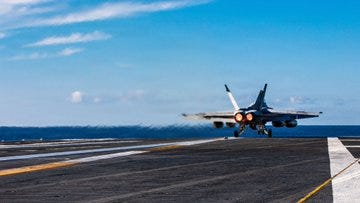
Arguments about American aid to Israel, or about the value of the alliance, Israeli government policies and its extreme elements- are all legitimate. Those are conversations worth having. but these deserve to be conducted seriously — and with at least some facts involved.
I am not downplaying risks involved. This week, I discussed the long-term implications of this war in an interview with Matt Welch and Michael Moynihan on their excellent podcast, The Fifth Column. Here’s a segment.
Great article and podcast
Thank you Nadav!!! Great info!!