

BREAKING: The United States Launches “Operation Epic Fury,” Marking a Historic Turning Point in the Middle East
With Israel as an active partner, Washington moves beyond deterrence- targeting Iran’s ballistic and nuclear infrastructure, challenging the future of the regime itself

In the early morning hours (Jerusalem time), the United States launched Epic Fury, a joint American and Israeli campaign against the Iranian military and the leadership of the regime, including the supreme leader himself. The Israelis are calling their part of the campaign Lion’s Roar. Israeli sources said this evening, Israel time, that they are certain Khamenei was killed in the strike, and that visual and additional intelligence evidence was presented to the Israeli Prime Minister confirming his death.
Air and naval forces carried out unprecedented and extensive strikes across Iran with a clear objective: beyond eliminating Iran’s ballistic and nuclear capabilities, to open the door to the fall of the regime. This marks the first time the United States has taken formal action explicitly aimed at regime change in Iran.
**This is an initial post, written as events continue to unfold. Information is developing rapidly, and details may change as updates come in.
President Trump issued a statement before dawn, U.S. time, calling on the citizens of Iran to rise up. Iran launched missiles and explosive drones toward Israel and six other countries in the region. This is video of an Israeli airfoce strike against rocket launchers in west Iran:
The operation began with an extraordinary attempt to eliminate Iranian missile launchers and missile stockpiles. So far, Iran has launched dozens of missiles toward Israel and other countries, causing limited damage. The relatively low volume appears to stem from extensive destruction of Iran’s military infrastructure. However, officials caution that these are only the first hours, and a broader Iranian response remains plausible.
American targets were attacked across the Middle East. According to reports from the Gulf, an Iranian missile struck a U.S. base in Bahrain, and at least one missile was launched toward Qatar and the United Arab Emirates. Jordan was also attacked. In total, Iran has so far fired at roughly seven countries in the region - Israel is only one of them.
The IDF spokesperson addressed Iranian civilians in Persian, warning that anyone living near military infrastructure should immediately evacuate their homes for their own safety. Massive traffic jams as civilians attempt to flee Tehran.
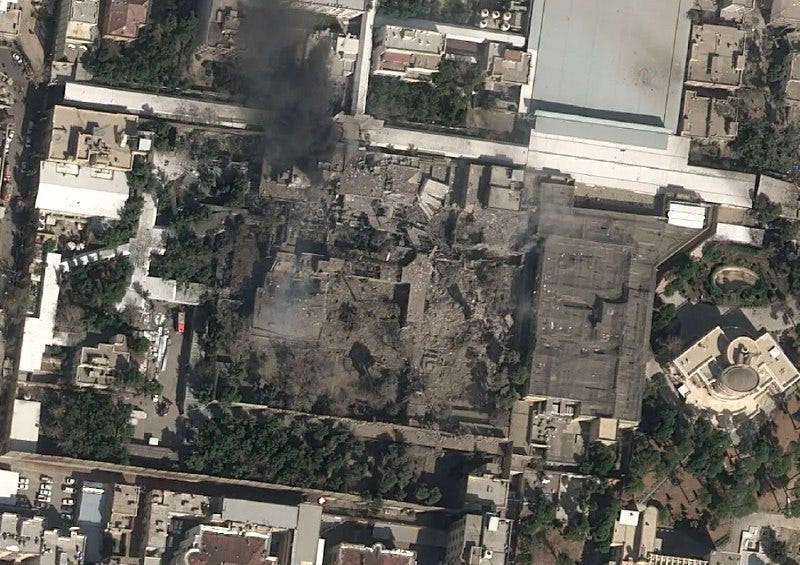
The residential compound of Iran’s Supreme Leader, Ayatollah Ali Khamenei, was attacked and reportedly completely destroyed. His fate is unknown. It can now be disclosed that many of the U.S.–Israel discussions in recent months focused on Israel’s ability to carry out targeted assassinations of senior regime figures — a long-standing Israeli specialty. Israeli officials say there is a “good” chance that Ali Samkhani, Khamenei’s senior adviser responsible for the nuclear program, was killed.
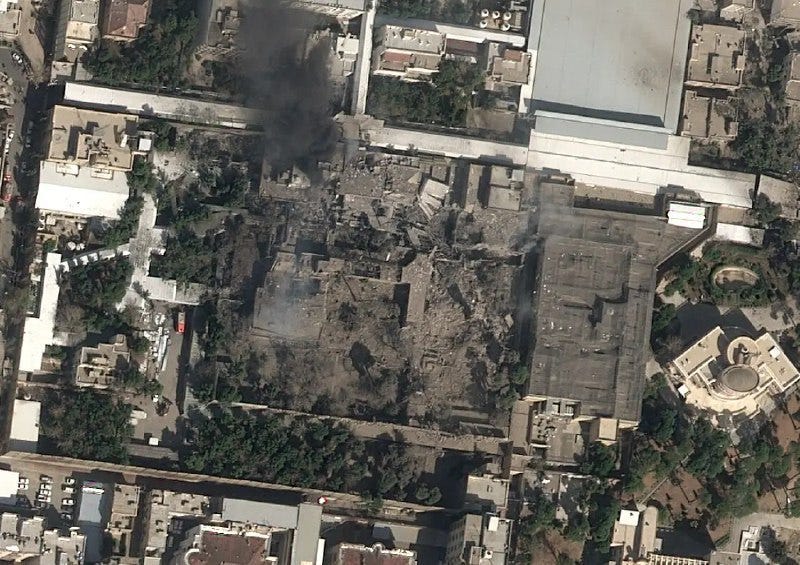
The compound of the Supreme leader of Iran was destroyed A senior non-Israeli official told me: the idea was not only to eliminate top figures of the regime, but also those who could replace them - to decapitate the leadership as fully as possible, enabling internal change or popular uprising
Israeli officials believe the commander of the Islamic Revolutionary Guard Corps may have been killed. According to Israeli media reports, an attempt was also made to assassinate Iran’s president. Iranian sources state that “senior figures in the state” were killed but have refused to provide names.
Israel has mobilized approximately 70,000 reservists. The call-up began quietly and covertly several days ago.
A range of deception measures were employed in recent weeks, including briefings suggesting the strike would likely occur at night. Instead, it took place in the early morning hours, in broad daylight. Many of the news items and quotes that we saw in recent weeks were part of that deception.
Strikes are being conducted not only in Iran but also against Iranian-backed pro-Shiite militias in Iraq. Hezbollah has not, so far, attacked Israel. The Houthis in Yemen have officially announced their intention to join the fighting and launch attacks across the region.
Flights to and from Ben Gurion Airport have been suspended, and civilian aircraft have been evacuated out of Israel. All schools across the country are closed.
Initial Thoughts
The Middle East has already been changed forever — even if Iran’s regime survives this operation.
President Trump opened his pre-recorded speech by invoking the long and bitter history between the United States and the Islamic Republic of Iran. That history is not rhetorical background; it is central to understanding what Washington, with Israel’s support, is now attempting to do.
Senior Israeli officials describe the goals of the operation in two layers. The first is military: to destroy Iran’s ballistic and nuclear capabilities and infrastructure. The second is political: to create the conditions for the downfall of the regime. The statements made by President Trump and Prime Minister Netanyahu leave little ambiguity on that point. According to senior Israeli sources, the fact that the IDF reportedly attempted to target both the president of the Islamic Republic and the Supreme Leader suggests that this is not a limited punitive strike but a full-scale attempt to reshape the equation.
A key question - raised here before - is whether there is coordination with factions inside or outside the regime in Iran that might be positioned to assume control. There is no public answer yet. Still, it is reasonable to assume that as preparations for the strike advanced, Western governments explored channels to potential alternative leadership in Iran. Whether any of those efforts bore fruit remains unclear.
The region is now on full alert. Iran has launched ballistic missiles and explosive drones at at least seven countries. Yet the Iranian response so far - and these are very early hours -appears limited relative to the scale of the opening blow. It is not for lack of intent to kill as many Americans as possible in response to the strike. Although the operation had been anticipated, it likely achieved operational surprise and caused substantial damage to military infrastructure.
Israeli officials are concerned about the possibility of a ground escalation - whether from the north, or via pro-Iranian militias operating east of the Jordan River. At this stage, every scenario remains on the table, and Israelis are searching for the Iranians surprise counter-attack. The regime’s survival is at stake, and that makes it unpredictable.
President Trump’s speech made clear that we are witnessing the boldest attempt by his administration - arguably by any American administration in recent decades — to redefine deterrence. His message was that a regime built around the slogan “death to America” cannot continue to act on that ideology and expect to remain intact. Either it abandons those ambitions and reforms, or it will face direct consequences.
Listening to the address, one could not avoid recalling the phrase “new world order,” invoked by President George H. W. Bush after the first Gulf War, when the United States stood as the sole superpower shaping global architecture. The impact of these strikes will take time to become clear. But their purpose is unmistakable: a broad attempt at structural change, with consequences that will shape not only the region, but possibly America’s standing around the world. This moment, as the President was careful to note, carries dangers of its own.
There is also the possibility that Iran will shift into a prolonged war of attrition — a scenario previously discussed here. That path would rely instead on endurance, proxies, and time. Israel has prepared to that.
For Israelis, Lion’s Roar is framed as a moment of reckoning
Since its inception, the Islamic Republic has directly or indirectly led to the deaths of more Israelis than any other state or terror organization. It has operated through proxies such as Hezbollah, while also directing and supporting attacks against Jewish targets worldwide — among the most notorious, the bombing of the Jewish community center in Buenos Aires. Iran designated Israel its primary regional enemy from the outset: the “small Satan,” always within reach.
For years, Israel absorbed conflict with Iranian proxies, particularly Hezbollah, losing soldiers annually while Iran itself maintained a cloak of immunity. Obviously, that’s over. The leaders of Tehran thought October 7 was the beginning of the end for Israel; it may turn out to be the beginning of their own end- both physically and politically.
It is also a deeply difficult moment. Sirens are again sounding across Israel. Parents are running with their children to shelters. Civil life is disrupted in a country already marked by prolonged conflict and trauma. And yet, among many Israelis, there is a rational calculation: if this operation were to produce genuine regional change - if it were to change the trajectory that has defined the past four decades - then the cost may be one they are prepared to bear.
The fact that Israel is participating but that the operation is led, organized, and ordered by the President of the United States- and the forcefulness of Trump’s language and commitment - has given many of those I have spoken with a sense of gravity, and of hope.
Would be nice if we could synchronize the operation’s names. Maybe epic roar. ❤️🇮🇱🇺🇸
Thank you so much for this update. It’s so helpful!