

America at 250: Notes from an Outsider
Despotism is humanity's default operating system. America is the 250-year rebellion against it. Plus: what really forged the U.S.–Israel alliance

In my native language, the word “America” has traditionally served as an adjective. “How was your vacation?” you ask someone. “America,” comes the reply. “How’s the new car?” you ask a friend. “America,” is the answer. A related expression is lehiyot large — the second word borrowed from the English — meaning to be generous. The way they are in America.
The United States is celebrating its 250th birthday. I am not an American, but I find myself in a position from which to humbly offer a perspective.
It is far from an objective one. I grew up pro-American — third generation in a line of deep affection for this republic. These sentiments were instilled in me from childhood, through stories I heard from my grandfather. As a young officer in the Israel Defense Forces, he was sent to the United States for command-and-staff training.
For him — a man who had grown up in the small Jewish community of pre-state Israel and fought in the 1948 War of Independence — the encounter with the American military in the nineteen-fifties was the encounter with the United States. It left so deep an impression that he was still telling us stories about it decades later. As an engineer, what struck him was the unambiguous clarity, the order, the capacity to think and to execute on a grand scale.
On his first day at the military College, he recalled, the young officers were handed a stack of books, color-coded. Red books were to be mastered cover to cover; yellow books were to be read; blue books were optional. To him, this represented a certain candor and efficiency — the kind that, in those days, could exist only in America. He adopted a great deal, and put to use many of those tools throughout his life.
This text does not pretend to be an analysis of the state of the union, or of the American dream; I do not consider myself equipped for that. Nor is it a true accounting of the successes and failures of the current American system. It is written on a celebratory note — under the assumption that “there is nothing wrong with America that cannot be cured by what is right with America,” a line from President Clinton’s first Inaugural Address (which I came across recently at an event with Bret Stephens).
A Rebellion Against History
When we speak of the American Revolution, we usually speak from the vantage of the revolutionaries — of those who fought for liberty. But it is worth looking at it from a different angle as well, the efficiency of government. The democratic mechanism preserves the possibility of replacing a government peacefully. Such transfers of power run contrary, of course, to human behavior across nearly all of recorded history. This is the critical point: the American Constitution is not a natural outgrowth of history. It is a rebellion against history.
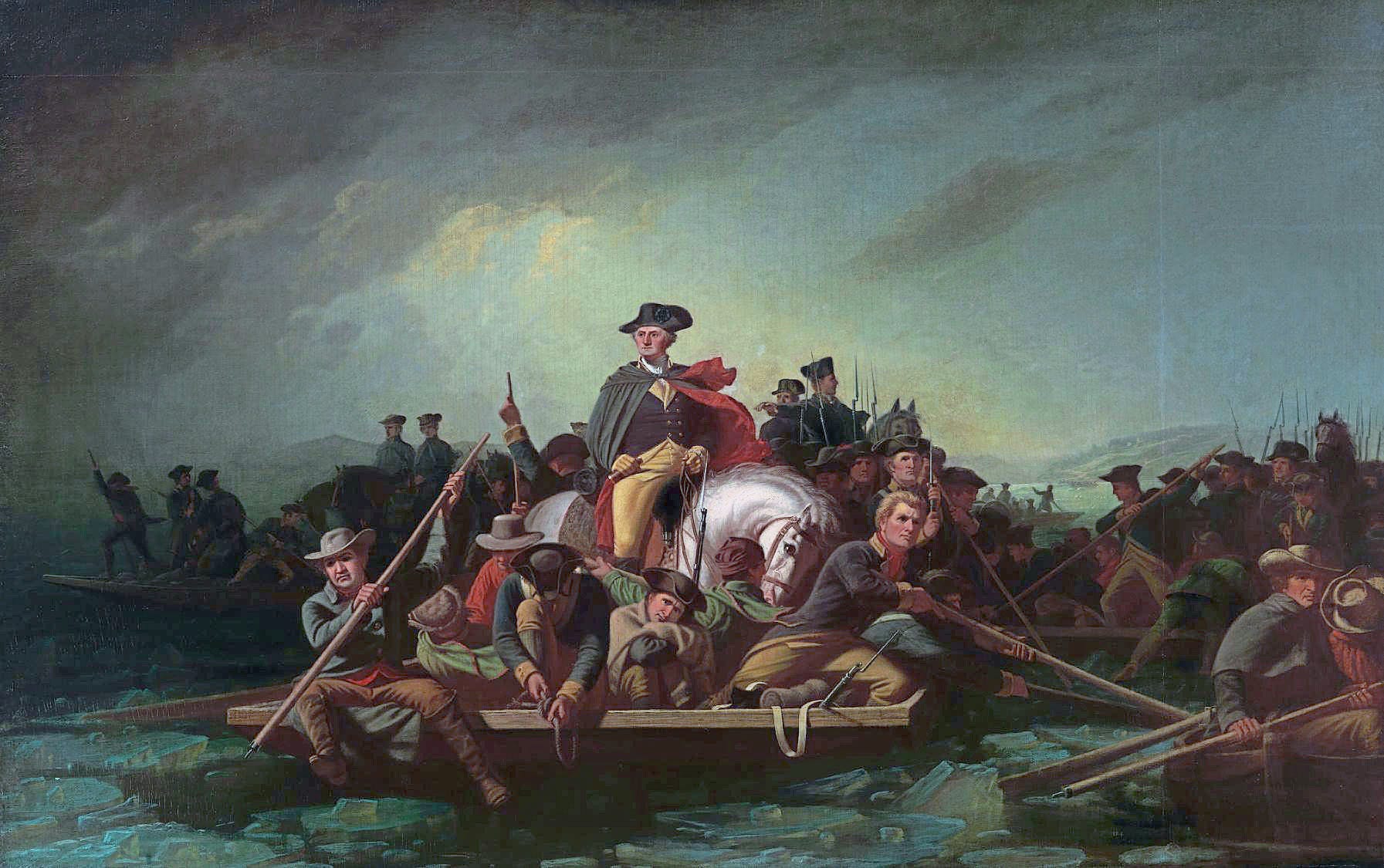
The traditional human rule is that once you have attained power, you must never give it up — not merely because you covet the perquisites of office, or because you believe you rule by divine right. Relinquishing power can, in itself, be fatal: the new ruler, fearing for his own safety, may well have you killed. (Benjamin West, the American-born court painter to George III, liked to tell of a conversation with the King toward the end of the War of Independence. What would George Washington do, the King asked him, if America actually won its independence? He would retire to his private affairs, West replied. If he does that, the astonished King said, he will be the greatest man in the world).
In the past, government was always a criminal enterprise: nearly impossible to retire from, and participation itself was appallingly dangerous and violent. Mehmed II, the Ottoman sultan, made it a matter of law: the son who inherited the throne was entitled to murder all his brothers. One sultan killed nineteen of his brothers upon coming to power.
For thousands of years, the human species used a wretched, misery-making system to manage its social affairs. That system was rule by force — by an emperor, a king, a count, an oligarchy. It often ended badly for the ruler himself, or for his children. The system was endorsed by nearly every religion; the famous exceptions are the democratic city-states of ancient Greece and the vision of the Hebrew prophets. When the Israelites come to the prophet Samuel, before the age of the kings, and beg him to set a king over Israel “like all the nations,” Samuel delivers an astonishing, republican speech, warning of the tyranny of the king — the one who will take your sons for his army, your daughters for servants, your property for himself, and turn all his subjects into slaves. The people of Israel insist on a king. Samuel is forced to crown one, and his prophecies of wrath come to pass.
Consider: when you set out on a long hiking trail, evacuation points are marked along the route, in case someone breaks a leg. Dictatorships have no such points. You must wait for the ruler to die, to change his mind, or to be deposed. Until then, you suffer. The American Founders grasped this point of failure. The perpetual talk of freedom and liberty is justified, but it misses one further, essential point: authoritarian rule is a pyramid scheme that always ends in tragedy.
I do not focus on the angle of governance in order to dilute the sheer revolutionary character of the American experiment, which has no parallel in the history of humankind — the enduring freshness of the idea of "life, liberty, and the pursuit of happiness." To some, these words may sound self-evident. For most of humanity, at this very moment, they are anything but. What Americans have made their nature — that a President cannot be elected to more than two terms, or that the division of power between the federal government and the states reduces the odds of a tyrant's rise — is what people all over the world are still fighting for.
The Center of the Imperium
From this follows, too, the republic’s almost unbelievable flexibility — of character, of temperament. As a journalist, I remember the gloomy texts about America’s decline, written from the left, during the Bush Presidency. And yet, a few years after the United States is attacked on September 11th, it elects a President with a completely different vision, whose very identity is unprecedented in American history. The prophecies of American decline promptly renew themselves, this time from the right — the claim that the country is about to become a socialist republic. And then the United States elects Donald Trump. I myself have listened to American voters, and interviewed families who voted for Bush, then for Obama, then for Trump. That capacity to change your mind — to look at politics from a wide angle rather than a tribal one — is bound up with seeing politics as a practical instrument, and not as a form of self-definition.
The effect on the world, of course, is astounding. Every newly elected American President generates a certain aura that radiates across the entire global conversation. Washington is the center of the imperium, and it echoes out into the world.
I remember the first time I came to Washington, D.C., as a young man — a journalist. Here is how I described it in my book, Revolt: The Worldwide Uprising Against Globalization:
“When I stepped out of my hotel onto Connecticut Avenue and wandered the streets of Washington for hours on end, I felt something that it is hard to explain to Americans. It was a sensation totally unrelated to current events or politics. A general feeling that there was order in the universe, that suddenly everything made sense, and that I had arrived at the power center from which that order and logic emanated. I was in the capital of the empire I lived in; I felt like a young man who had grown up in Iberia in the second century must have felt when he arrived in Rome and saw for himself its grandeur, and its decadence.
Throughout history, people have been drawn toward the center of gravity from which their world was ruled; after all, in the chronicles of human civilization through the first half of the twentieth century, the essential political unit was the empire. We who live in the West’s far-flung provinces see the markers of empire everywhere, even though the United States is not an empire in the full historical sense. We know, rationally, that the dollar is the world’s fundamental currency; that the U.S. wields power, hard and soft, in all sorts of ways, all over the world; and that American culture, in particular U.S. film and television, is all-pervasive.
But it’s only when you physically arrive in Washington or New York that you suddenly feel, rather than just know, that a most salient part of our lives comes from America. You understand that our political, economic, and even aesthetic discourse at home is really this distant culture dubbed in any one of a number of languages. It comes with the force of an epiphany, and with no sense of inferiority, that the United States broadcasts continually into your present life and your history…
I ascend the steps of the Lincoln Memorial and turn to its south wall to read the passage from the Gettysburg Address inscribed there: “government of the people, by the people, for the people.” Many rulers and regimes promise that, and liberal democracy is no longer confined to the United States, which may not be its best incarnation today. Yet this is the wellspring of that fairness. And it is incised in stone. No one else will ever sound like Abraham Lincoln; his assertion of “government of the people” will always be primal. A subject of the empire encounters this reference point and feels just like someone who wakes up past midnight with the solution to a long-forgotten riddle.”
The Lodestar
I am, after all, a resident of the Middle East. When Egyptians pour into Tahrir Square, wanting to free themselves of a dictatorship, they call out to America. When Syrians march in the first demonstrations against Bashar al-Assad, they yearn for America. When Iranian citizens stand, with astonishing courage, against a repressive regime, they hope to realize some small measure — just a little — of the freedom of America.
I fear that many Americans do not grasp the degree to which the republic’s very existence serves as a lodestar for so many around the world — how essential the presence of the United States, as a republic that sanctifies democratic values, is to every protest movement and every struggle for national liberation. When people say that America is the last, best hope of mankind, this can be taken to mean that salvation will come from America. But at a deeper level, America is a code word for hope — a confluence of hopes — for so many of the wretched, the oppressed.
No one needs to explain to me — a working journalist — the gap between the ideal and its realization, specifically on these times. It is glaring, say, in the collapse of public mental-health care in many American states, or in the failures of equal opportunity, or the dangers to democracy today - all over the world. But the classical-liberal ideal of the Founders was always greater than all the sins of those who spoke in its name, greater than all possible hypocrisies.
To Bigotry No Sanction
I cannot close without saying something about the alliance between Israel and the United States, on the occasion of America’s 250th birthday. The bond between the two countries flows, first, from Israel’s being a free country in an unfree region. The second reason is a significant, indeed remarkable, public sympathy for the Zionist idea within the classical American tradition. The American Founders — from President Washington’s letter to the Hebrew Congregation in Newport onward — established the first political entity in the history of the world that rejected antisemitism by its very nature. And out of that rejection of antisemitism, it was clear to many Americans that Jews have a right to self-determination, like all the nations. That public sympathy produced elected officials who supported the establishment of the State of Israel, and then the state itself.
The third reason is no less important. The alliance between America and Israel solidified, above all, after the Six-Day War, when it became clear that young Israel was a strong country — that it could stand and win in the fundamental contest the United States was waging against the Soviet Union and its proxies. And it did so persistently, delivering brilliant achievements to the West at a time when the West was absorbing painful, repeated blows from the Soviets and the Communists. Only after 1967 did the United States agree to sell Israel the Phantom, its first-line fighter jet, and while many of the world’s nations were severing relations with Jerusalem, America deepened them. This flowed from a recognition of Israeli success.
Success is the simplest, clearest argument for the American way. Success — of peace, of freedom, of a prosperous and open economy — is what persuades people of counterintuitive ideas: for instance, that the constitution must be preserved, and the ruler replaced. Despotism is the default operating system of human civilization, written into our history and perhaps into our DNA. What overrides it is success — not ideals alone, but also the material promise they hold.
That success does not merely flow from liberty, in all its parts, including the protection of private property; it also preserves liberty, gleaming armor in the general darkness. It is the reason so many around the world cling to America’s better angels, praying they will deliver them from despotism and want. And it is the reason that anyone who believes in freedom and in human rights — even if he does not agree with every American administration — should mark 250 years of this republic.
Happy birthday, and thank you.
Wow, a wonderful paean during these fraught and beleaguered times. A joy to read.
Such a clear explanation of American values and traditions makes what the current administration is doing even more distressing. America has never had to recover from such an anti democratic administration in its entire history.